
The Age and the SMH worth $144 apiece? Mark Hawthorne’s piece today in theage.com.au suggests that via websitevaluecalculator.com, says that:
…we found www.theage.com.au valued at $8,941,542, and www.smh.com.au at $13,668,819. A personal ego search revealed that Collins & Spencer’s Twitter site is worth a paltry $78, and I could get $152 if I sell my Facebook page.
All rather undervalued, I hope, but rivals may want to stop reading now. Based on traffic levels, Business Spectator’s homepage is worth just $127, which is $9 less than the website of our Fairfax Media stable mate www.afr.com.
Before you ask, we haven’t left off any zeroes. The nation’s self-proclaimed leading national newspaper has a homepage worth $136, so we wish Rupert Murdoch luck realising that part of the online asset empire.
Interesting that he fails to mention that searching for theage.com.au or smh.com.au on the same website could lead you to believe that they’re worth $144 each.
How about we round it to $250 for the pair?
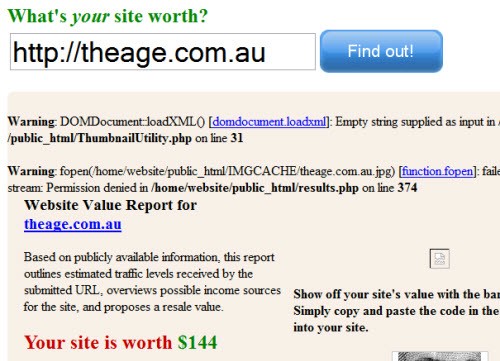
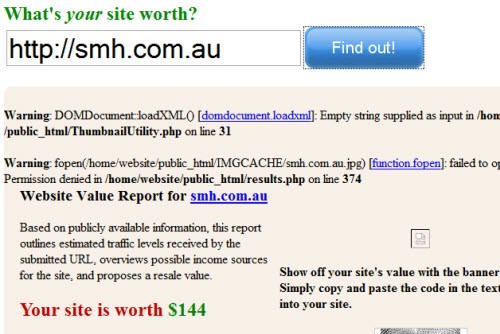
— Rowan Wilde, marketing manager Business Spectator
Internet activists whip up a “T-tstorm”. A group known for its anti-Church of Scientology stance brought down government websites today as part of its protest against the controversial internet filtering laws. Dubbed “Operation T-tstorm”, the group called Anonymous targeted sites including the Parliament of Australia website. — mUmBRELLA
Seven spearheads next gen broadband. The Seven Network has announced $14 million plans to roll out its Vividwireless broadband network into the five mainland capital cities in yet another sign that the media group will pursue growth opportunities outside its traditional television business. – The Australian
Iranian state email to usurp Google. Iran’s telecommunications agency announced what it described as a permanent suspension of Google Inc.’s email services, saying a national email service for Iranian citizens would soon be rolled out. — WSJ
Shrinking sales decline for US news stands. In another tough stretch for the magazine business, newsstand sales and subscriptions declined in the last six months of 2009. The only good news: the rate of decline is getting less steep for newsstand sales. — NYT
Horrocks posts status update for BBC. BBC news journalists have been told to use social media as a primary source of information by Peter Horrocks, the new director of BBC Global News who took over last week. He said it was important for editorial staff to make better use of social media and become more collaborative in producing stories. – The Guardian
Latest Google expansion: super-broadband. Google, the world’s biggest online search engine, wants to turbocharge your Internet connection. The company said Wednesday it is getting into the broadband service business with trials for fiber networks that will deliver Internet access speeds that are 100 times faster than what most Americans are getting today. — Washington Post


websitevaluecalculator.com self-scores itself at $20,544.
And http://www.crikey.com.au scored $136 while my personal occasionally updated knitting blog is apparently worth $95.
Methinks the whole thing isn’t worth the energy required to deliver the pixels to a computer screen.
I haven’t seen too much media coverage today of this latest attempt by Conroy and therefore Rudd, of yet more censorship on the internet
http://www.smh.com.au/technology/technology-news/google-baulks-at-conroys-call-to-censor-youtube-20100211-ntm0.html
When I saw the article header I thought oh just another wild scheme by this idiot. But then I read the full article and was bowled over. What arrogance,what a facist, what a bludy lunatic. Than God Google have told Conroy and Rudd to get proverbally ‘stuffed’. Read the article and make up your own mind. This is now becoming very serious and I cannot beleve the majority of cabinet are allowing it to proceed. This Government under a PM who has lost the plor completely are determined to hand this coming election on a plate to the Mad Monk and his deciples. Its becoming a mad house this country.