
A pleasing growth result. Even the economic pundits can be pleased with this morning’s GDP figures released by the Australian Bureau of Statistics. Growth of 0.9% in the December quarter was right on the median forecast of the business economists surveyed by Bloomberg, even if a revision to the September GDP figure meant that they ended up underestimating growth for the year.
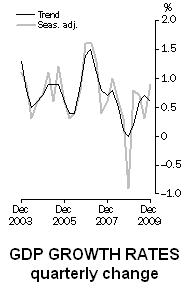
No evidence of inflationary pressures yet. When the Reserve Bank governor Glenn Stevens talks of interest rates returning to normal levels, presumably he is expecting inflation as well as growth to make a similar return. Well, in the GDP figures there is no sign yet that inflation is beginning to rise, so perhaps we will escape all of the interest rates rises the economists are so cheerfully predicting.
The chain price index for Household Final Consumption Expenditure (HFCE), the national accounts measure most directly comparable to the CPI, rose just 0.2%, compared to an increase of 0.5% in the Consumer Price Index (CPI) over the same period. Labour costs are also remaining under control. In the December quarter 2009, seasonally adjusted compensation of employees rose 0.4%, and the seasonally adjusted number of employees recorded in the labour force survey rose 1.0%. Average compensation per employee decreased 0.5%.
Good news for a new Premier. If it is true that when it comes to politics it really is “all about the economy stupid” then it should have been no surprise that the Labor Government of New South Wales was doing it tough in the opinion polls in the 18 months to the end of 2009. The largest state was the one that did it toughest during the turmoil of the global financial crisis, probably through no real fault of the government.
Equally, the strong revival shown in the ABS growth figures today has nothing to do with the new Premier Kristina Keneally either. In the December quarter NSW led the way with an annual increase of 5.2% in state final demand compared to 5% in South Australia, 4% in Victoria, 3.3% in Western Australia. I will be surprised if the return to strong growth is not soon reflected in a pick-up of political support for Labor as measured by the p0llsters.
Already the pollsters are registering a growing dissatisfaction with the Government of Anna Blight where state final demand fell by 1.1% in the year to December.
A frightening model. Foretelling the future by its very nature is an inexact business. Not until the race is actually run do we know the accuracy of forecasts. We mere mortals can but make our best guess and, while acting accordingly, be prepared to change when new material changes the prediction.
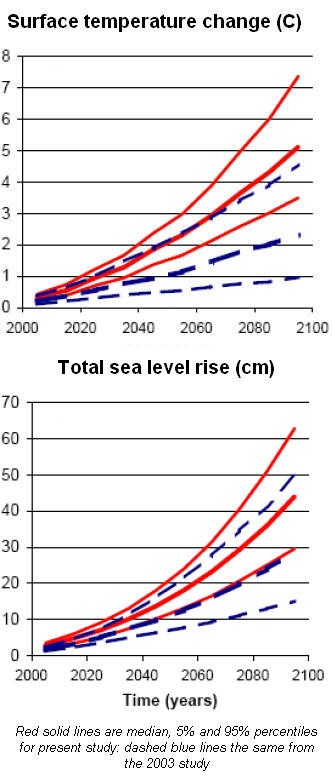
Which is what the statisticians at America’s highly regarded Massachusetts Institute of Technology recently did with their assessment of the likely future course of the world’s temperature. The MIT Integrated Global System Model, first published in 2003, is used to make probabilistic projections of climate change from 1861 to 2100. Substantial improvements to the model and improved estimates of the probability distributions of “uncertain input parameters” have become available.
The new projections are considerably warmer than the 2003 projections, e.g. the median surface warming in 2091 to 2100 is 5.1°C compared to 2.4°C in the earlier study. Many changes contribute to the stronger warming; among the more important ones are taking into account the cooling in the second half of the 20th century due to volcanic eruptions for input parameter estimation and a more sophisticated method for projecting GDP growth, which eliminated many low emission scenarios. However, if recently published data, suggesting stronger 20th century ocean warming, are used to determine the input climate parameters, the median projected warning at the end of the 21st century is only 4.1°C. “Nevertheless all our simulations,” reports the MIT team, “have a very small probability of warming less than 2.4°C.”
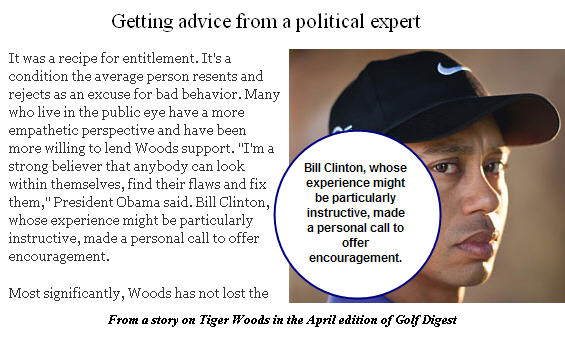
Help from an expert.




Crikey is committed to hosting lively discussions. Help us keep the conversation useful, interesting and welcoming. We aim to publish comments quickly in the interest of promoting robust conversation, but we’re a small team and we deploy filters to protect against legal risk. Occasionally your comment may be held up while we review, but we’re working as fast as we can to keep the conversation rolling.
The Crikey comment section is members-only content. Please subscribe to leave a comment.
The Crikey comment section is members-only content. Please login to leave a comment.