
When will companies learn? Greenpeace produced a splendid parody of those old “Have a Break” KitKat ads targeting Nestle’s reliance on palm oil from destroyed rainforests in Indonesia (the blood dripping on the keyboard is gorily inspired). When Greenpeace posted the video on You Tube, Nestle immediately demanded its removal for copyright infringement, which only encouraged You Tube users to upload it anyway there and on other video sites and promote the video on Twitter. Within hours a parody of Nestle’s response had appeared. The Downfall video awaits.
Mind you, Nestle is pretty up-to-date with all this social media stuff, and has a Facebook page “for Nestle fans” (transnational food companies have fans?) where, alas, its message about its “commitment to using only Certified Sustainable Palm Oil by 2015” has been swamped by attacks on the company and posts of links to the video. — Bernard Keane
Top Gear host not one to sermonise on security. Braying fauxletarian Jeremy Clarkson had a piece in the Times the other day about what a con security arrangements at airports are. No disagreements there, but the ex-Repton inmate may not be the one to listen to on security matters.
After the government lost computer discs containing the personal data of millions of people in 2008, Clarkson let rip on those whining about loss of privacy, and expressed such confidence in the banks that he published his own account details. Within hours his account had been hacked, and direct debits to charities — for weak untermenschen! — established. Clarkson had to change his account. And publicly admit he’d made a mistake. We’re still waiting for SBS to do the same about Top Gear Australia. — Guy Rundle
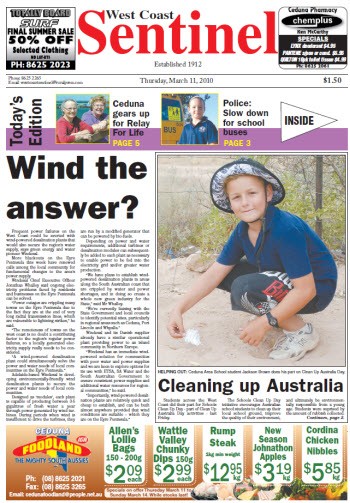
Spinning in the wind. Readers of the West Coast Sentinel were treated to public relations dressed up as journalism last week, when their entire front page was devoted to a story promoting wind power. In a fine case of PR spin, the story quoted just one source: the CEO of “green energy and water pioneer” Windesal.
AAP aims to protect brand by restricting Twitter
“Australian Associated Press is cracking down on its journalists who use social networking sites while on the job. The agency’s editor-in-chief, Tony Gillies, says this is because reporters have been posting their thoughts online while on assignment.” — ABC Online
Google set to make the leap to TV
“Google and Intel have teamed with Sony to develop a platform called Google TV to bring the web into the living room through a new generation of televisions and set-top boxes. The move is an effort by Google and Intel to extend their dominance of computing to an arena where they have little sway, the TV.” — New York Times
Google Maps — your brand here
“Google has developed yet another new revenue stream from its mapping product — companies are now able to pay to have their brand logo appear on their location on Google Maps.” — Mumbrella
Social network sties bringing the hate
“The use of social networking sites such as Facebook, Twitter and YouTube by militant and hate groups grew by almost 20% in the past year, a report by the Simon Wiesenthal Center has found.” — Sydney Morning Herald
Free-to-air TV on the mend?
“A report from Deloitte paints a picture of the media industry recovering from the hammering it received during the global financial crisis. Deloitte says the free-to-air TV industry is forecast to grow at a compound annual revenue growth rate of 4% from 2009 to 2014.” — The Australian
Murdoch’s Arab foray a ‘Trojan horse’
“The tie-up between Arab entertainment giant Rotana and pro-Israel media mogul Rupert Murdoch is viewed in Egypt not only with suspicion but as signalling the decline of Arab film and art heritage.” — Middle East Online
Is innovation dead at Microsoft?
“It’s not often you read the words Microsoft and innovation in the same sentence these days, which is odd for a company with one of the biggest research laboratories in the world.” — Sydney Morning Herald




Crikey is committed to hosting lively discussions. Help us keep the conversation useful, interesting and welcoming. We aim to publish comments quickly in the interest of promoting robust conversation, but we’re a small team and we deploy filters to protect against legal risk. Occasionally your comment may be held up while we review, but we’re working as fast as we can to keep the conversation rolling.
The Crikey comment section is members-only content. Please subscribe to leave a comment.
The Crikey comment section is members-only content. Please login to leave a comment.