
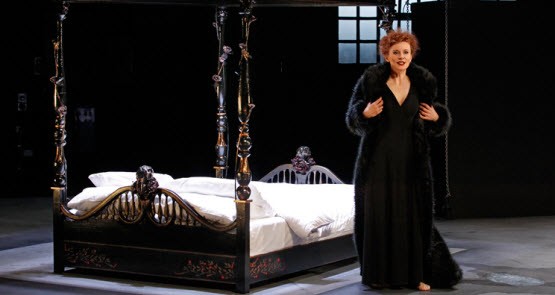
“It is the key that leads to the kingdom of the unimaginable,” describes Angela Carter’s pastiche reimagining of Bluebeard. He is talking about a key to a small room in the furthest reaches of his castle; a room that his new wife has been forbidden to enter; a room that she has defiantly explored; a room that she aptly coins: The Bloody Chamber.
The Bluebeard legend tells the story of a French nobleman with blue facial hair who has wed several times before, his previous wives all mysteriously vanished. The legend begins with Bluebeard’s most recent marriage to an impoverished and naïve young maiden who he has been decadently courting in Paris. But on his wedding night he goes away on business, giving her the keys to all of the rooms in his castle including his private chamber, which he insists is the only room she must not enter. Desiring to unlock the secrets of his soul, she is overcome by curiosity and enters the chamber. Inside, she discovers the bodies of her husband’s previous wives all grotesquely strung up on hooks: the dark truth of his murderous soul.
English novelist Angela Carter’s 1979 reimagining has been adapted for the stage by Malthouse Theatre associate artist Matthew Lutton. By its poetical nature, The Bloody Chamber seemed to be neither monologue nor play, but rather an inherently literary reconciliation between the both. Carter’s novelette also provides a feminist shift from the legend, portraying the young girl’s motive for marriage as more intentionally capitalistic, as well as changing the dramatic denouement where it is the mother who comes to her rescue, rather than her two brothers.
Carter and Lutton have attempted to re-establish the gender politics of this legend and find a more modern resonance for the contemporary audience. Lutton explains this in the program notes, describing how “Australia’s media frequently remind[s] us that misogyny and assumptions based on gender run deep in the Australian psyche. Gender still falls into false and backwards-looking stereotypes; discrimination and judgement still prevail.” Lutton’s play offers a protagonist who isn’t entirely innocent, and a mother who can overcome the monstrous male antagonist, subverting what we have been led to expect from traditional story tale gender roles.
Anna Cordingley’s set design was incredibly provocative, with gothic sensibilities that helped establish the chilling atmosphere of the play. With a colour palate of black and grey, the set also consisted of three large black crates which were suspended and lowered at certain times throughout the performance to reveal different settings and elements of The Bloody Chamber. One crate revealed three live harpists whose music was more atmospheric than melodic, providing a jarring underscoring that successfully evoked the unhinged psyche of the young maiden. The vastness of Cordingley’s set also festered the maiden’s feelings of solidarity and fear throughout the play. The sparseness of the set also encouraged the active imagination of the audience. With such a text-dense script, this was a necessary element for the creation of the story.
The audience becomes co-authors in the story as we are encouraged to imagine the horrific experiences of the play rather than being literally shown by the actors. This was continued through Alison Whyte’s portrayal of both the young maiden and her concupiscent husband. The use of voice-manipulation technology, designed by Jethro Woodward, allowed Whyte’s voice to be distorted to sound masculine as she transformed into her oppressor. This ventriloquistic device was petrifying at times, as we saw Whyte physically embodying the fear of the maiden with the voice of her domineering husband. Woodward’s sound design in collaboration with Cordingley’s set was instrumental in delivering the chilling emotional impact of the play for the audience.
Whyte was an obvious choice for the role, as she has clear strength and maturity as a performer. The Bloody Chamber was performed in retrospect as well, with the “young maiden” looking back upon her experience as a grown woman. However I was curious to see the young maiden performed by a 17-year-old actor, as this is the age she is described as being. This might have allowed the youthful naivety and lamb-esque innocence to be evoked more effectively. This is not a dismissal of Whyte’s performance though, as she most certainly carried the show with the strength of a seasoned and professional performer.
The Bloody Chamber is a production that brings light to the grotesque realities of the darker undertones of the fables and fairy tales we tell to children at bedtime. It transcended text as we were transported into the world of The Bloody Chamber as voyeurs and participants. It questions our desire to unlock those secrets that perhaps should be left behind closed doors.
The details: The Bloody Chamber plays the Merlyn Theatre, Malthouse until August 10. Tickets on the company website.






Crikey is committed to hosting lively discussions. Help us keep the conversation useful, interesting and welcoming. We aim to publish comments quickly in the interest of promoting robust conversation, but we’re a small team and we deploy filters to protect against legal risk. Occasionally your comment may be held up while we review, but we’re working as fast as we can to keep the conversation rolling.
The Crikey comment section is members-only content. Please subscribe to leave a comment.
The Crikey comment section is members-only content. Please login to leave a comment.