

By Luke Buckmaster
.
Contents
.
1. Introduction
.
At Private Media we use social media to market our journalism, but in a sense it is a cutting-edge form of journalism itself. Just as there is skill involved in the craft of journalism, there is skill involved in writing that perfect tweet or sizzling status update.
I have written this document to share knowledge of techniques I have found useful in order to make the most of our content on social media platforms. It is limited to Twitter and Facebook; not because other platforms aren’t important, but because Facebook and Twitter are by far the largest generators of social traffic to our websites.
It is by no means comprehensive and should be read with the knowledge that social media is built on shifting sands: what might work today might not work (or even exist) tomorrow. Having said that, I’ve deliberately focused on techniques that have longevity and focus on how content is composed rather than the technical elements that surround them. Hopefully this will also encourage you to experiment with your own techniques.
2. Facebook
.
2.1 Overview
.
As publishers on Facebook our aim is to spread Private Media’s content as far and wide as possible and collect as many click-throughs as we can. To do this we take on a challenge similar to one posed by Google: we want to reach prime real estate where our content can generate maximum impact.
Facebook’s News Feed is governed by a complicated set of algorithms that place varying levels of importance on many factors. Engagement and relevancy are key factors. Below you will find information on how Facebook processes the information we put into it, effective ways to shape and format that information and other lessons learnt.
2.2 Publishing on a Facebook page
.
There are three options for publishing links to our content on our Facebook pages. They are:
- A status update;
- A photo update;
- A link update.
Each has a different impact on exposure, engagement and click-throughs. For advice on how to format updates, consult the “formatting” section.
Value of variety
.
There is value in publishing a variety of post types. When determining where to place stories on the News Feed, Facebook (using information collected about past engagements) takes into account types of posts users prefer, and serves them up to these users more regularly. This means pages that only publish one type of post risk having these posts seen less by fans that interact more with other kinds. It is also important for a publisher to play to their demographic’s strengths. If image-based posts tend to go well, we should take advantage of that and do more of them. Information to inform this decision is available through Facebook Insights, with a few caveats (feel free to approach me and we can discuss them).
2.3 Writing Facebook updates
.
Updates involving people, places, events and those that carry an emotional or ideological message are often the most appealing to Facebook users. This is in part a reflection of their on-site behaviour and in part a reflection of the platform’s structure and where its psychological emphasis lies. For example, users “like” restaurants/places, manage events in their calendars and are encouraged to tell friends how they are feeling (“what’s on your mind?” is the question that permanently appears on Facebook’s homepage). This is part of the day-to-day experience in the Zuckerberg universe.
There are ways we can phrase descriptions of our stories that use an understanding of the platform and thus give them particular currency. Additionally we can be aware of the sensibilities of our publications’ demographics and share content in ways that resonate with them. This awareness generally comes from a substantial period of time spent engaging with readers and noting their responses, or tracking them through analytics. It doesn’t have to be a numbers game. Understanding is often developed empirically.
2.4 Knowing your audience
.
Just as different publications have different readerships that prefer different things, the same can be said of each publication’s Facebook page.
For example, Crikey’s Facebook fans largely consist of left-leaning 25-44 year-olds. A story about injustices suffered by asylum seekers, if described in the right way, generally generates a lot more traction than, say, one about a successful business initiative. Conversely, on SmartCompany, a story about a successful policy implemented by the Coalition is more likely to resonate.
This doesn’t mean we bend our descriptions of a story in order to provide readers with what we think they want to hear (or that we take the opposite approach and provoke them by writing something they don’t want to hear). But it does mean we are able to make informed decisions when sharing our content across multiple platforms.
2.5 Techniques for generating engagements
.
More likes, shares and comments on Facebook posts mean more engagements. More engagements mean wider exposure on News Feed and more click-throughs. Therefore, the need to generate as many engagements as possible is paramount. I have written below about four different engagement generating concepts/strategies you should be aware of. I have coined them:
- Me too;
- Expressing a lesson, moral or message;
- Using colour and humour;
- Up voting.
All are discussed with relation to user behaviour, then taking what we understand of that behaviour to use for publishing purposes. The first two techniques are, in my opinion, the most powerful and effective.
Me too
.
Likes can be a way for users to say “me too” or “I agree” with the sentiment expressed. This feeds into one of the most effective ways to get likes: you give people something to like.
Bernard Keane wrote a short story in July about the appointment of ALP Senator Jacinta Collins as the new mental health minister. The essence of the story was essentially the suggestion she was not the most appropriate choice for the job. Collins is a conservative who has spoken out against same-sex marriage and abortion.
I could have copied and pasted the lead and written the Facebook teaser this way:
ALP Senator Jacinta Collins, who is on the record as being anti-gay marriage and anti-abortion, has been appointed our new mental health minister.
But Crikey Facebook users would be reluctant to like and share it (it is also not really what the essence of the story was about). Users of an anti-abortion Facebook page would likely have responded quite differently, and this is where understanding our audience comes into play. By adding one final sentence, this update was able to gain traction, fly to the top of News Feeds and get great circulation. Here’s the complete post:
ALP Senator Jacinta Collins, who is on the record as being anti-gay marriage and anti-abortion, has been appointed our new Mental Health Minister. Maybe, just maybe, she isn’t the right person for the job.
Here is another example. This one from Women’s Agenda. For a story headlined “Tony Abbott’s new Cabinet: Alarmed but not surprised” I compiled a couple of sentences from the story for a draft Facebook update. The draft update read:
During the election campaign we saw Tony Abbott’s attitude towards women in its gritty, patronising glory. We can be alarmed by the lack of women on his new cabinet, but we can’t be surprised.
It took only a moment to realise that a simple change in emphasis could make the world of difference. Note the second sentence in the actual update:
During the election campaign we saw Tony Abbott’s attitude towards women in its gritty, patronising glory. The lack of women on his new cabinet is not surprising, but it is certainly alarming.
Another kind of “me too” doesn’t necessarily endorse the sentiment, but rather the way in which it is described.
Expressing a lesson, moral or message
.
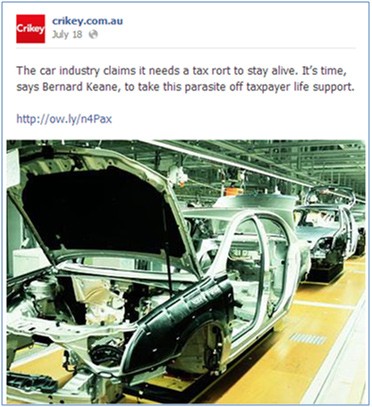
Most of the time the overarching message/thrust of the story won’t be as easily compatible for Facebook as the example mentioned above. A more subtle approach can be taken pertaining to a lesson / call to action.
For example, if you have a start-up success story, you can link the owner of the business to the title of the business, the broad summary (success/failure, profit/bankruptcy) and end on a lesson mentioned in the story that loops back to that “like” psychology: i.e. this business reminds people about how hard work pays off; this is about the little guy who wins against the big guns; this is a reminder of why you should properly fill out your tax return, etc.
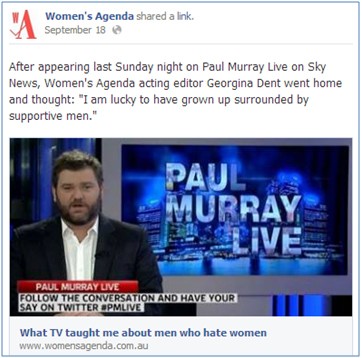
There are countless iterations of these kinds of “lessons to learn” stories across our websites, most commonly SmartCompany, StartUp Smart and Women’s Agenda. Sometimes a single line deep in the article allows us to frame the item as a lesson-based piece of content. Take the below example. Nobody likes that Georgina got harangued on Twitter by a bunch of grisly men, but they do like the lesson:
Colour / humour
.
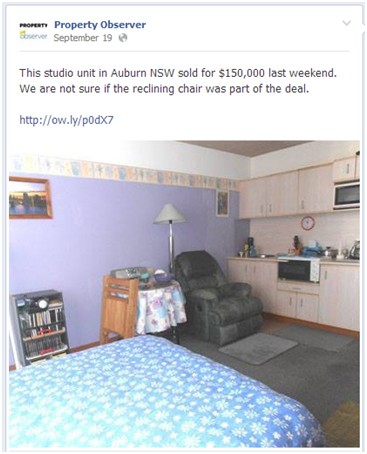
The story you are linking to may not be a quirky feature or a rib-tickling collection of gags but that doesn’t mean you can’t use colour and humour to help promote it. Readers often respond well when social media publishers show personality, provided it isn’t out of step with the voice of the publication.
Facebook users may see a review of a new theatre production appear on their feed. They may not have seen it, therefore they may not agree that it is “more boring than listening to Kevin Rudd read the dictionary”. But they may like the colourful description.
Up-voting
.
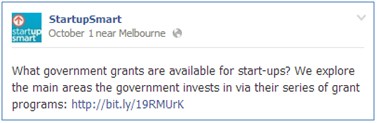
This is the most universal variety of update. People generally click like because they are up-voting the content described, rather than being directed to the description itself. Often users will up-vote a story because it connects with them in some way, i.e. their profession or hobbies.
2.6 Affinity
.
In addition to sharing links to our content there are various ways to generate engagement and sustain a robust social presence, including publishing polls, questions and images. Women’s Agenda shares pictures that do not directly increase referrals but maintain the voice of the publication and appeal to its readers:
This has no direct benefit onto referrals because there is no referring URL. However, through the generation of engagements, updates such as this build what Facebook calls “affinity” – the closeness of the relationship between brand and user. This is an important factor used by News Feed’s algorithms to determine placement of stories.
The most simplistic way to understand it is to imagine Facebook’s robot algorithm saying: “we know you have liked many Women’s Agenda posts before, so the next time they publish one we will make sure you are more likely to see it than the average user”. While there may not be a short-term benefit, there is likely to be a long-term benefit.
2.7 Post sentiment
Some quick points:
- Posts with a neutral tone tend to get fewer likes;
- Very negative posts tend to get more comments;
- Positive posts tend to get more likes.
2.8 Self reference
.
Posts with a high number of self-referential words such as “I” and “me” tend to get more likes. However, these are of limited use to us as publishers given we share content from the publication, not from us personally (unless we do so through our own personal accounts). However, there might be a quote we can use from an interviewee to help promote the story. Take this (entirely fabricated) example:
“I started growing tomatoes in my garden,” says world fruit king Mr Tom Mato. “I never thought I would sell millions to them to China.” Read about his success story here: [insert link]
2.9 Formatting posts
.
Facebook posts can be formatted in a variety of ways. Below I have written examples of ways you can format your posts and divided these examples into the three options available for page publishers: status updates, link updates and image updates. You should use a mix of them in order to appeal to users who prefer one kind of update over another, but you should also play to your page’s strengths. I can help you determine what kind of ratio/mix you should be using.
These aren’t hard and fast rules. They are ways to format that I have found effective in the past.
Status updates
Here is a nice way to publish a clean and easily readable status update. If in doubt, keep them short.
One-three short sentences followed by a paragraph break and a shortened URL. This should be the default option. Example:
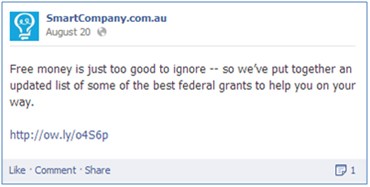
Image updates
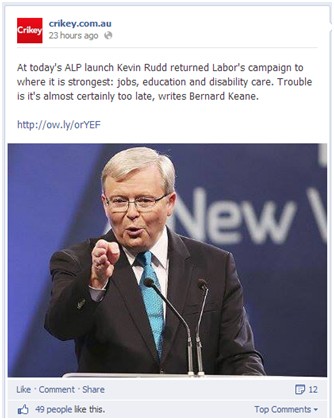
Two-three short sentences followed by a paragraph break and a shortened URL. The image should be around 400px by 400px (width is more important than depth; the height of the image can vary but use the above as an indicator). It is important to keep the teaser short, given the image will consume a significant amount of screen real estate. Example:
Link updates
One-three short sentences plus a very short description (around 15 words) in the area below the headline next to a thumbnail graphic. This needs to be vigilantly short as Facebook has a character count that will cut off the text. Example:
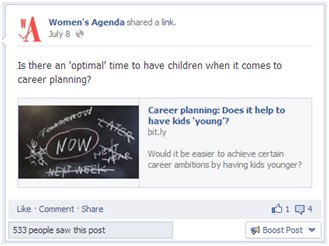
One thing to keep in mind about links: if the article being linked to does not have an image inserted in the body of the page, Facebook will not know which thumbnail graphic to display and present options. These will often not be the correct ones (i.e. author pic, company logo or an ad). In case this, click the “Upload Image” link and select an image to accompany the story.
3. Twitter
3.1 Overview
.
Unlike Facebook, Twitter feeds are not governed by a set of complicated rules. Despite the influence and widespread use of Twitter, the process by which it arranges information is very simplistic. With few exceptions, tweets are seen (or not seen) depending on the time they are tweeted versed the number of other accounts the user they are being tweeted to is following.
If a person follows 10 users, they will probably see most of the tweets by those users for days, or even weeks. If that person is following 1000 users, they may only see them within a very small window of time. This is why retweets are valuable and sought after: they make a tweet appear at different times, to different people.
3.2 Techniques for writing good tweets
.
Posing a question
Find a nugget of interesting news, generally the thrust of the piece, and then an accompanying question. In the three examples below, the first is a question asked in the story. The second is a question asked to create more interest in the story. The third is just the question itself.
Example one
Headline: Chris Uhlmann departs 7.30 to make Labor doco
Tweet: Chris Uhlmann, @ABC730’s tough political editor, is leaving to make a doco about Labor. Who will replace him? https://ow.ly/oIBUo
Example two
Headline: Summerless Park homestead and farm at Yarramalong sells
Tweet: Pharmacist Ross Brown and his wife Joan have sold their picturesque Yarramalong Valley farm. Would you move in? https://ow.ly/ozHof
Example three
Headline: Legal certainty boosts business ties between Australia and the UAE
Tweet: Why would NSW and Dubai courts bother signing a Memorandum of Guidance? https://ow.ly/oY6cv
Juicy info
Take the colourful bits from the story and use them to sell it. Provide information people might not have known, which may inspire them to read more.
Example
Headline: Rich Tales: Palmer’s off to Canberra, but what do we really know about him?
Tweet: Clive Palmer’s priorities: pour money into health, raise aged pension & fly in asylum seekers, reports @myriamrobin https://bit.ly/1fOoykJ
Colourful stance
If an author takes a colourful/opinionated stance or reveals something surprising, endeavour to reflect that in your tweet.
Example
Headline: Rundle mythbusts Abbott’s victory
Tweet: Abbott won in a landslide. Abbott has a mandate. Total repudiation of Labor. Wrong, wrong and wrong. Rundle mythbusts https://bit.ly/17SV00f
Short and sweet
Don’t rely on headlines to make good tweets. Often, however, they can be effective in a short and sweet (and arguably “clickbait” style) way. These tweets can be quickly written, which helps if you are time-strapped.
Example
Headline: Why the world’s richest billionaires shun university
Tweet: Why the world’s richest billionaires shun university https://ow.ly/oY66L
Others can be short and punchy in the manner of a “tell me more!” teaser.
Example
Headline: Your business might be on this ASIC database, and you don’t even know it
Tweet: Your business might be on this database — and you don’t even know it https://ow.ly/p0dkR
3.3 Dos and don’ts
.
Don’t:
- Copy and paste a headline into a tweet and publish it without considering ways to change it. Twitter is a different platform and requires different thinking. A headline might be perfectly fine for Twitter, but it may not. Often with a headline that seems appropriate, slight tinkering can make a big difference. Also, the style of headlines for some publications lend themselves to a tweet far better than the headlines of others.
- Publish tweets in a “cluster” or “flood” by posting in quick succession and “bombing” your followers.
- It’s generally best to avoid using words associated with categories/sections of your website. Some examples across Private Media sites include “Richard Farmer’s Chunky Bits,” “Rich Tales,” and “Guilt Free Zone.” The names of categories/columns may work on a website, but on Twitter they often look without context.
Do:
- Take a couple of minutes to develop a good tweet that accurately reflects the content and compels people to read it.
- Spread your tweets out, spanning different days and different times of the day (a tweet scheduler will help).
- Include hash tags and @ mentions to authors and relevant parties where appropriate.
- Use the majority of your 140 character count to capture the tone of the story and entice people to read it.
- Inject humour and colour, in line with the voice of the publication.
4. Cross-platform publishing: the difference between a tweet and a Facebook update
.
A well-written tweet is rarely a well-written Facebook update, and vice versa.
So now we have looked at techniques for writing tweets and publishing Facebook updates, there’s merit in giving an example of how one story can be refitted for both platforms, using some of the strategies discussed.
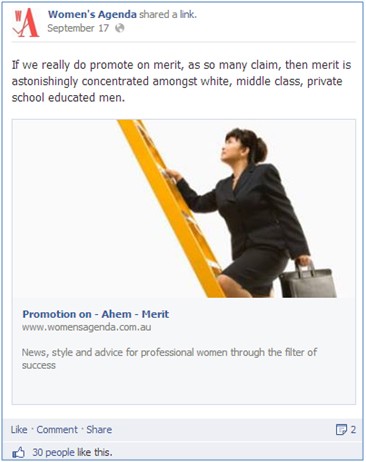
Take this Women’s Agenda story on getting promoted on the basis of merit. Here’s the tweet:
It’s good that we promote by merit. If by “merit” you mean “middle class, private school educated men.” @JaneCaro: https://ow.ly/oVM8R
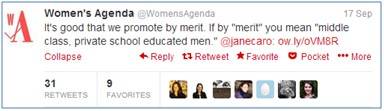
That is a sarcastic tweet. Twitter likes sarcasm. But if you posted that verbatim on Facebook the sarcasm might not translate as well. So a simple change was made. Here’s the Facebook post:
If we really do promote on merit, as so many claim, then merit is astonishingly concentrated amongst white, middle class, private school educated men.
5. Conclusion
.
The above techniques were developed after many months spent failing, learning and trying again. If you aren’t making mistakes in social media, chances are you aren’t trying anything new. These techniques provide a solid groundwork for publishing on Facebook and Twitter – but that’s not to say they need to, or should be, followed without deviation.
It can be dispiriting when you think you’ve written a perfect tweet or a sparkling status update only to watch it get little traction. But keep at it! Social media engagement comes in waves. When it catches on, it can make the world of difference to your publication’s readership. Please let me know of any of your success stories. It would be great to rewrite this one day with ideas contributed by yourself.




Crikey is committed to hosting lively discussions. Help us keep the conversation useful, interesting and welcoming. We aim to publish comments quickly in the interest of promoting robust conversation, but we’re a small team and we deploy filters to protect against legal risk. Occasionally your comment may be held up while we review, but we’re working as fast as we can to keep the conversation rolling.
The Crikey comment section is members-only content. Please subscribe to leave a comment.
The Crikey comment section is members-only content. Please login to leave a comment.