

It’s no secret that Australian state and federal governments of all stripes spend big on advertising, but a new Grattan Institute report has found a large number of “public interest” campaigns funded by the taxpayer honeypot to be little more than political ads.
Current regulations stipulate that political advertising seeking to “confer a political advantage” is for parties — not the public — to pay, and yet the report identified that each year a quarter of the federal government’s annual $200 million advertising spend was used for political point-scoring.
Over the past 13 years, two in five of the biggest federal government campaigns came with “strong political overtones”. These included Labor’s $60 million 2010-2013 NBN campaign, and the Coalition’s $39 million 2016-2021 “Building Our Future” and $24 million 2019 “Tax and the Economy” campaigns.
Ads were dressed up with on-brand statements, slogans and colour schemes that either spruiked the government of the day or promoted the party itself. But it was a partisan effort — both Labor and Coalition governments exploited the honeypot in equal parts.
Analysis of the top 10 campaigns (by dollars) over the past 13 years also found timing was of the essence, with seven of these run right before elections. In the nine months preceding the 2019 federal election, the Coalition government drew more from the public purse than the combined advertising spend of all political parties. Compare the combined $82 million “party-funded TV, print, and radio advertising” budget to the Coalition’s $85 million taxpayer-funded campaign to make political ends meet.
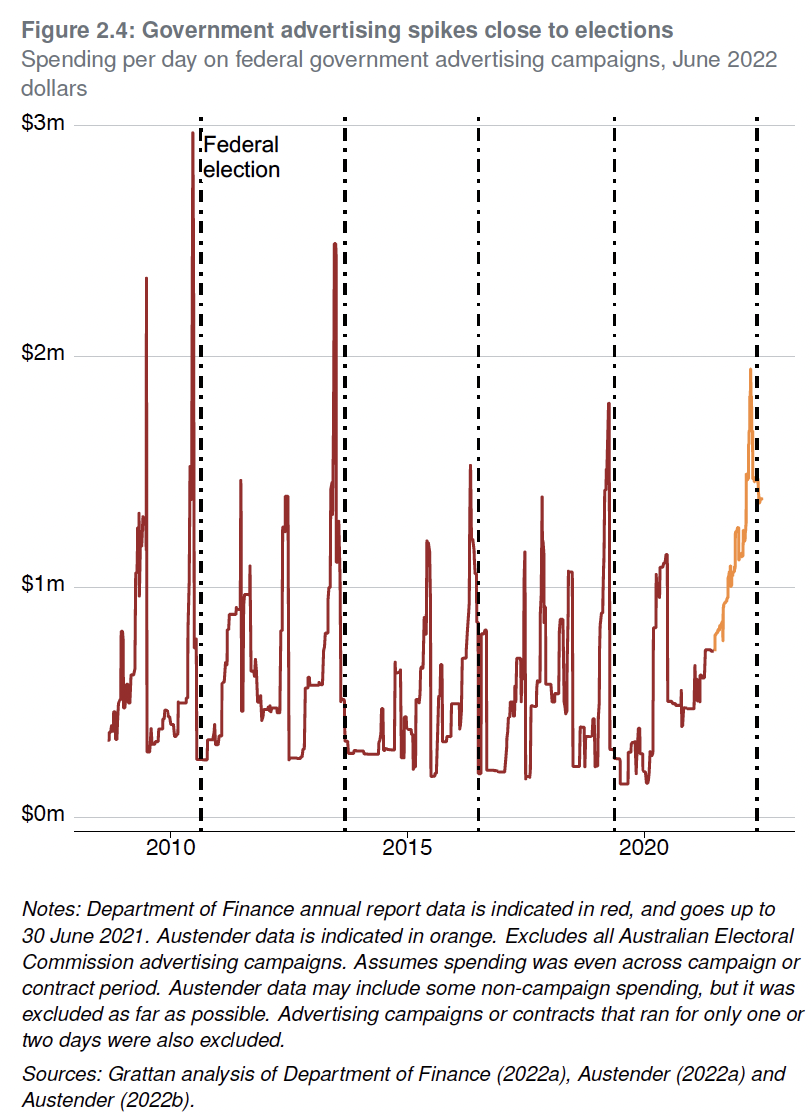
The surge in spending pre-election was also said to disadvantage opposition, minor parties and independents. Given the Coalition’s landslide defeat in the 2022 federal election and clear failure to leverage taxpayer-funded ad spending for political purposes, it raises the question of just how effective it actually is.
The Hon Anthony Whealy KC, former judge of the NSW Court of Appeal and chair of the Centre for Public Integrity, told Crikey that the teals did well “because of direct community support” that “outweighed government advertising”. He added that political parties need to remember that it’s “not their money” and not there to be “spent on themselves”.
“I think it’s quite scandalous that it’s used as a promotional exercise for any government when it’s meant to be material in the public interest,” he said.
In line with the report, Whealy said it was more concerning that state and federal governments largely lack any “proper enforcement mechanism to curtail it”.
“Just like ICAC, we need an enforcement policy that’s got some teeth.”
This is one of the key recommendations listed in the report, alongside legislation that clearly delineates public v party-interest advertising, an independent approval process for government campaigns, and repercussions if these rules and regulations are breached. Notably, government will be forced to front the costs.

Gosh, this is shocking. I hadn’t noticed this insidious abuse of taxpayers’ money. I expect it will cease now it’s been exposed.
Perhaps it does raise the question, but the question is unanswerable. You can only use that result as a measure of its effectiveness when you compare it with the results after the same election except without the taxpayer-funded ad spending for political purposes. That is unknowable. Maybe it would have been worse for the Coalition. Maybe better. Maybe no difference. It’s anybody’s guess.
Both major parties are corrupt as hell. They are made up of career politicians whose agenda is to personally make themselves wealthy by whatever means. They recognise no great wrong they want to right. They have no moral imperative to improve things for all Australians and the world as a whole. They also have no moral boundaries they will not cross if they can personally collect a few bucks. Sad.
This has been going for years with both political parties…..
Scammy rort. Pollie machines have it as the default setting. Aholes.