
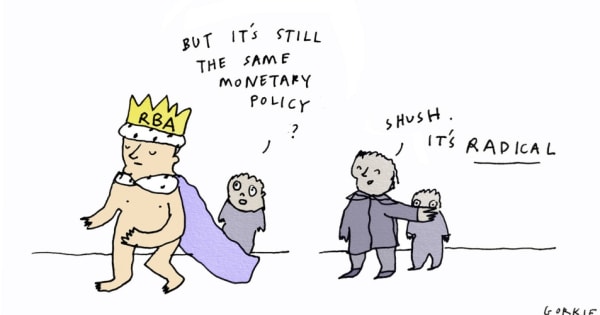
Does the Reserve Bank (RBA) want house prices to rise? Why did it not hike interest rates on Tuesday?
The RBA has been relying on house prices falling to help reduce consumption and lower inflation. The famous “wealth effect” that makes homeowners spend more as their property rises in value has gone into reverse recently, with declining values making homeowners tighten their belts and spend less.
That’s a very deliberate strategy. The RBA has spelled out exactly how this works in the minutes of its monthly meetings.
“Declines in net wealth, driven by lower housing prices, would also weigh on spending,” it said in the minutes of the February meeting — at which it hiked interest rates by a quarter of a percentage point.
The RBA wants spending to fall, or at least to stop growing so quickly. The reason is that hot demand lets businesses raise prices. An electrician whose phone never stops ringing figures he can bump up prices by 10% and still be busy. A butcher who is selling out by 2pm concludes the same. Those business decisions — to raise prices — create inflation when are repeated time and again across the economy. The RBA wants the electrician’s phone to stop ringing and the butcher to finish the trading day with lamb cutlets unsold. That way, the pressure is on them to cut prices, not raise them.
The RBA can affect spending in a number of ways. One is by compressing house prices. The people who reduce spending most when house prices fall are the wealthiest. It makes sense, right? The wealth effect can’t really hit people with no wealth — older demographics with their houses paid off tend to vary their spending most when property prices change.
If house prices rise, the wealthy spend more, the butcher and the electrician keep rising prices and the RBA’s fight against inflation gets harder. At the last moment, CoreLogic’s data shows house prices starting to stabilise and even rise. So why leave rates on hold?
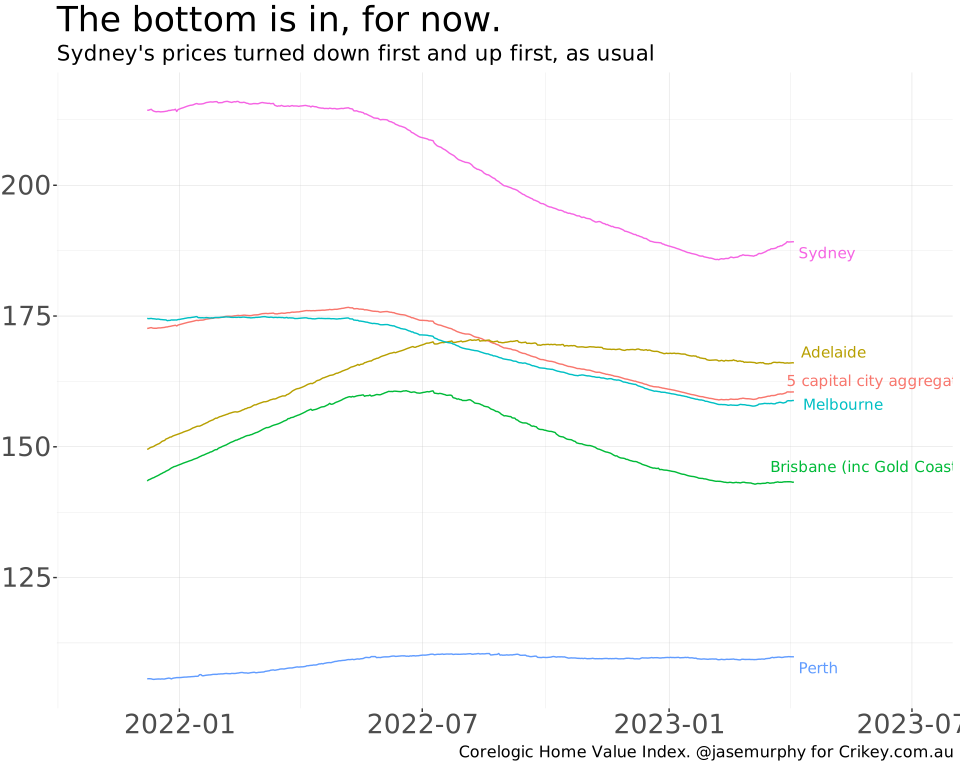
As discussed here recently, the end of price falls need not mean the start of price rises. It’s important not to learn lessons from a subset of history, and while Australian property prices have risen in spectacular fashion over the past two decades, the full history of price changes says long periods of stasis are perfectly normal.
Nevertheless, the rise in Sydney prices can be a bellwether. Sydney’s price moves usually signal the future for other major markets. Does this sound surprising? Of course, in a stock market, if there’s a price pattern, people trade it until the pattern disappears: e.g. if you know prices are low every September, people buy in September until prices aren’t low in September anymore.
But housing markets aren’t liquid like stock markets, and it means the price patterns aren’t all eaten up by hedge funds doing algorithmic trading. Instead the patterns just sit there, visible to all, but very hard to make money from given stamp duty, etc.
The biggest patterns are that Sydney leads the rest of the country, and that the top end of the market leads the bottom end.
“The lift in housing values has been most evident across the upper quartile of Sydney’s housing market,” write CoreLogic in its recent house value index.
But the RBA paid this no heed. In fact, it trotted out the same old line that falling housing prices will compress spending. That may be true in some markets, but not the country’s biggest property market.
The bank has left itself the option to lift rates next time it meets, in early May. If auction clearance rates froth upwards and house prices show more signs of life, I’d tip at least one more rate rise.

“Does the Reserve Bank (RBA) want house prices to rise? Why did it not hike interest rates on Tuesday?”
Why indeed did it not hike interest rates on Tuesday in the latter part of 2021? Nice and slowly. Obviously it was to help his Liberal Party mates who benefit from rising property prices that low interest rates generate. And to avoid what happened to John Howard in 2007 when interest rates were rising in the months prior to the election, giving the lie to his oft repeated mantra that interest rates will always be lower under a Liberal Government.
Just wondering how raising interest rates will reduce the $50 per week increase in my grocery bill (30%), or the 30% increase in my electricity bill, or the 30% increase in my house insurance? Come to think of it, my mortgage payments have increased by … about 30%.
Seriously. Interest rate hikes are paused for one nanosecond and we’re already speculating on house prices? We are a sorry bunch.
I was always brought up to regard the family home as a home. Not as a profit making commodity.
Exactly
Me too. I guess we’re in the wrong country.
older demographics with their houses paid off tend to vary their spending most when property prices change.
I can’t see this. people who have been living in their paid-off house for years needn’t pay much attention to property prices – it doesnt affect them.
‘tend to’ and ‘most’ is ambiguous language. And so is ‘older demographics’. Presumably, someone has studied wealth effects on consumption seriously in Australia (the RBA?). Overseas results are non-transferable because of the bizarre way housing is treated for Australian taxation and social security purposes, for both owner-occupiers and investors. Housing is the major asset held by a high proportion of the population, trumping compulsory superannuation. Notably, Australia does not have inheritance taxes. The bequest motive is a powerful influence for oldies lucky enough to own their houses. It is a stretch to say older people who own their houses are unaffected by property prices.
Yes, Mr Lowe is a it again. Gaslighting Australian workers, warning in his National Pres Club address today, that wages need to be held back to check inflation, bringing it to its target band of 2-3% by 2025. He, more importantly, also said the rise in inflation was not due to profit taking. And he used, what must be a most unusual and excruciating method of showing this at the Address today, by means of a Powerppoint presentation. He has misused figures to prove this analysis. He said that his conclusion that inflation is not due to high profits because the share due to profits is the same now as before, though he didn’t specify a time period. Before the pandemic or after? How much before and how long after? Was it measured the last 6 months, 1 year? He also said that companies were passing on prices due to measureable inputs and the increase of these measureable inputs in the costs of production. Yet he significantly said that this excludes resources. That means the giants of the stockmarket and the energy companies – all coal of any type or purpose, all iron ore, all oil, petrol and gas and other who make their living digging stuff up or extracting stuff – all were excluded from his dubious analysis of profit generated inflation. No petrol price increases considered in profit taking inflation. No gas and electricity price rises included though they have been gouging us for over a year now. Keep up the good work Crikey. You are clearly wearing him down and showing up the RBA for the incompetents and charlatans they truly are. Pursue what he says. He is clearly rattled.