
Today’s national accounts answer a key question for the Government in the lead-up to the May Budget: are we, to use the Prime Minister’s unavoidable phrase, out of the woods? The answer is yes.
Lindsay Tanner and Wayne Swan can now frame the Budget confident that the economy is making the necessary transition from public-supported demand to private demand as the stimulus packages wear off.
Remember today’s figures are for the December quarter — the last quarter in which the stimulus packages will make a positive contribution to growth. From this current quarter on, the scheduled withdrawal of the stimulus measures will start detracting from growth. That’s why the fact that the biggest contribution to today’s 0.9% figure is from private capital formation expenditure is important.
There’s an element of business confidence versus actual business conditions in that expenditure — NAB recently found the former was a lot better than the latter at the start of the year, suggesting businesses have been confident conditions will improve even if they’re not so hot at the moment.
It’s also significant that the Australian economy started that transition at the end of last year, when evidence suggests overseas economies were still struggling out of recession or, in the case of Sweden, falling back into recession for a double-dip.
There’s still room for external factors to affect the economy, particularly if overseas problems drive the dollar up significantly. Perhaps it’s the external environment that continues to make the Government cautious in its rhetoric, but that’s no longer justified by domestic conditions.
So it’s time for the Government to get back to the central task of managing a rapidly growing economy. That means keeping discipline in the fiscal process and accelerating the process of eliminating the deficit. And now they can do that with the confidence that, to use one of Swan’s colloquialisms, they won’t be pulling the rug from under demand.


Which woods are we out of? There are people who would like to explain away the GFC as a north Atlantic hiccough and that somehow we are immune, but there are plenty of signs in China (when their property bubble bursts something extremely unpleasant will collide with the cooling system) to suggest we aint seen nothing yet and that Mr Stevens and his cabal may well have got it badly wrong. See NYT analysis by Landon Thomas for the worst about UK debt http://www.nytimes.com/2010/03/03/business/global/03pound.html?nl=todaysheadlines&emc=a6
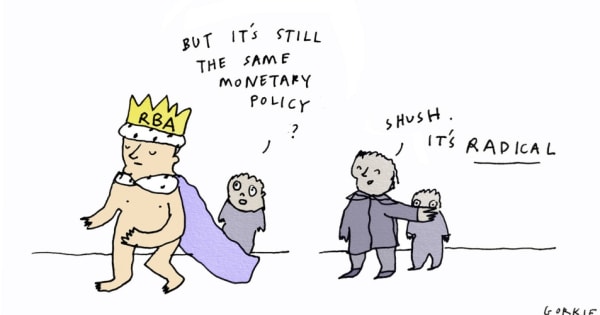
Glen Stevens and his acolytes seem to be cheerleading the property bubble with their predictions
of a twenty year boom whilst hubristically congratulating themselves on their management of the pit.
These are the same public servants who completely missed a world recession that seems to be fast tracking
into depression territory. The new paradigm seems to be when the USA gets influenza we get the sniffles.
Our largest customers main client seems to be on the ropes and yet the RBA doesn’t seem to be able to connect the dots.
Mr Stevens commented a month or so ago that he could see the taillights of the GFC , this utterance would have had
some credibility if he’d spotted the headlights and not been a hit and run victim.