
As an Australianism, “fully sick” isn’t exactly the latest news but somehow it still has the power to enthuse and dismay. I first remember hearing it in Melbourne in the mid-1990s and became an instant ironic user. The Macquarie word map has reports of people using it Melbourne and Sydney only, so it’s possible that many readers won’t be familiar with it. For those out of the loop, “sick” is an expression of enthusiasm or admiration. E.g., “Have a listen to this song, it’s sick”.
The obligatory intensifier for “sick” is “fully”. It’s associated with Mediterranean and/or Middle Eastern Australian English and speakers of these varieties certainly became early adopters, as represented in the popular SBS program Fat Pizza. By the time of the 2000 Sydney Olympics it had trickled up to Roy and HG who included it (at least ironically) in their commentary.
And the Med/Mid-East connection was reinforced by YouTube sensation Clare Werbeloff, whose false account of witnessing a shooting in Kings Cross featured all kinds of ethnic “voices” in the manner of a classic raconteur. Notice, for example, the distinctly kiwi inflection of the “fatter wog” (video here):
…there were these two wogs fighting and the fatter wog said to the skinnier wog, “Oi bro, you slept with my cousin, ‘ey!”. And the other one said, “Nah man, I didn’t for sh-t, ‘ey!”. The other one goes, “Oh, well I’ll call on my fully sick boys,” and then they pulled out a gun and just went “Chk chk, boom!”. And I ran away, because that’s all I wanted to see.
Why “fully”? I’ve a feeling that “fully” had already been floating around well before “sick” came onto the scene. For almost as long as I can remember I’ve heard “fully” used to express agreement. E.g., “That exam was hard” “Yeah, fully”. That “sick” is prefaced with any kind of intensifier at all might have something to do with the fact that its figurative meaning (“excellent”) is semantically opposed to its literal meaning (“ailing”, “shabby”). Could it be that “fully” coupled itself to “sick” to guard against possible ambiguity? Consider these expressions:
“That band is sh-t” (negative evaluation) vs. “That band is the sh-t” (positive evaluation)
“Carlos Celdran is a bastard” (negative evaluation) vs. “Carlos Celdran is a funny bastard” (positive evaluation).
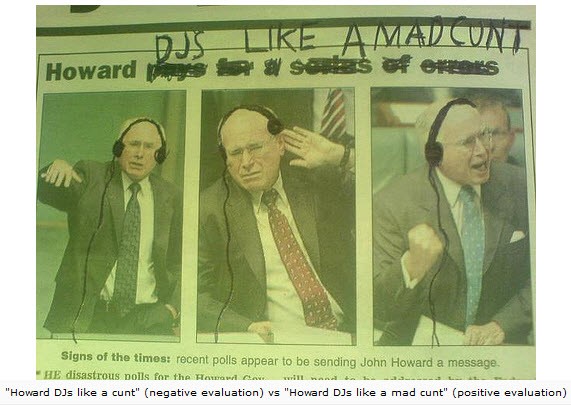
Of course “sick” doesn’t necessarily need a modifier to be understood in its intended sense, which reminds me of the Spanish slang use of cabrón (bastard, literally “billy goat”) which can carry the sense of a positive evaluation of a thing without any ornamental words to prevent it from being misunderstood.
On the other hand, calling a Spanish gent una putamadre (a motherf-cker, literally “sl-t mother”) is an invitation to a fight, possibly to the death. But refer to the same caballero as la putamadre, with awestruck intonation, and you are offering them the highest form of praise.
Context, as Clare Werbeloff keenly understood, is everything.





Crikey encourages robust conversations on our website. However, we’re a small team, so sometimes we have to reluctantly turn comments off due to legal risk. Thanks for your understanding and in the meantime, have a read of our moderation guidelines.