
If you were unsure of the magnitude of the current markets crash and downgrade of the US credit rating, the weekend’s newspaper front pages from around the world drill the message home pretty quickly.
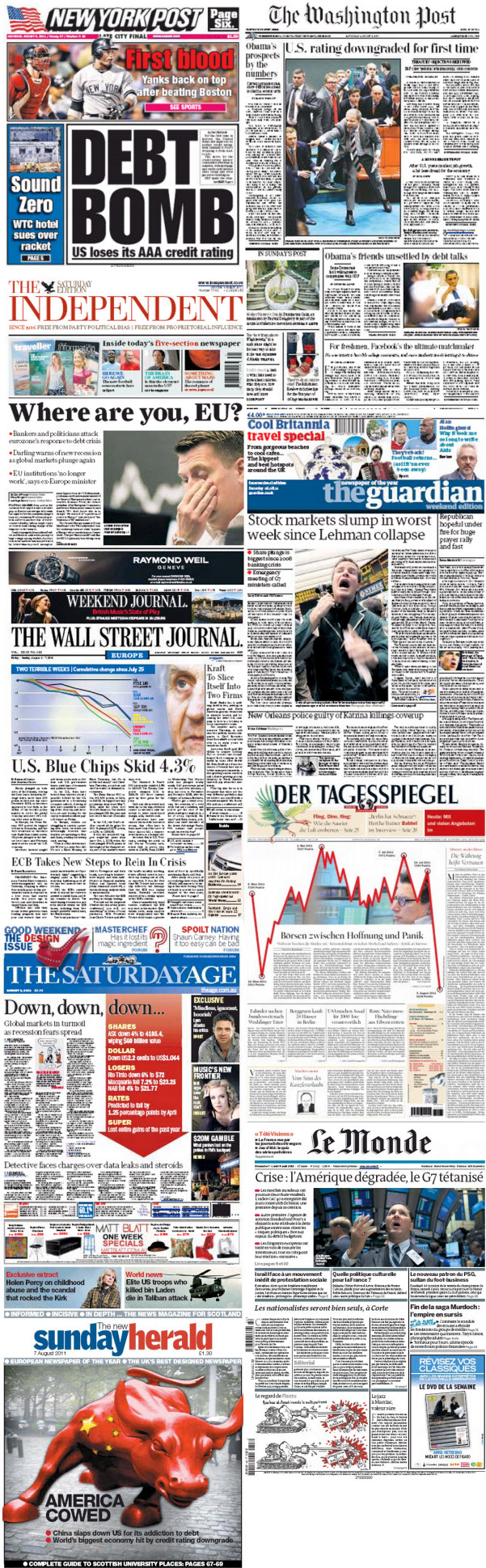
The fearful front pages are thanks to a combination of the US losing its AAA credit rating care of S & P and the euro debt-crisis. Credit rating agency Standard & Poor’s downgraded the much-cherished AAA rating of the US to AA+ on Friday, despite Congress passing a debt deal last week in order to raise the debt ceiling and avoid defaulting on its loans. The press release from Standard & Poor’s about the downgrade highlights their concerns about the ability of US politics to steer through the crisis:
The downgrade reflects our opinion that the fiscal consolidation plan that Congress and the Administration recently agreed to falls short of what, in our view, would be necessary to stabilize the government’s medium-term debt dynamics.
More broadly, the downgrade reflects our view that the effectiveness,stability, and predictability of American policymaking and political institutions have weakened at a time of ongoing fiscal and economic challenges to a degree more than we envisioned when we assigned a negative outlook to the rating on April 18, 2011.
Since then, we have changed our view of the difficulties in bridging the gulf between the political parties over fiscal policy, which makes us pessimistic about the capacity of Congress and the Administration to be able to leverage their agreement this week into a broader fiscal consolidation plan that stabilizes the government’s debt dynamics any time soon.
The outlook on the long-term rating is negative. We could lower the long-term rating to ‘AA’ within the next two years if we see that less reduction in spending than agreed to, higher interest rates, or new fiscal pressures during the period result in a higher general government debt trajectory than we currently assume in our base case.
There was the small matter of a $2 trillion error in their calculation of US deficits over a 10-year period, and initially Standard and Poor’s scrambled in the afternoon Friday to reconsider its decision to downgrade the United States government. Sources familiar with the situation say S&P had to rouse several of its European committee members from bed to hold an emergency conference call as markets headed toward their close in the US. But ultimately, the agency affirmed the decision.
It’s not clear yet how this downgrade will affect an already fragile US economy, report Motoko Rich and Graham Bowley in the New York Times:
“The hit to the United States’ prized credit rating may have arrived with a jolt Friday, but many analysts say it’s not so clear that it will deliver any immediate shock to financial markets or to consumers. That is because it confirmed what the markets, economists and most people already know: the United States has a debt problem and Washington is deeply divided over how to solve it.”
Others are talking down the significance, after all, the other two major credit agencies Moody’s and Fitch’s, rate the US at AAA.
“Crucially, this means investors governed by investment rules stipulating they must only hold AAA rated assets are unlikely to be forced to sell their Treasury bonds and push up the cost of US borrowing,” writes Jessica Irvine in The SMH.
“In the short term, the credit downgrade potentially means next to nothing,” says Irvine. “However, from a longer term perspective, the embarrassing removal of the US government’s prized AAA rating says everything. It serves as a stark reminder that the situation is bleak. The US economy is staring down the barrel of, at worst, another recession and, at best, a lost decade of sluggish growth and high unemployment.”
But it does reassess where the US economy stands on a global level, especially given India and China are in lecture mode, write Heather Stewart, Tania Branigan and Dominic Rushe in The Guardian:
“When India joined China in criticising America’s chaotic handling of its hefty debts this weekend, describing the challenges facing the White House as “grave”, it was the clearest indicator yet that the old order had been swept away.
Until recently the United States was the unassailable economic superpower, and the prospect of the White House being bossed about by the bond markets — let alone by Beijing or New Delhi — was unthinkable.”
How do other nation’s credit ratings compare? The Guardian has a handy infographic comparing troubled euro economies with the US.
What’s happened in the last week wasn’t what leaders — both in Europe and the US — expected, say David Böcking, Maria Marquart and Philipp Wittrock in Der Spiegel.
“Uncertainties on markets actually should have calmed this week. The United States prevented a federal default on its debt at the last minute, and in Europe the results of a special summit on the euro at the end of July were celebrated as a success. But now, of all times, the mistrust of investors has penetrated the markets at full force. They fear that economic growth will stall and that nations worldwide will fall further into debt spirals.”
The European Central Bank (ECB) is buying government bonds from countries at risk, like Ireland and Portugal, although it’s a controversial practise and one that will soon lay in the hands of the European Financial Stability Facility. Investors are questioning the strength of Europe’s €440-billion bailout package.
Finance ministers from the G7 nations — the United States, France, Germany, Italy, Japan, United Kingdom and Canada — agreed to interrupt their summer holidays for emergency phone meetings on the weekend to discuss the US credit rating and to prevent that concern spreading to already-struggling euro markets when they open on Monday.
Meanwhile, officials from the ECB also had emergency phone conferences to discuss buying up government bonds in Italy on Monday to calm rising interest rates. Along with Spain, officials fear Italy is at risk of defaulting on its loans.
What has happened in the last week to send markets into a freefall and put the fear into investors? It’s partly explained by investor psychology, writes Julie Creswell in an intriguing article in the New York Times, where she notes investors bitten by the 2008 crisis are quick to sell:
“In recent years, an area of study called neurofinance has tried to use brain science to explain how our primal circuits can, and often do, override our reason when it comes to investing.
It’s a heretical thought on Wall Street, where most people insist that logic prevails. The economic theory of rational expectations has enshrined the principle that people make judicious economic choices and learn from their mistakes. As a result, our collective expectations about the financial future — from the price of T-bills next week to the earnings of Google next quarter — are, on average, accurate.
Or so the theory goes. In practice, we do stupid things all the time. Some of us gamble away money, doubling down when logic tells us to quit. Others let their winnings ride when any rational person would cash out.
But many experts say the 2008 financial collapse recalibrated investor psychology. After living through the collapse of Lehman Brothers and the panic that followed, some investors are apt to sell first and ask questions later. Wall Street’s notion of worst-case scenarios has darkened considerably.”
Meanwhile, all eyes are on Australian markets this morning, as the Australian equities and foreign exchange markets will be the first to react to the cut, because the news emerged after Wall Street closed last week.
“The early futures market points to a soft open on the S&P/ASX 200, but most analysts expect the sell-off of last week to worsen,” reports The Australian.
Almost $100 billion was wiped last week from the Australian sharemarket, which tumbled to its lowest point in two years.

Interesting update. May I suggest that Crikey base these wrap-ups on reputable unbiased sources only. This clearly excludes all NewsCorp publications. This would be very much appreciated. Thanks.
I am with Gocomsys
The same trash who created the GFC, have exploited the senate situation for the political gain of the T party in the next USA election.
This is a friggin disgrace and is mirrored here by Hockey and the nutbag death riding unemployment figures which are disappointingly good, interest rates which stubbornly wont rise like they want them to and balance of trade figures which are still positive in our favour.
This liberal trash are praying for Australia to do it tough for their political gain. You wont read about that in the Australian or hear about it on their ABC.
Christ almighty…. everyone is to blame from the Liberals to the Republicans to the “News Ltd” media.
Could it just be that the markets are reacting to the reality that the U.S and most of Europes economies are stuffed?
And why doesn’t Obama get any blame, isn’t he the President?
And why doesn’t Obama get any blame, isn’t he the President?
Hmm, Why blame Obama when it was the fault of raygun and clinton?
I smell deads**t.
I don’t understand why he didn’t blame Juliar.
She is responsible for everything else