
It could be the greatest tax avoidance scam ever perpetrated: $50 billion in tax cuts to be handed a corporate-funded political party to some of the world’s biggest corporations, all on the pretext that it will drive economic growth, business investment, employment, wage increases, higher productivity … in fact pretty much any economic benefit ever identified in an economics textbook will be achieved by cutting the company tax rate for large corporations to 25%.
Except no one can produce actual evidence that it will do anything of the sort — despite countries like the UK and Canada having cut corporate taxes in recent years, enabling a comparison of their performance with Australia; despite the United States having the highest company tax rate in the developed world.
What’s being proposed is a $50 billion handout to big business that won’t, based on any empirical evidence, produce any benefits.
Last week Crikey asked James Pearson of the Australian Chamber of Commerce and Industry — one of many employer lobby groups demanding a tax cut for big companies — what specific evidence ACCI could point to that any benefits would flow from a company tax cut, given the UK and Canadian experience appears to suggest poorer economic outcomes result from it. Pearson dodged the question and replied with a classic “appeal to authority” argument — my question was better directed at Treasury, he said, because they had argued the case for it.
You’ll be astonished by this, but when Treasury backed a mining superprofits tax in 2010 in the wake of the Henry Tax Review, do you think ACCI was content merely to take Treasury’s word for it? No fear.
That’s just the usual hypocrisy of public debate, of course — although the company tax debate comes with an unusually large dollop of hypocrisy from all sides. As Pearson noted, Labor had also backed a company tax cut — originally 2%, then 1% — in 2010 along with the mining tax. Now Labor only backs further company tax cuts for businesses up to $2 million in turnover.
The charge of inconsistency against Labor is certainly fair, although it falls a little flat given even Labor’s original proposal of a 2% company tax cut would only have reduced the rate to 28%, not 25%. Labor’s proposed cut was also made in the context of an economy struggling with a mining investment boom and a strong dollar (that in the following two years became much stronger still). More to the point, Labor’s hypocrisy and inconsistency exists in perfect symmetry for the Coalition, given it opposed Labor’s company tax cut, but now believes in going much further.
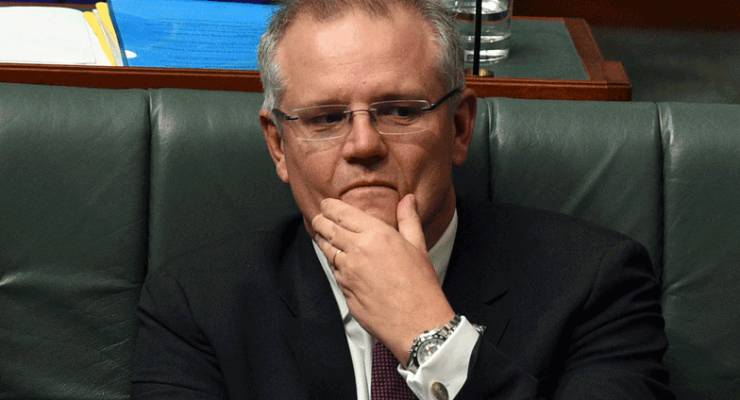
The fact that last week Malcolm Turnbull and Scott Morrison in effect distanced themselves from their own tax cuts by emphasising how small and medium businesses would be the beneficiaries while multinationals would have to wait three elections was evidence that Labor’s campaign against the cuts has been biting — much as Labor’s campaign on increasing the GST forced Turnbull to back away from that over summer.
But along the way, Treasury’s credibility has also been dealt a blow. Its own modelling admits to modest economic benefits from the proposed tax cut (1.2% of additional GDP over decades), but Australia’s best economic commentators have taken aim at both the modelling and the government’s policy — Peter Martin, Ross Gittins, John Daley and, on Friday, a forensic savaging of Treasury’s assumptions by the ABC’s Stephen Long.
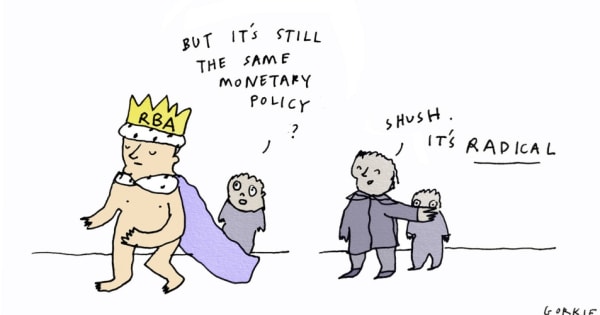
That Treasury only offers modelling as evidence of the benefits of corporate tax cuts, when real-world evidence is potentially available from other countries, reflects an important characteristic of Treasury’s position: it is an ideological one, not one based on empirical experience. Treasury, after all, has seriously put forward corporate tax cuts as a solution to the problem of corporate tax evasion — requiring companies pay less is their idea of reducing the amount of tax lost to companies avoiding tax.
The mainstream media (well, outside News Corp) is becoming increasingly sceptical of private economic modelling, and increasingly willing to challenge the claims of vested interests pushing bespoke modelling. Treasury was always supposed to have greater credibility and authority. But its rigid ideological support, in the face of real-world evidence, for company tax cuts is undermining that authority. Treasury might discover that, in the course of one of Australia’s greatest tax scams, its own credibility has been stolen as well.




It’s amazing how many people think companies employ workers out of the goodness of their hearts (the fundamental assumption underlying the argument that lower taxes == more employment) rather than as a response to demand.
That’s been my fundamental point for some months now DrSmithy. Businesses invest only for the purposes of making more money, not out of some social welfare program. It is a business decision, not a welfare decision, and tax rates have little effect on whether business will invest in a money making venture or not.
The whole debate is a non-sequitur. Has always been.
Doc – I doubt that anyone is so deluded as to believe that but the weird thing is that they pretend to believe such guff.
As if it were a sign of …virtue?
It’s the underlying premise of good old trickle-down economics, and there are people who _fervently_ believe that’s a good idea even though its direct benefits to them are small to nonexistent.
I believe we even have a few such posters here. 😉
Yeah, I was wondering where OneHand has been lately. Have we reached Peak Political Idiocy and his work is done?
Well, Henry Ergas of the Australian is in favour of the company tax cut so that’s decided me. I’m definitely against it.
He claims that it’s irrelevant that a lot of the benefit will go to foreign shareholders. He claims that foreign investors insist on a given rate of return after tax. If company tax is relatively high in comparison to other countries, then the income necessary to make up the returns to the necessary levels has to come from somewhere – and Ergas claims it comes from wages and salaries of employees who are paid less than otherwise.
So he argues that if company tax is reduced, then employees will be paid more, so he claims that a company tax costing $8.2 billion (I assume per year – he doesn’t specify) will give a consumer benefit of $4 billion. Or $8.7 billion. Or whatever. The figures appear elastic. Some of the rubbery figures I suppose are increased wages. And other are increased dividends.
I suspect the investors will get most of the $8.2 billion (with some clawed back from Australian shareholders as a result of the reduced franking credits in dividend imputation) and the directors and executives will get a few hundred million or perhaps a billion in increased remuneration (as usual).
I doubt that companies will increase employee numbers in order to ‘grow’ unless they can see that it will increase the profits. Otherwise, they’ll just keep the money.
Employers increasing wages just because they’re nice ?
That’s even sillier than the idea employers will put on more workers just for laffs.
These comically incoherent ideas probably brought to you by the same people who think removing negative gearing will increase rents.
Does Morrison’s Snake-oil work on bunions and dandruff?
Go Klewso…spot on as usual.
This is Malcolm and Scott lying on a breathtaking scale, and a priority for Labor when they take office is to restore independence at Treasury.
Who is the head of Treasury now?
The really key point in all this is ‘why is Treasury backing and financing bullshit modelling to support bankrupt ideological policy’?
Treasury used to be, as all public service is supposed to be, impartial advisers, not boosters of lunatic ideas.
So that leads to the question that really needs asking, and Bushby Jane has just asked it!