
On the evening of June 3 and early morning of June 4, 1989, the Chinese leadership sent tanks into central Beijing to murder and maim its own citizens rallying for more freedoms; along the way, the hardliners deposed liberal-minded premier Zhao Ziyang and purged many party members in the aftermath.
Prime minister Bob Hawke, in one of his finer moments, stood up. Acting on instinct, he tearfully offered 42,000 Chinese students studying in Australia, at that time, asylum.
On June 4 this year, the 27th anniversary of one of the signal events that shaped the China we know today, the country is less democratic, more authoritarian and, these days, increasingly bleak. This year the current PM said precisely nothing.
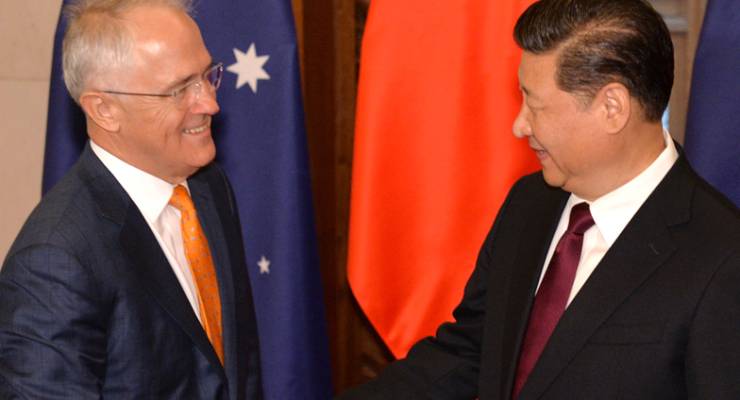
This is the latest illustration of Canberra’s — and Australia’s in general — increasingly fractured and, frankly, strange relationship with its largest trading partner and regional hegemon.
Elsewhere around the region, things were different. In Hong Kong it has become an annual ritual, and more than 100,000 people gathered for a candlelight vigil on Saturday night, a number organisers said was only 10% down on last year despite student groups holding different rallies elsewhere in a city that has been feeling the unwanted warmer embrace of Beijing in recent years.
And it took Taiwan’s recently installed new President Tsai Ing Wen, the leader of the country most in danger from China, physically and potentially economically, to say what countries like Australia should be saying to China, openly and often — and particularly on June 4. (China has thousands of missiles trained on Taiwan and not only maintains the pretence that it is not an independent country but bullies most of the rest of the world into mouthing the same fiction).
“As a president, I’m not finger-pointing at the political system on the mainland, but sincerely sharing the experience of the democratisation of Taiwan,” Tsai said on Saturday in her first statement about the crackdown.
“If the mainland could give the people more rights, the world would pay it more respect.”
And by the way, Chinese living in Australia or Chinese-Australians who rely on the Chinese language press in Australia would not have been reading, hearing or seeing anything much of the anniversary of the Tiananmen Square massacre as the Chinese Communist government controls large swathes of that sector, as noted by Swinburne University Professor John Fitzgerald.
Bob Hawke’s decision did precisely nothing to affect Australia’s then-nascent but burgeoning trade relationship with China, yet ever since Kevin Rudd’s name was effectively placed on the shit list by Beijing after lecturing the Communist Party on Tibet, Australian politicians have been spooked at mentioning the “Three Ts” (Taiwan, Tibet and Tiananmen) or other human rights issues.
Yet the Abbott and Turnbull Coalition governments have been more aggressive than most in the region at arcing up about China’s aggression in the South China Sea. The third piece of this disconnected and unco-ordinated policy responses to China is is the ongoing, relentlessly bullish attitude towards doing business in China. Exhibit A was the recent caravan of 1000 Australian business people flocking to a country that would chew up and spit out most of them if they set up shop there.
The news was pretty much all good. Yet, apparently, while China is a country that is becoming dangerous to regional security, the clear message from government and Australia’s generally know-nothing (about China) big business community, the Business Council of Australia, etc, is that China is brimming over with opportunity.
The government’s alleged financial brains trust, Treasury, once again got its China-related forecasts in the budget completely wrong, and this will punch another multibillion-dollar hole in the budget that will make the long-term repair job stretch out into eternity. Perhaps this is no surprise, Turnbull’s public service chief, Martin Parkinson, was in charge of forecasting for Treasury in the China boom years, when Canberra got China wrong on the downside. Now he seems to be balancing his overall record.
What rarely gets mentioned at any serious policy discussion level is the serious trouble that the Chinese economy is now in, loaded up with ever-increasing amounts of debt by a government that has lost its grip on the economy. In the opinion of most serious economists, China is heading for a serious recession and probably a lost decade or two. But you won’t be reading that in any election policy platforms.
Yet the growing anti-Western attitudes of China, led by its leaders and fomented by its propaganda department, are squarely laid out in its aggressive policies in the South China Sea.
Australia appears to accept this reality and is preparing by way of the defence white paper and strengthening alliances with a range of nations in the regions. Yet on the other hand, where, arguably, it matters more — in the economy and top business — Australia lives in cloud cuckoo-land.
As the Chinese Communist Party showed on June 4, 1989, there are actually no rules, no laws that can be relied on and no guarantee that things won’t change overnight. That is as true in China’s attitude towards economy and business as it is in its repressive, cavalier attitude towards human rights. Nearly three decades after the Tiananmen Square massacre, nothing much has fundamentally changed in China, yet Australia lives under the delusion that some of it, somehow, has.

There is another China issue that is not yet receiving much attention. It concerns the damming of the Mekong River and the consequences of low flow to all of the countries downstream. Myanmar, Thailand, Laos, Kampuchea and Vietnam all depend on Mekong flows and, with the El Nino causing extreme drought in parts of these countries, dependence is even greater when there is so little rain as all are wet rice cultivating countries needing reliable water supplies. A future in which these countries are forced into submission by insufficient water to feed their peoples is not far-fetched.
Not unlike Turkey’s action and plans for the Two Rivers of Mesopotamia.
Not for the first time Mr Sainsbury gives vent to his ignorance and prejudices to present an inaccurate account of what allegedly transpired at Tiananmen Square 25 years ago. such ignorance does nothing to establish good relations between China and Australia and in fact has the opposite effect.
Likewise with Mr Sainsbury’s wholly ignorant representation of the South China Sea as an example of Chinese “aggression.”
This is not reporting Crikey. It is not even intelligent commentary as Mr Sainsbury is so obviously consumed by his bigotry that it totally clouds his judgment.
China is far too important a figure in Australia’s future to have its policies and actions portrayed in such an appalling fashion.
Apart from his dreary prose ” …China, led by its leaders “, Sainsbury strikes me as being so far down Langley’s fax list that the script is pretty thin by the time he wields his magic marker… err pen.
As James O’Neill points out, there is a back story to the alleged ‘massacre’, which was widely known even at the time – but of course, to this day, you’ll never hear those facts from the faux liberal Australian MSM, as they bow & scrape to the US State Department line on China.
Sadly nothing will change until the economic blackmail exerted by the US on Australia,
This far right wing dross by Michael Sainsbury is not worthy of a disinterested Chinese geopolitics 101 student – can’t Crikey come up with a reliable China watcher outside the US/DFAT orbit?…this coverage is very disappointing.