
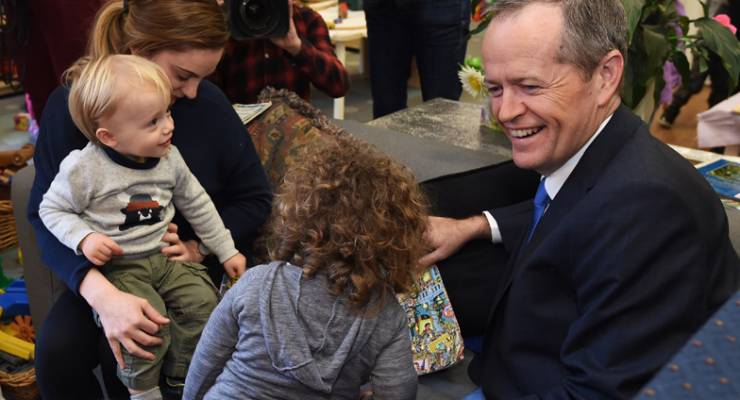
While Labor’s childcare policy announcement yesterday is cannily targeted at working families with young kids — and with the policy overlay of encouraging women back into the workforce — it might have been the first serious misstep of the opposition’s campaign.
The Coalition has been trying to combat Labor’s health and education spending commitments by asking where the money is coming from — despite its own claims of a black hole blowing up in Scott Morrison’s face. Labor’s policy — a re-working of the Coalition’s policy to lift funding for lower-income earners and start earlier — comes with a $3 billion-plus price tag. Labor insists that the policy — which is within the same funding parameters as the government’s, is fully funded, except that Labor opposes the Family Tax Benefit cuts that the government is using to fund its package.
The fine detail of which chunks of money need to be moved around to fund which policy probably won’t cut through with voters. But the fact that Labor keeps making large promises — Medicare, the Pharmaceutical Benefits Scheme — plays into the Coalition’s claim that Labor is happy to spend up big without explaining where the money is coming from.
The Coalition, of course, has exactly the same problem with its $50 billion company tax cut, which won’t be offset with any other tax rises or identified spending cuts — indeed, the government plans to put tens of billions on the national credit card with its ramping-up of defence spending, topped with a premium of billions more to build Royal Australian Navy vessels here. None of that is funded — but then no one ever bothers to ask how defence spending is funded.
Labor has promised to offer a full accounting of its policies well ahead of the election — something the Coalition refused to do either in the 2010 or 2013 elections (as it turned out, the Coalition could never have kept its 2013 promises without blowing a huge hole in the budget anyway, so it simply ditched many of them after the election). But if you look at the television coverage of the childcare announcement last night, the issue of their funding is given equal billing; Seven in particular contrasted the general nature of the Coalition’s campaign promises, which tended to be in the millions, with Labor’s multiple billion-dollar announcements.
Voters with small kids facing a daily struggle finding the right childcare options and having some money left over from their wages after paying for it might not be overly interested in how Labor’s policy will be funded. But the issue of costings is becoming a weakness for Labor, and the government will keep hammering it. That full accounting of policies can’t come soon enough.


Bernard,
What MSM do to Labor’;s policies and the attacks they make on their “lack” of funding is hard to counter with anything, but the Insiders show on ABC showed very clearly that you cannot expect an overall posting of policies until they all announced and the PBO assesses the claims put forward by Labor. The call for early demonstrations of their funding were dismissed with a shrug. I would have though that you would have known what the situation is Bernard but no doubt there are temptations to following MSM, who want to have Turnbull elected and will no doubt use all means to achieve that result.
The problem is that we will have a man elected, who undoubtedly shows proper bearing and love for the job of PM, but who is also no doubt pretty ignorant about the workings of real capitalist market economies, as many officials in Treasury are. This man will offer an austerity program, which has failed miserably in the EU. He will offer nothing required for jobs and growth, which calls for borrowings of bonds at record low interest rates for investment in infrastructure, which gets progressively run down under austerity budgets, and a recognition that education and health can only properly work to give people opportunity and dignity if they are publicly funded (in real world capitalist market economies)
Good assessment.
All the media talk of funding, or lack thereof, is a waste of time. The lie that the Coalition are the responsible money managers has been discredited long ago, but is still perpetuated by vested interests, who wish a return of the status quo.
correction “a return of the status quo”.. sorry.. meant maintain the status quo.
“The fine detail of which chunks of money need to be moved around to fund which policy probably won’t cut through with voters.”
Not unless it has a direct impact, and in the case of childcare, we aren’t idiots; we see that cuts to FTB B in order to fund increases in childcare is a reprehensible attack on the most vulnerable and once again, not even addressed by the media. Childcare is a “productivity” measure while FTB is a “welfare” measure. I guess because they still largely fall into the bucket of family/women’s issues they can be played off against each other. I thought Shorten’s statements (to paraphrase) that “it is the second income” and “workers rely on their wives to organise childcare” – seriously WTF????
That was the fail, right there.
Fairly easy to argue that this is part of Labor’s jobs and growth strategy, and more directly linked to actual jobs and growth than some off in the neverland benefits of hugely expensive company tax cuts.
And while true that the public may be gulled into worrying about Labor and billion dollar programs, this one might actually cut-through that because it directly affects hip pockets of mums and dads (plenty of them out there, mini baby boom still happening) but also because it is good economic and public policy, giving people a reason to vote with their hip pocket.
Very hard to know whether this one will play well for Labor or LNP. I doubt that anyone has the capacity to call it, and young parents are more likely to ‘swing’ in their votes due to their changed personal circumstnces, than young unmarrieds and older settled types.
If Labor have no ultimate comeback to how they will fund programs that might well be crucial, but if they have any brains the last weeks of the election period will be all about that, more likely with us actually paying attention.