
Looking for a clear policy difference between the parties? Culture could be it.
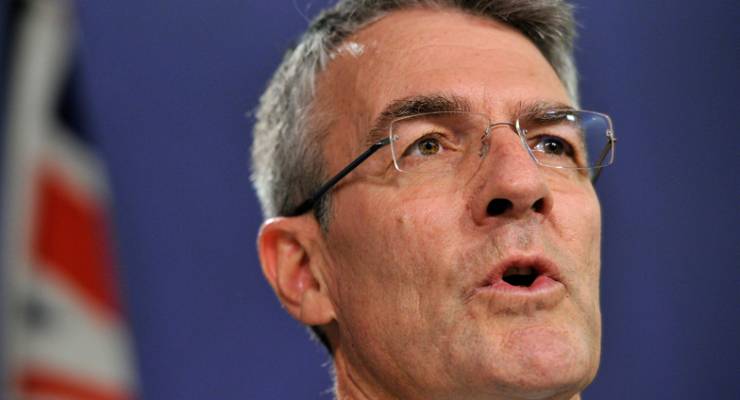
Labor’s Bill Shorten and Mark Dreyfus launched Labor’s arts policy on Saturday at Melbourne’s Malthouse Theatre.
It was a surprisingly enthusiastic affair. Shorten appears to have a genuine passion for the portfolio, which contrasts to the indifference shown by former PM Julia Gillard. There was a good turnout for the event, too, with Labor faithful mingling with Melbourne cultural figures, including pianist and artistic director Paul Grabowski, who was given a prime spot in the audience sitting next to the Shorten family. Opposition spokesman for the arts Mark Dreyfus also had an iconic musician in the audience: his dad, George, a well-known composer.
In his speech, Shorten lent heavily on his friendship with the late Bob Ellis, a figure now firmly fixed in the Labor pantheon. “Bob would have loved this gathering of the great and the good,” Shorten confided, “the snap and the crackle of talent and intellect, the chance to tell some tall tales and say some outrageous things.”
“Bob often used to talk about a person’s ‘hinterland’,” he continued. “A great Australian word for an intangible sense of curiosity … of intellectual depth and cultural breadth, of a rich and varied life of the mind.”
If this sounds decidedly un-Shorten-like, well, think again; Shorten’s embrace of culture consciously harks back to the grander visions of Labor greats like Gough Whitlam. In an election campaign that has been sorely missing “the vision thing”, here was a policy speech in which a major party leader really seemed to care about what he was pitching.
“Mark Dreyfus and I are here today because we believe in the arts, and we believe government should invest in the arts,” Shorten intoned, to a round of cheering from the faithful.
So what’s in the policy? Labor’s arts statement is largely a repair job, but will be all the more welcome within the cultural sector for that. Widely hated former arts minister George Brandis came in for plenty of stick, with Labor promising to reverse the government’s loathed Catalyst program and return unspent funds to the Australia Council. In addition, Labor has committed to an extra $80 million for the council over the forward estimates. According to my calculations, this should return around $105 million to the Australia Council should Labor be elected.
There was also a promise to spend $60 million on new Australian drama to air on the ABC. Other promises included $8 million for regional arts, $2.35 million for music in schools, $5.4 million for the highly successful Sounds Australia program (including a funding renewal for the National Live Music Office) and $5.6 million for community radio, which has been hurting from cuts to digital transmission in the May budget. All up, by my calculation, Labor’s cultural policy commits to $161 million in new funding for culture.
In a nod to the unrest in the publishing sector over the Productivity Commission’s recent copyright report, Shorten also promised that Labor would consult over any changes to copyright regulations such as reducing the term of copyrights or parallel importation for books.
Perhaps the really encouraging thing for artists was Shorten’s symbolic commitment to culture. In the doorstop media conference after the launch, he strongly defended spending on the arts as an “investment”, rather than simply a cost.
Labor’s policy is not as generous as the Greens’ cultural statement, which was roundly applauded by the arts industry. The Greens’ Adam Bandt last week pledged $270 million in new funding, particularly targeted at smaller companies and individual artists, with some welcome support for the national collecting institutions.
All told, the Greens have committed $219 million extra to the Australia Council over the forward estimates, which presumably they will try to negotiate for with a hypothetical balance of power. There was also some clever policy work around advocacy, with the Greens wanting to spend $1 million on a new national advocacy body for the arts, $5 million on a body to replace the ill-fated Book Council, and a commitment to inaugurate a National Arts Week.
But while Labor’s cultural policy is slightly less generous than the Greens’, both the left-of-centre parties stand in glaring contrast on culture to the Coalition. So far, we have no policy or promise of any kind from the Liberal or National parties on arts and culture.
Maybe there simply won’t be any. The Coalition didn’t take an arts policy to the 2013 election either, and arts funding of any sort is opposed by the right of the Liberal base. As Shorten admitted on Saturday, culture rarely decides elections. But the havoc wreaked on arts and culture by the Abbott and Turnbull governments has mobilised a previously quiescent industry.
Liberal Arts Minister Mitch Fifield has been conspicuous by his low profile during the campaign so far. Given that his portfolio encompasses a struggling National Broadband Network and a hostile cultural sector, we can perhaps understand that.
But Fifield won’t be able to hide for too much longer. He’s scheduled to appear alongside Bandt and Dreyfus at a national arts debate at Melbourne’s Wheeler Centre on Wednesday.
It will be interesting to see whether Fifield uses the opportunity to announce a 2016 arts policy, or whether the Coalition continues to ignore culture, in the hope that swinging voters don’t care.

Actually “hinterland” is a German word. The Australian expression is “the outback”.
hinterland to me is like the gold coast hinterland – the rural mountains just out of the city
Like ‘kindergarten’ and ‘delicatessen’.
Gesundheit!~
“Liberal Arts Minister Mitch Fifield has been conspicuous by his low profile during the campaign so far. ” And Brandis has been wearing his invisibility cloak day and night for a month now.
Good point. He had certainly slipped down my memory hole.
Now you’ve reminded me that he exists which is not nice.
Brandarse that is.
I had not previously known of the existence of Fifield and have no need change that status.
Good news and good on Crikey for reporting it. Haven’t noticed it mentioned anywhere else. Probably because the Coalition is right: nobody cares.
Labor, be it with arts policy or anything else usually “brings passion, vision to election” debates.
The passions are often misguided and the visions disastrous, but steadfastly they continue to do this, because we’re a Party full of people who care deeply.
Even the Crikey Commissariat censor knows this.
I thought Journalist being writers would be really interested in the arts! And being Journalist’s they would be researching a subject! The Greens and Labour are responding to the elephant in the election room. The ARTS PARTY (yes! we have one in Australia created by creative people fed up with attitudes of all political parties ) The Labour policy is pathetic and like the Greens is a reaction to try and stop the the arts party getting a foot hold. Nip the artists in the bud! Well there is some really simplistic thinking going on here! “The arts are to be enjoyed by all Australians! WHAT AUSTRALIA’S CREATIVE THINKERS AND PRODUCERS ARE JUST A BUNCH OF ENTERTAINERS! JUGGLERS AND CLOWNS IS WHAT IS BEING IMPLIED HERE. (NOT THAT I HAVE ANYTHING AGAINST JUGGLERS AND CLOWNS DO A BIT OF JUGGLING MYSELF GOOD FOR THE MIND YOU KNOW!) PHEW Caps lock off! NOw look here CRIKEY lets shift this up a gear “the ARTS” arena is not just entertainment. Design, Architecture, are part of the arts and it we shift our thinking out of the trough into thinking clearly about creativity and the nexus between Design and industry the development of computing would be diabolically died without the visual arts. Gaming design engineering have all developed out of the creative thinking of artists And what is the definition of an artist ???? come on I expect better from CRIKEY am at the point as to whether to subscribe?? better lift the game Rodney Scherer HYBRID ARTIST