
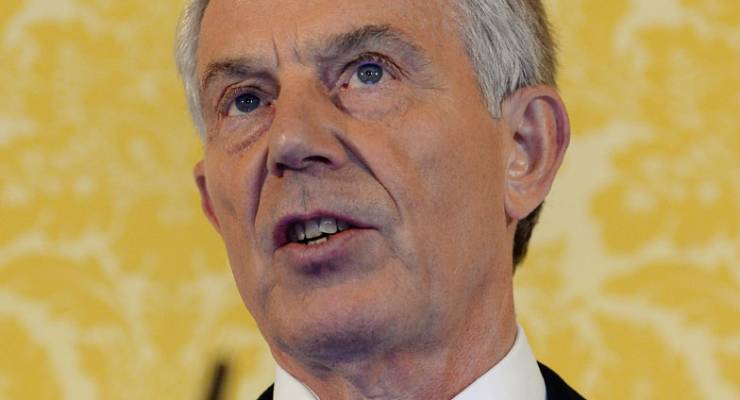
Among many other elements of the Blair government’s decision to join the invasion and occupation of Iraq, the report of the Chilcot Inquiry provides forensic detail about not merely how the Blair government was warned it would increase the threat of terrorism, but that it ignored that warning because of a commitment to making a political point.
While the inquiry report shows the flawed intelligence process that led to false claims about Saddam Hussein’s weapons of mass destruction stockpile, and the political process that led to Blair hyping the threat of those WMDs, it also details the specific risks judged by British intelligence agencies relating to terrorism, those WMDs and their potential use by terrorists or Hussein himself against the West.
The main form in which these judgements were conveyed to Blair and his government were Joint Intelligence Committee assessments — reports prepared by a cabinet office committee composed of the heads of MI6, MI5, the surveillance agency GCHQ, Defence Intelligence and Defence, Foreign Office and other senior bureaucrats, chaired by a permanent head (usually a former senior intelligence officer); representatives from the CIA and Australian, Canadian and New Zealand intelligence services may also participate in the group. The committee has its own assessments staff as well as the material provided by the three collection agencies.
The assessments provided by JIC on terrorism in the lead-up to the attack on Iraq make for damning reading. JIC advised Blair that there was little chance of Saddam Hussein co-operating with al-Qaeda. In November 2001, JIC advised “Saddam Hussein had ‘refused to permit any Al Qaida presence in Iraq'”; “evidence of contact between Iraq and Usama Bin Laden (UBL) was ‘fragmentary and uncorroborated'” and that “we judge it unlikely … There is no evidence UBL’s organisation has ever had a presence in Iraq”. There was, according to JIC, “no credible evidence of covert transfers of WMD-related technology and expertise to terrorist groups”.
In early 2003, JIC told Blair “despite the presence of terrorists in Iraq ‘with links to Al Qaida’, there was ‘no intelligence of current co-operation between Iraq and Al Qaida'” and that “Al Qaida would ‘not carry out attacks under Iraqi direction’.”
What about Saddam himself? Would he launch terror attacks against the West? In 2002 and again in 2003, JIC assessed “Saddam’s ‘capability to conduct effective terrorist attacks’ was ‘very limited’ and Iraq’s “‘terrorism capability’ was ‘inadequate to carry out chemical or biological attacks beyond individual assassination attempts using poisons’.”
Afterwards the head of MI5, Baroness Eliza Manningham-Buller, said that this assessment of Saddam’s minimal capacity to launch terror attacks on the West had “turned out to be the right judgement”. However, JIC did warn beforehand that attacking Saddam would increase the possibility of a terror response, even if his capacity was limited. He would “… aim to use terrorism or the threat of it. Fearing the US response, he is likely to weigh the costs and benefits carefully in deciding the timing and circumstances in which terrorism is used.”
But what about in the future? Could Saddam Hussein develop a capacity to launch terror attacks at the West using WMDs? Again, intelligence agencies disputed the possibility:
“Asked specifically about the theory that at some point in the future Saddam Hussein would probably have brought together international terrorism and weapons of mass destruction in a threat to Western interests, Baroness Manningham‑Buller responded: ‘It is a hypothetical theory. It certainly wasn’t of concern in either the short‑term or the medium‑term to my colleagues and myself.'”
So, Blair was told by intelligence agencies there was little threat of Saddam launching terror attacks on the West or of him working with al-Qaeda to do so — but attacking him would increase that threat, albeit within his limited capacity.
But intelligence agencies also made assessments about the broader consequences of an attack on Hussein. According to the report, in February 2003, JIC warned Blair that “Al Qaida and associated networks would remain the greatest terrorist threat to the UK and its activity would increase at the onset of any military action against Iraq”.
Moreover, the removal of Saddam Hussein would increase the risk that any WMDs (which fortunately turned out to be fictional) could fall into the hands of terrorists. This was the JIC advice Blair got:
“Al Qaida and associated groups will continue to represent by far the greatest terrorist threat to Western interests, and that threat will be heightened by military action against Iraq. The broader threat from Islamist terrorists will also increase in the event of war, reflecting intensified anti‑US/anti‑Western sentiment in the Muslim world, including among Muslim communities in the West. And there is a risk that the transfer of CB [chemical and biological] material or expertise, during or in the aftermath of conflict, will enhance Al Qaida’s capabilities.”
The following week, JIC repeated the warning to Blair, then repeated it again in March. The report states “Baroness Manningham‑Buller subsequently added [in her evidence to the inquiry] that if Ministers had read the JIC Assessments they could ‘have had no doubt’ about that risk.”
This is chilling reading. As Crikey and many others have been pointing out for years, Manningham‑Buller told the inquiry that they knew afterwards that attack on Iraq led to to an increase in the terror threat to the United Kingdom. She told the inquiry:
“I think we can produce evidence because of the numerical evidence of the number of plots, the number of leads, the number of people identified, and the correlation of that to Iraq and statements of people as to why they were involved … So I think the answer to your … question: yes.”
But now we know in detail that intelligence agencies before the attack repeatedly warned of exactly that outcome, without the benefit of hindsight. Why did Blair not heed that advice? In his statement to the inquiry, he said: “I was aware of the JIC Assessment of 10 February that the Al Qaida threat to the UK would increase. But I took the view then and take the same view now that to have backed down because of the threat of terrorism would be completely wrong … There are ample justifications such terrorists will use as excuses for terrorism.”
Blair’s second point can be disposed of quickly: terrorists can always find justifications for their attacks, yes — the issue was the increase in their ability to recruit willing supporters to help them conduct those attacks that is the key issue, and the attack on Iraq acted “as a recruiting sergeant for a young generation throughout the Islamic and Arab world”.
Which leaves his first point: he deliberately ignored repeated advice that he was increasing the risk of terror attacks on the West in order to make a political point about “not backing down” — a point all the more absurd given repeated advice that Hussein posed minimal terror threat to the West anyway.
There are many far worse consequences of this illegal, immoral war: hundreds of thousands of dead Iraqis (the allies who invaded Iraq, Chilcot notes, didn’t bother keeping any accurate record of civilian casualties), over 4000 US personnel, 179 UK personnel dead, the scores killed in post-Iraq terror attacks in Western cities, hundreds of thousands of allied personnel and Iraqis injured, an estimated long-term cost of US$4 trillion, the rise of Islamic State, the dominance of the Iranian regime over Iraq. But the invasion didn’t even succeed on its own terms — it was a “strategic failure”, as the report notes — because it never could have succeeded. The advice to Blair was that Saddam posed a limited terror threat, even with WMDs, and removing him would increase the risk of terrorism. Blair went ahead in full cognisance of that and helped remove him. He has a sea of blood on his hands, along with his co-conspirator George W. Bush and vassal state leaders like John Howard who obediently fell into line with the attack.
The most important duty of a political leader is to keep his or her nation safe. Blair, Bush and Howard made us less safe. The Chilcot Inquiry demonstrates how they did so wilfully.

The allies after the Second World War tried and executed Nazi leaders for waging war. Bush, Blair, Howard, et al ought to be subject to war crime tribunals for waging illegal war.
If he is genuinely remorseful, well I doubt if that matters either, they knew the consequences, what would I have done in the same circumstances, well I would have been kicked out of parliament, they would have put in some one that would go along with the whole charade, and I would have lost money and my powerful position. Not sure if peer pressure is worse amongst the wealthy and powerful but i expect it is, it’s part of the glue that keeps them togeather.
Blind Freddy could have seen that the invasion of Iraq would be a disaster which was why so many Australians rallied at the time to protest John Howard’s decision to get Australia involved. All you had to know was how fragmented the country really was, held together by a dictator, and that if he was removed, the whole place would fall apart and create the opportunity for terrorist groups to move in. It was obvious before the invasion that this was what would happen
As important as a Chilcot-type enquiry might be, I think that an important question is being sidestepped and even masked- that is, if Blair, Bush etc were lying about WMDs, why were they so keen to invade? After all, Saddam might have been a brute, but no worse than lots of other brutes in the Middle East and elsewhere.
The clue, which was described in some detail in an article in the AFR in late 2002 (I can’t locate the exact reference), was that it was clear that the decade-long disastrous embargoes were going to be lifted soon and many countries (including France as I recall), were busily negotiating oil supplies from Iraq post-embargoes. The problem was that most of these deals were denominated in Euros, not US$. This was seen as a disaster for the US economy, which invasion and prolonged disruption would resolve.
Naturally, this view has not been given much airing and then it has been labelled paranoid. It is the only explanation that makes sense.
I do remember that when Iraq switched from using US$ to Euros in about 2002 it was almost immediately followed by a very sharp ratcheting up of war talk. I am sure that was one driver.
But I think even more than that, and this is as silly as it is tragic, for 12 years before that, Iraq has been the “punching bag” for the US. The country that got hit with bombing raids whenever the current US president needed a popularity boost or a distraction. The 91 Gulf didn’t end up as planned with the removal of Saddam Hussein. I think the overwhelming driver was that the US administration thought this was an easy way to look good and finish off a job. It’s terrifying, but we went to war and killed hundreds of thousands of people because it was easy. Or at least that’s what those incompetent criminals thought.
An irresponsible ego-maniac matched only by his peers in the “Coalition of the Shilling” – with their own “Comical Ally” in Murdoch with his FUX/Limited News to look after PR/propaganda – embedded, to take care of what got out.