
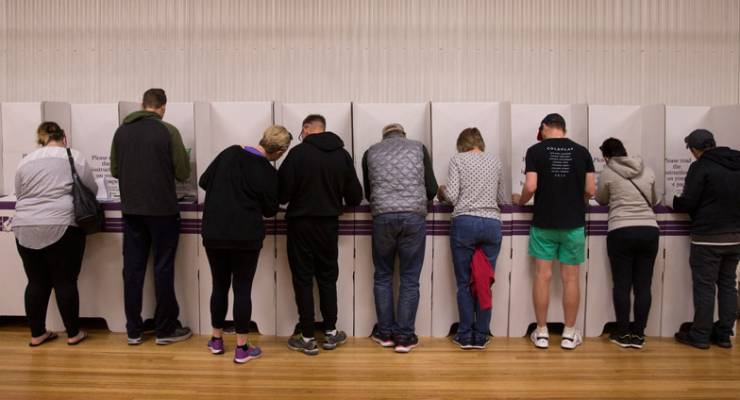
In many seats around Australia, the number of informal votes was higher than the number of votes that decided the margin in the electorate. Areas with higher migrant populations, as well as poorer electorates, recorded higher numbers of informal votes.
The marginal seat of Lindsay had the highest number of informal votes in the country, with 11,756 votes not counted. Labor’s Emma Husar took the western Sydney seat from the Liberals’ Fiona Scott with a margin of 1683 votes.
The seat in Australia with the lowest number of informal votes was Kooyong, in Melbourne leafy eastern suburbs, where just 1738 votes were recorded as informal. It’s a safe Liberal seat, held by Energy and Environment Minister Josh Frydenberg.
The six seats with the highest percentage of informal votes are all in New South Wales, including Blaxland, Watson, Fowler, McMahon and Parramatta. The seat of Herbert, where Labor’s Cathy O’Toole edged out Ewen Jones by 37 votes, recorded 6444 informal votes.
Informal votes include votes that have been left blank, scribbled on (but otherwise left blank), or incorrectly filled out, meaning that some of these informal votes could have been done by accident. Others ignore the correct process in protest or apathy.
Across the country, the rate of informal votes for the 2016 federal election was 5.03%, a lower rate than at the 2013 election, by 0.88%. That election had the highest rate of informal voting in 30 years, at 5.91%.
The turnout level has hit a new low, however, with more than a million people not bothering to vote at all. Across the country, the turnout rate was 91%. In the Northern Territory it was 79%. Tasmania had the highest turnout rate, at 93.57%. The NT also had the highest rate of informal votes, at 7.35%, with the Australian Capital Territory recording the lowest percentage of informal votes, at 2.76%.
In Queensland, seats like Forde, Capricornia, Longman and Flynn were decided by fewer votes than those recorded as informal. Cowan in WA, Hindmarsh in SA and Batman, Chisholm, Melbourne Ports, Dunkley and La Trobe in Victoria are also on the list.
Professor of politics at the University of Adelaide Lisa Hill says that in this election there has been a higher rate of informal votes for those voting above the line in the Senate, while the rate of informality for those who voted below the line has gone down, reflecting the level of complexity in Senate voting.
Hill says unintentional informal voting is highest in areas with “high concentrations of new migrants, people with lower levels of education and less money, where people have a lower level of literacy and numeracy competence”.
This isn’t an argument against compulsory voting, she says, but one for better voter education. “We know that when the AEC targets those people with education campaigns, they are really effective. They’re people that are trying to cast a vote, they aren’t confused about who they want to vote for, they are actually very sure of who they want to vote for.”
Complexity of voting protocol, confusion between different voting systems at a state and federal level, and English as a second language are all factors that inhibit people from voting correctly, Hill says.
“A lot of people say that we shouldn’t have compulsory voting because then you are likely to get more politically uninformed voting, but this is not true; we know that in compulsory voting regimes people have better levels of political knowledge than in voluntary systems. It causes people to go out and educate themselves.”
“In compulsory voting regimes people have more respect for the law, because they actually voted for the law makers; people also have more satisfaction with the way the democracy is working.”
“There’s less wealth inequality and more wealth distribution in compulsory voting regimes, and governments are more responsive to what people want,” Hill said.
The change to the Senate voting system is an example of the government responding to public opinion, Hill says.
Intentional informal voting is a different kettle of fish to unintentional formal voting, and over time the AEC has recorded what, exactly, people do when they lodge a ballot paper that will not count towards the election result. In 2010, blank ballots made up 28% of informal votes, taking over papers that had only a number one. The AEC also measures whether people write a profanity or not, and whether it’s politically motivated.
In an election in which the government has just a one-seat majority in the lower house, the number of informal votes, as well as the lack of turnout, shows that every vote really does count.


Lisa Hill’s observations in favour of compulsory voting certainly strike me as plausible, and I have to confess are very much in line with my own thinking. The self evident unarguable case, impaired slightly only by the degree to which the ‘donkey’ vote is real (and it is – but the impact is a few percent in most cases) is that voters overwhelmingly demonstrate they have a preference – to the tune of 94%. Still, I would love to have Lisa set out in Crikey exactly the evidence her observations are based on. Over to you, Lisa.
Hi Nereus. The so called donkey vote is contentious, as your comment implies. I feel it should still be classed as formal because it can express a true preference in electorates with only a few candidates. The list in my electorate this time was quite long, with a dozen or so, but I have voted in elections that only had a choice of three. I was a scrutineer for a booth in this election and saw that quite a few people only wrote up to six numbers, suggesting confusion with the new senate system. I would be interested to see any breakdown between what could be construed as accidental informal and the clearly intentional.
Maybe the majors could do something new and innovative, like give us someone/something to vote for …. rather than endorse their “static quo”?
Perhaps we could learn something from the Russians, who until not so long ago included an “Against all” box on their ballot sheets. This might catch some of the informal votes as well as giving the politicians some honest feedback. (Unfortunately, Vladimir Putin removed this option from the paper not so long ago after “Against all” won in three districts in 2003: http://imrussia.org/en/politics/646-against-all-and-for-the-kremlin)
What happens when “Against All” gets the most votes ? How could a legitimate Government possibly form ?
Good question. No doubt that’s why Putin removed it from the ballot. He’d initially accepted it as a bait that would drain the opposition, but once the “Against all” vote began to win, he took the logical step of aboloishing it, which is a bit of a shame as it does send a stronger and more legitimate signal than simple informal ballots.
Having said that, I believe that the “Against all” choice has been resurrected for municipal ballots, but I’m not sure how it works when it wins. I’ll reread the article I linked more closely and see if I can make sense of it all.
In the USA they might refer to it as ‘None of the Above’ binding, forcing fresh elections in 30 days. It might also disallow the same candidates from running again, in that series. It’s a disincentive from running lazy campaigns and poor political performance. Ralph Nader has mentioned it from time to time.
Preventing individual candidates from running is a pointless endeavour in a party-driven system.
This is a topic that needs a far better article than this toe dipping.
There are many reasons for informal votes (apart from the usual 5% No Shows) and these are NOT the same as donkey votes which, unfortunately, are Formal – hi! Leyonhelm.
Interesting that Professor of politics at the University of Adelaide Lisa Hill is so up on compulsory voting regimes and the wonderful things that accrue thereon; I can only think of 3 – OZ, Belgium & Kazakhstan and they are not noted exemplars of her claims.
BTW, the biggest question from this Senate election is the number of people who put a single 1 Above the Line which then exhausts, the savings provision in the legislation having at least recorded it for the party so blessed.
If, as has been the case since the 80s, 5% don’t turn up, 5% cast informal ballots and the rusted-on nonsentients on both sides are under 40% then really our elections are decided by the most dangerous cohort of all, the 10% who are swinging voters who by definition are greedy (to want what is proffered), stupid (expecting to be given what is proffered)and utterly lacking in the smarts necessary to handle sharp objects, even the stumps of pencils in our cardboard polling booths.
Apparently another advantage of compulsory voting is that it makes ballot access fairer for any potential candidates.