
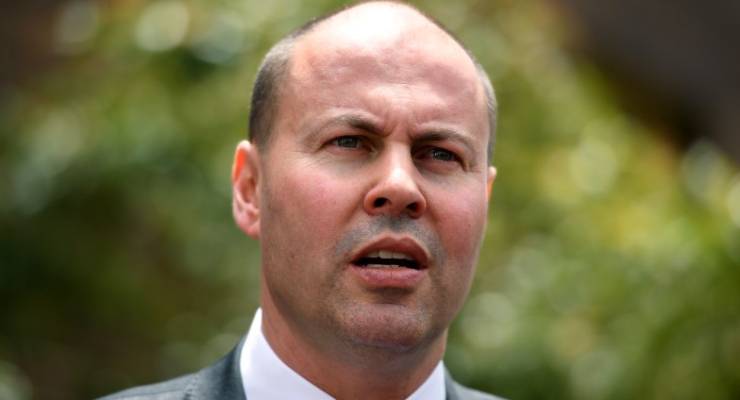
While budgets, and especially this one, are all about political theatre, to what extent did Tuesday night’s pitch from the government line up with the actual priorities in the economy? The overall answer is mixed-to-poor, but maybe not as poor as the government’s critics might think.
For the overarching and most critical economic issue facing Australia, climate change, it’s a definite fail. The government has no policy on climate change beyond its “soil magic” handout scheme, which is to be extended (Labor says it will kill it off). But you knew that already.
The most pressing short- and medium-term issue, wage stagnation, is another fail. Again, the government has no policy to address this, except to pretend wages growth will magically return in future years. That lie was particularly evident this year because the government continues to insist wages growth will shoot above 3% in coming years despite its forecast that unemployment would remain the same over the course of the Forward Estimates, at its current level of 5%. On the government’s and the Reserve Bank’s logic — i.e. that labour market pressure will drive wages up — why would wages growth increase if unemployment is going to remain the same?
So instead the government has a treat-the-symptom-not-the-illness policy of tax cuts aimed at low- and middle-income earners, using the low- and middle-income tax offset to boost household incomes. As economist Jim Stanford points out, the (maximum) $1080 offset payment that workers on up to $90,000 will receive (workers on lower incomes will receive much less) is a fraction of what they would receive from higher wages growth.
A small consolation, however, is that tax cuts at least may go some way toward signalling to disaffected voters that the economic-political system can work for them as much as it works for corporations and the wealthy — the kind of resentment that is driving voters away from the major parties toward more extreme groups.
Wage stagnation is a key reason for the other persistent economic problem, soft growth. After years of deficit spending by the Commonwealth and record-low interest rates, Australia’s economy is still growing below 3% and, despite strong jobs growth under Malcolm Turnbull, unemployment remains at 5%. We’ve become more reliant on jobs growth in the government-funded health and education sectors in recent years than before, especially as construction has peaked and begun to contract.
Here, the government’s tax offset plan makes a lot of sense: it will be delivering money to low- and (particularly) middle-income earners who are much more likely to spend the money than high-income earners (who will have to wait until the 2020s for substantial tax relief). And it’s certainly better than handing a tax cut to corporations, as the government wanted to do previously, given that would have leaked out of the country to foreign shareholders or been passed on via share buybacks and higher dividends to investors. The expansion of the instant asset tax write-off will also boost small and medium business investment — although remember that those firms need to have the money to invest in the first place before they can use it as a deduction.
Then there’s the persistent problem — part economic, part political — of the inability to deal effectively with high population growth, especially in Sydney and Melbourne. The government is fiddling at the margins on the permanent migration cap, while encouraging heavy inflows of foreign students and temporary workers, but the budget has a strong focus on increasing infrastructure spending to enable city transport networks to cope better.
One good thing about Scott Morrison is that he has continued Malcolm Turnbull’s commitment to Commonwealth spending in urban areas — something traditionally resisted by the Coalition, which saw such spending as favouring Labor electorates, when it preferred to spend in National Party electorates in the bush. That tradition has now gone by the board, hopefully forever, and the government has signed up to a substantial “congestion busting” program on urban infrastructure as well as supporting big-ticket projects. Like many government programs, its allocation will be influenced by political decisions — but it’s a start in enabling urban infrastructure to catch up with demand.

“.. that tax cuts at least may go some way toward signalling to disaffected voters that the economic-political system can work for them as much as it works for corporations and the wealthy..”
Really BK? This economic-political system can work for us? Is the electorate so gullible?
Alas, yes, demonstrably.
It is too kind/generous to describe the electorate as “gullible” – try greedy, grasping and dumb as a bag of rocks.
Bernard says,”Australia’s economy is still growing below 3% and, despite strong jobs growth under Malcolm Turnbull, unemployment remains at 5%.”.
Yes Bernard, you’ve suddenly woken up to pea and the thimble trick. Net jobs growth rather than overall growth is the key. If 400,000 new jobs were created and the unemployment rate remains at 5%, it means that job creation is only just keeping up with immigration.
Also the flattening of tax brackets so that those earning up to $200,000 pay the same rate as those paying $50,000, gives huge tax benefits to the already wealthy.
In the end this buget goes into the same bin as this hapless government will. Neither will see the light of day.
Bizarre that they waste so much energy getting rid of Malcolm Turnbull, only to then produce a centrist budget which offers comparatively little for the conservative base.
Apart from the nonsense assumptions about the mechanical inevitabilities derived from conventional market economic theory, this budget is utterly irrelevant. If this mob is still in government after May, I may move to NZ.
Fixing the now wide-spread opinion in the electorate that neo-liberal economics is nonsense and harmful to society will take more than fiddling with ‘forward estimates’ and crowing about a surplus delivered by serendipity factors, not this incompetent government. We must elect governments that are committed to taking back democracy from the corporates and the wealthy. That is, it is a democracy and social issue, it is not a mere prosaic economic issue. And this government is demonstrably incapable of delivering democracy back to citizens. A few terms on the opposition benches may illuminate for these dolts what the real problem is.
On the negative side, I’d add the continued underfunding of scientific research and scientific infrastructure as a long-term economic problem. Ultimately, both our capacity to generate new industries on the back of innovation and to make the most of global advancements will depend on our scientific and technological capacities. All governments tend to concentrate on short-term applications of research (eg. industry R&D and forcing researchers to justify efforts based on immediate commercial applications) rather than the longer-term, more fundamental research and capacity building. Either that or they over-weight medical research (an applied science) at the expense of more fundamental disciplines.
General environmental funding, especially for biodiversity conservation, is another area with long-term economic impacts. Too much effort (especially by Labor and the Greens) goes into regulatory fixes that are neither effective nor efficient. Better programmatic responses (and proper funding for environmental management) at scales commensurate with the problem, are desperately needed to avoid exacerbating land and water degradation and the collapse of economically important ecosystem services. Yes, climate change also exacerbates these risks but we can, and should, be doing a lot more to insure against degrading our natural resource base. Cuts (and “efficiency dividends” over the past ten years have left very little in the way of comprehensive, on ground, responses.