
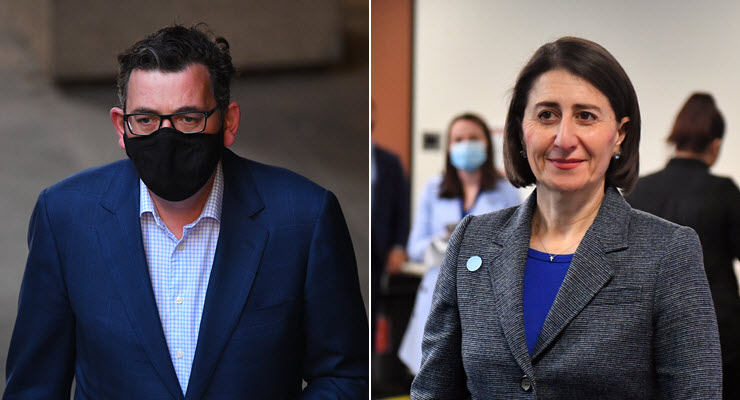
As most of Australia enjoys the lead-up to summer, Victorians will still be locked down until late October. And while the Andrews government hopes a cautious reopening will mean the state can have a close to normal, virus-free Christmas, there are still plenty of frustrating, unanswered questions about how the hell Victoria landed in such a mess.
Is NSW better at contact tracing?
Prime Minister Scott Morrison has lauded NSW as the “gold standard” in contact tracing. Its highly efficient and quick test and trace system has been praised for helping keep new case numbers at a manageable level.
Victoria, meanwhile, has been criticised for an underfunded and ill-resourced contact tracing team, which was quickly swamped when cases began growing exponentially in Melbourne, and has been playing catch-up on huge backlogs ever since.
But are the two states really that different? ABC health reporter Norman Swan told ABC News Breakfast yesterday: “NSW isn’t the gold standard. NSW is lucky.”
University of NSW Kirby Institute head of biosecurity Raina MacIntyre writes that critics of the Victorian system overlook the fact that the process of contact tracing in both states is the same. The difference is the number of cases Victoria’s team had to deal with.
“If NSW were facing 700 cases a day, it would be in a similar situation to Victoria,” MacIntyre said.
And because NSW hasn’t had to deal with such high case numbers, we don’t know whether the system is that much better than Victoria’s, said Grattan Institute health program director Stephen Duckett.
But he also suspects NSW system is more successful because of the more detailed public data about cases and their movements its Health Department has been able to provide.
“They have consistently, over a longer period of time, been publishing data on how effective they are, and how quickly they contact cases … Because they are publishing that on the web, I suspect they’ve been using that information themselves. They jump on it when things are going awry.”
Finally, there are structural differences. For decades, successive Victorian governments stripped funds from public health — the state spends less on public health than any other.
And unlike Victoria, where public health has always been centralised, NSW follows a devolved model where it is managed in 15 local health districts. That model allows teams with a knowledge of the local area to do the tracing, something Victoria is now trying to emulate.
Is the modelling wrong?
Victorian Premier Daniel Andrews justified his conservative approach to easing restrictions by pointing to modelling which suggested easing up too quickly would be likely to put Victoria back in lockdown by Christmas.
But there’s been plenty of criticism of that modelling. Speaking to Crikey yesterday, Deakin University epidemiology chair Catherine Bennett said the modellers didn’t provide enough transparency around the parameters used or the questions asked by the government.
Today we got a little more detail on what the modelling didn’t factor in.
According to The Age, the model’s projections relied on outdated assumptions about Victoria’s contact tracing capacity. And speaking to ABC Radio National Breakfast this morning, the University of Melbourne’s Jason Thompson, one of the model’s developers, said it did not factor in local data — it didn’t consider the fact that most cases were happening in settings like health and aged care.
Can’t we just lockdown the hotspots?
In regional Victoria, the daily case average is now under five. Several local government areas in the regions have gone weeks without a case, and conservative politicians don’t want the whole state bound by Melbourne’s rules.
While regional Victoria is under looser restrictions, there are still limits on gatherings and restaurants until September 13.
But within greater Melbourne a localised plan which ring-fences “hotspot” postcodes hasn’t had great success — Victoria tried that approach in late June. Within a week all Melbourne was locked down.
“We saw from the early stages that ring-fencing postcodes in Melbourne didn’t work,” says Duckett.
We also can’t isolate hotspot settings, like aged care and health workers, because as Duckett points out, those workers mingled in the community, caught the virus and brought it in.
Why did hotel quarantine fail?
Good question. It’s still the topic of a wide-ranging inquiry now in its final days. So far, the hearings have exposed a shambolic system that let the virus get out. For months, nobody really knew who was in charge — responsibility seemed to bounce between health, employment and the police.
Infection control was inadequate and responsibility was placed on private security contractors who were often recruited via WhatsApp, given scant training and told to bring their own PPE.
And while there was criticism of guards’ poor behaviour, nobody has been able to work out who decided to use them.




Since Scotty from Marketing’s promotion of NSW as a ‘gold standard’ for contact tracing the media has been awash with it, swallowed it hook, line & sinker. Apart from Dr Norman Swan, that is.
On all breakfast TV channels this morning Gladys Berejiklian was spouting NSW credentials as the best. Curiously, no mention of Queensland.
Yep Lib State’s GOOD! Lab States BAD!
We all look like cave men banging rocks together compared to the Koreans right now, anyway. The gold standard crap will look real silly if they have an outbreak and it gets completely out of control. We must all aspire for continuous improvement in contact tracing and not leave it all to wither away when the pandemic is over. It is one of many things we must get right to fight something like this so hubris from the libs is terrifying.
Kishor thank you for this article. I think it’s appropriate to ask questions at the moment as we’re still learning answers.
I’ve been tracking the transmission data since March and also think NSW is lucky: I fear there have been too many community transmission sites per week to call NSW case-load under control. Here’s a simple back-of-the-envelope calculation to show why.
In early August NSW was sometimes listing more than 10 community transmission sites per week — places like gyms, restaurants, clubs and cafes. In recent weeks that number is coming down toward five which is good news, but not as good as before Victoria’s second wave outbreak when virtually nothing was listed. Obviously, the sites listed are only those NSW Health knows about.
Now suppose NSW tracking and tracing is so good that the chance of a site being missed is around one in fifty or two percent. With around five new sites per week the chances of all five being detected in a week is therefore 98% multiplied by itself five times, or around 90%.
That gives us a 10% chance per week of one or more sites being missed.
Across a small number of weeks that can look very successful, and sometimes a site missed might have few or no transmissions before it’s cleaned. But as weeks stretch into months, if there are still five prospective outbreak sites per week NSW could miss site after site, including some exposed to large transmission potential or cleaned poorly and especially as restrictions ease some could produce enough transmissions to explode inside weeks just as Victoria’s did.
I believe NSW needs to be posting no more than a small number of community transmission sites per month. Until it does, it remains exposed and if we’re looking at many months into 2020 before any viable, effective vaccine candidate becomes available that’s a lot of weeks at 10% risk per week.
By contrast, at the moment Queensland seems to be in a much better position, but the more it opens its borders it New South Wales the more readily it becomes exposed to any risk that might eventuate in NSW.
Border closures are horrible for the regions and bad for Australia’s economy and morale but even though I disagree with Queensland’s current hotspot definition policy and realise that there are election politics in the motives I can also sympathise with not wanting to open borders to residual NSW risk at this time.
Meanwhile, the same kinds of questions can be asked about Victorian regions. Many regions got spillover outbreaks from Melbourne metro under control relatively quickly and many towns have posted nothing. On the other hand if Melbourne can’t get its community outbreak sites down (too early to know) they’ll be exposed as I believe NSW is.
This sort of analysis can easily be refined by knowing people movements and outbreak site profiles better, but in the aggregate I think the point stands. Nobody in NSW Health should be complacent just now, and NSW should not be held up as ‘good’ just because Victoria has recently been worse.
Thanks for your careful and consideredcomments, and thanks for the article Kishor.
From the evidence already given, public servants in Dept of Jobs, Precincts and Regions were charged with putting together the plan for quarantining tens of thousands of returning travellers ‘over a weekend’. A public servant gave evidence she approached the police suggesting they provide staff on site and was advised by senior police that they didn’t see this as their role and that they would have plenty else to do in supervising lockdowns etc during the pandemic. The job should be done by private security and the police would be available on call if there were breaches at the lockdown hotels.
Security staff’s role was “observe and report”. They had no power to restrain Austalian return travellers in quarantine. If there was an incident – eg attempted breakout or assault they were to call 000.
The police were not subject to direction by the public servants in charge of designing the lockdown setup. (They would presumably answer to the Premier and the Police minister.) It has also been suggested – floated in media reports – that the police were not all that keen in the involvement of the ADF personnel.
This was all very early days in our understanding of the pandemic. From what we hear, word that all this was not working perfectly on the ground ought to have filtered back up to the top and revision of the original plan could have avoided some of the problems that have emerged subsequently.
So the Vic. Police don’t want to do a job they are offered by the Vic. State Government? They just said to the Andrews Govt through their spokespeople to the Dept Heads that they don;t want to be front-line hotel quarantiners? I think that Andrews and his inept Ministers should have stood up to the Police and reminded them that it is their job to serve and carry out the tasks of government. Blind Freddy could tell you that private security were never going to be up to the task. Most of them and their businesses management are a bunch of grubs and it wouldn’t matter how much or little you paid them. They are the class clowns where achievement of any kind is a foreign language and this is the only job they can get and they all cut their own throats anyway through cost cutting. Major companies subcontract. Larger companies like Wilsons lose contracts to smaller budget ones like Southern Cross Security for major retail outlets. How naieve are these politicians? They should have just conscripted the cops and the screws (Vic. correctional services), used whatever assistance ADF offered and taken these dickhead travellers into the middle of the Wimmera where they couldn’t harm anyone or infect anyone. They did this thing for refugees but not our spoilt entitled residents who shouldn’t have been there in the first place.
What happened to Scotty’s (from marketing) and hunt’s and the other LNP flunkie’s much vaunted Covid App.?
Scotty marketed it as the great saviour and plague solver.If tracing is a problem surely it is his problem.
Also if Vic. has the lowest health budget it surprises me, the Vic system knocks the spots off the Western Australian version where we came from.
Re the Covid App, Raina MacIntyre says in the Age today, “The COVIDSafe App has not worked because not enough people downloaded it, not because there is anything inherently wrong with the technology.” So purely a failure of Morrison’s marketing, it would seem.