
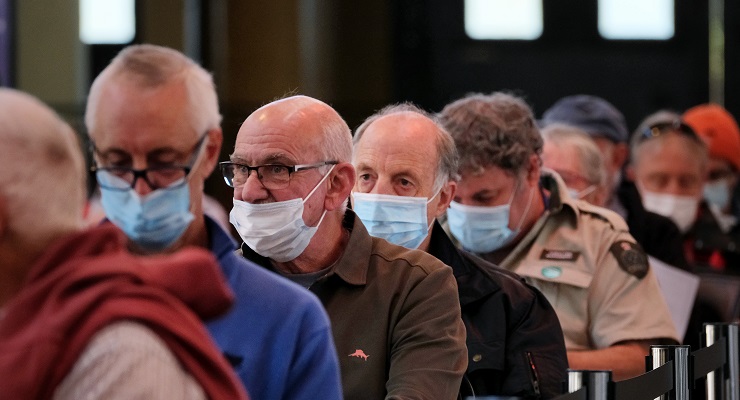
NSW has passed the 90% full vaccination rate. It’s one of the highest rates in the world, and Victoria isn’t far behind.
But in both states, scores of COVID-19 cases are still being recorded. New daily case numbers haven’t yet dipped below 1000 in Victoria, while NSW cases have been bouncing between 100 and 300 for the past two weeks.
Vaccine efficacy is measured by how well it prevents a person from developing serious illness while a secondary benefit is reducing chances of catching or transmitting the disease. But with international borders opening back up, are cases going down fast enough?
Will we see a drop?
Worryingly, cases are once again surging across the world. In the UK, COVID-19 numbers hit record highs in late October, while Germany has closed its famous Christmas markets for the second year in a row amid virus outbreaks.
While Europe was ahead of Australia in the vaccination drive, vaccine booster shot shortages have meant third doses weren’t available as immunity has waned. Fortunately, Australia is on track with other developed nations in our booster program, and the delayed initial vaccine rollout means boosters will arrive on time.
Monash University epidemiologist James Trauer told Crikey it’s not clear yet whether case numbers will dip further in Victoria.
“There are so many variables out there,” he said. While relaxed restrictions may fuel transmission, the virus appears to be more easily controlled in warmer weather as people meet outdoors and keep their distance from one another.
With Christmas just around the corner, any progress made now could be lost within a couple of months with international and interstate travel. But, Trauer said, it seems case numbers won’t explode for now.
“While Victoria’s vaccination rates are high, it takes about two weeks from the second dose to see that impact in the numbers,” he said.
“There are a lot of moving parts, but I think overall [the case numbers] are positive.”
We’re doing as well as expected
Doherty Institute modelling from August predicted that once 70% of residents aged 16 and over were fully vaccinated, new daily case numbers would sit anywhere between 300 to 1000. This is pretty accurate as NSW and Victoria have shown.
But, the modelling warned, this medium seeding could see outbreaks continue to grow, with public health and social measures key to stemming outbreaks. Across the country last month, daily average cases stagnated. While outbreaks in NSW and the ACT were brought under control, Victoria skewed the data with high case numbers.
Mask mandates, venue capacity limitations and travel restrictions have been eased earlier than expected in NSW thanks to effective vaccination drives in hotspot areas.
Hospitalisation data is key
Experts have been warning for some time that we’ll have to shift our focus from daily case numbers to hospitalisation rates. COVID-19 is likely to continue circulating in the community, and rather than locking down, Australia is learning to live with the virus, only introducing restrictions if severe cases of the disease get out of hand.
Nationally across 2021, 10.4% of all COVID-19 cases required hospitalisation, with a 0.7% fatality rate. Most of these deaths and hospitalisations were linked to NSW’s outbreak. In NSW, just 6.1% of those who ended up in hospital were fully vaccinated from June to October.
Updated modelling from the Doherty Institute released this week found with 70% vaccination rates, around half of all infections would be in vaccinated people — meaning most infections are milder and less likely to be passed on.
But as cases abroad show, we’re not out of the woods just yet.
“It doesn’t take much to tip cases, and you can quite easily get back into exponential growth — or exponential decline — in cases,” Trauer said.


The actual vaccination rate of the Australian population is about 68.5%. The 90% vaccination rate relates to vaccinated people over the age of 16. It should be made clear by the government and media alike that there is still over 30% of the population who has not been vaccinated, either due to age restrictions, pre-existing conditions or unwillingness to get immunised.
CoVid19 Vaccines were designed for the first variant of SARSII and while they provide high protection for serious illness and death even from the Delta variant, the protection from actually acquiring the virus is about 50-60%. Data now also shows that these levels of protection decrease after 3 months of the second vaccination and that a third immunisation after 6 months is necessary to strengthen the immune response to avoid serious illness as well as further massive outbreaks. It is also known that vaccinated people who become infected may not have symptoms but contribute to the spreading of Covid, albeit less virulently, as they are moving around freely and unmasked. Therefore, the virus gets passed onto unvaccinated people who are much more likely to be admitted to ICU and occupy beds that then can no longer be used for other patients, accidents, cancer patients, heart attacks and strokes.
Unless we maintain fairly strict distancing and hygiene rules and wear masks until all of Australia, as indeed the rest of the world, reaches a 90% vaccination rate of the total population, there will be many more serious outbreaks, many more serious mutations of the virus as well as thousands more deaths.
Thanks for that excellent update Amber.
I could not agree more with you when you say:
“But as cases abroad show, we’re not out of the woods just yet.”
I think that it will be some time yet before we hear the proverbial ‘fat-lady singing’.
I’d like to know the source for this ‘While Europe was ahead of Australia in the vaccination drive, vaccine booster shot shortages have meant third doses weren’t available as immunity has waned. Fortunately, Australia is on track with other developed nations in our booster program, and the delayed initial vaccine rollout means boosters will arrive on time‘
Seems ti implt we know what we are doing but Europe does not?
Many EU nations have long had booster rollouts happening (depends on nation), but with the rise in infections (not leading to higher death rates in western Europe for vaccinated vs. Eastern Europe) is more to do with relaxing sensible restrictions too quickly, summer with much socialising, many youth/children not vaxxed, adults too, and still too much media driven hesitancy, doubts and outright conspiracies.
Australia should not blindly follow the reckless ‘freedom & liberty’ in the Anglosphere as exemplified by the US and UK; back to square one again if not careful……
In a time of rampant dishonesty and powerful vested interests, true facts are hard to discern.
I have no idea what the reality of covid, vaccine efficacy and the now permanent booster shots about which every parrot in the pet shop is talking, living (dying?) with covid or let it rip.
There is only one certainty and that is that we are being lied to “the authorities”, either because they don’t know or dare not tell the truth of the matter for fear of social unrest unlike anything seen for centuries.
Interesting Times ahead.
I wonder how much sense it makes to use phrases like ‘dying with covid’. It seems popular in the world of Crikey commenters, but analysis suggests Australia’s case fatality rate is ~1%, with the tragedies in Victoria’s aged care system contributing to that number. With a highly vaccinated population and modest measures retained to protect the very vulnerable (aged care, immunocompromised, etc.), we can probably expect a fatality rate an order of magnitude lower. I appreciate the situation is serious and we will need to be cautious, but from my perspective using ‘dying with covid’ to describe a ~99.9% survival rate sounds pretty exaggerated.
Interesting to see where we’re at with Covid at the time of the election, and what effect it will have.
You may not be entirely delighted to read Peter Martin from the ANU in The Conversation suggesting “Economically, 2022 looks like an ideal time for a government to land re-election. Jobs, economic growth, wages growth and even home price growth are likely to look less threatening by the time we are asked to vote.” But yes, perhaps Covid will save us from another three years of Morrison regardless of other factors. Then again, Martin’s analysis of Morrison’s prospects is based on predicting the economy, a famously fallible art. As Ezra Solomon apparently said, “The only function of economic forecasting is to make astrology look respectable.”
Re soi disant boosters – tomorrow and tomorrow, for evermore?
I don’t recall, prior to this unbrave new world, vaccine efficacy ever having been “…measured by how well it prevents a person from developing serious illness while a secondary benefit is reducing chances of catching or transmitting the disease.
How is “reducing chances of catching” the disease “…a secondary benefit..” when the primary benefit is in not “developing serious illness” – is it a variation on Schrödinger’s Cat?
As for not “transmitting the disease” the rest of this pile of non sequiturs is so tangled up that it ends with “…you can quite easily get back into exponential growth — or exponential decline…”.
Not wanting to get into nominative determinism but the expert’s surname is rather unfortunate – trauer means grief and trauen to trust.
I don’t understand the confusion. Main goal = prevent death and serious disease. Bonus (‘secondary goal’) = prevent infection altogether, as well as transmission.
I do agree that the “exponential growth — or exponential decline” quote makes little sense. Kann es sein, dass Herr Trauer ein bisschen verwirrt ist?
The primary goal should be prevent infection – as was always the case with every other vaccine.
The secondary goal would thus be to prevent serious disease if the first goal fails.