

Look through yesterday’s political donation data for 2020-21 and you’ll see a common type of number. They’re curiously exact figures without any clear reason: $55,000; $22,000; $27,500; $16,500; $11,000; $33,000. They crop up over and over again.
Donors reported about 1600 donations and other contributions to political parties during the year: $33,000 pops up 10 times; $27,500 35 times; $16,500 13 times; $11,000 43 times; $22,000 17 times; $55,000 14 times. Even $13,200 is there a few times.
What do they all have in common? They’re easily divisible by 11. In other words, they’re the result of adding 10% to a nice round number. And they all demonstrate that we live in a two-speed democracy, where one set of people — political donors — get far more of a say than the rest of us.
It’s almost as if the corporations, trade unions and wealthy individuals who make up the list of donors have 10 times, or 100 times, the vote you have. And they’re not even on the electoral roll.
The 10% of course is the GST, because donors are buying something: access to politicians. If you give a donation to a political party, you don’t pay GST. You give what you give. But if you buy something, you have to pay GST — and donors are buying a seat at a table with a minister or opposition spokesperson to try to influence them: $10,000 for a seat, or $12,000, $15,000. Even $25,000. And always plus GST. Send a couple of people along and you cough up $20,000, $30,000, $50,000… plus 10%.
Such purchases aren’t disclosable by the donor, either — though political parties have to if they’re above the disclosure threshold.
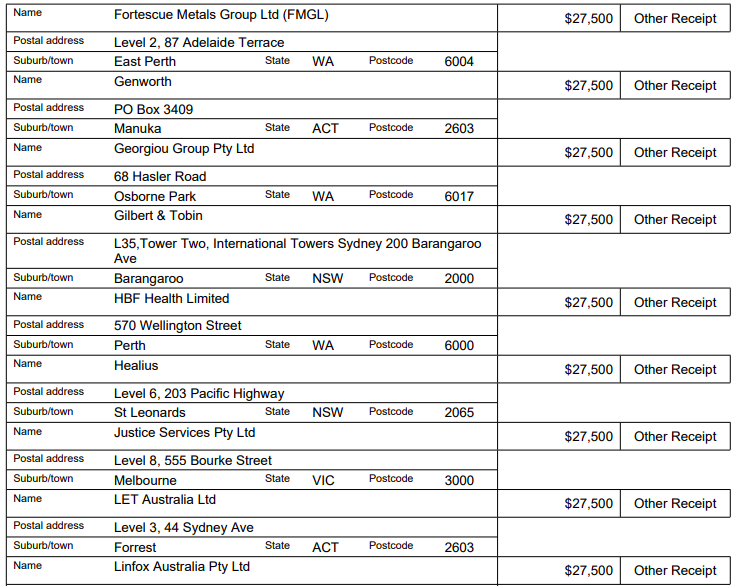
That’s why the returns of the major parties have almost no entries listed as “donations”. The great bulk are listed as “other receipts”, a catch-all category that can include investment returns, property and other asset sale returns, public funding and tax refunds — but of which the vast majority are for purchasing access to politicians.
As former Liberal Party treasurer Michael Yabsley has acutely observed, the problem with getting Australians engaged with the problem of political donations is that it is a kind of victimless crime — neither of the parties involved suffers, or has a stake in ending the current pay-for-play model.
The victims, really, are everyone outside the cosy donation system. Those who pay get special democratic privileges — they get to lobby the most powerful decision-makers face-to-face, in secret, with the knowledge they’ll be given a hearing and treated seriously because they may donate more in the future. The rest of us are stuck writing letters or emails to MPs, or calling or visiting their offices, or berating them on social media, with little expectation of anything other than a pro forma response — at best.
And for those corporations who prefer not to pay for play, it’s an invidious choice. What do you do if your competitors are in the room lobbying for their interests and you refuse to go in on principle? Many corporations don’t like having to attend fundraisers (many politicians don’t like it either), but they can’t pass up the opportunity to exercise influence.
Take ANZ for example. ANZ used to have a policy that it would simply pay a lump sum donation to each side, but not attend fundraisers — because “involvement in political fundraising activities can lead to perceptions of cash for access or favours”. In its 2019-20 annual report, ANZ reported: “Our policy is that we will make an annual donation to the two major federal parties to support the democratic process in Australia. In the 2020 calendar year, we donated $100,000 to the Liberal Party of Australia and $100,000 to the Australian Labor Party.”
But last year NAB abandoned the non-donation policy it had maintained since 2016 and got back into political fundraisers. With all three of its major competitors in the room without it, ANZ changed its policy. Its 2021 annual report states: “In October 2020, ANZ donated $100,000 to the Liberal Party of Australia and $100,000 to the Australian Labor Party. ANZ also attended paid events including business forums hosted by the major Australian federal political parties, totalling $47,600 … ANZ updated its policy on 1 October 2021. It prohibits political donations, but allows attendance at paid events hosted by the major Australian federal political parties.”
That is, ANZ now will only attend fundraisers — despite the fact that they “can lead to perceptions of cash for access or favours”.
It’s easy to criticise — God knows the big banks are easy to criticise for everything — but clearly ANZ decided its moral stance was not conducive to effective competition.
That’s why Australian democracy is like a toll road, one you haven’t got a hope of travelling on unless you’re ready to fork out $15,000 plus GST. You just get to watch while those who can afford whiz past and get special privileges in the way the country is run.


What a fantastic summary Bernard. “Australian democracy is a toll road . . . if you pay, there’s a fast lane and fewer red lights.”
Donor’s OWN our System. Politicians BENEFIT by delivering the OWNERS SYSTEM. And ‘we’ exercise choice: Vote for . . . or against.
Democracy is either an illusion or a reality? “WE” CHOOSE!
It is the LNP way,
All you have to do is pay,
Fast track your children’s education,
Simply make the right donation,
Healthcare abounds,
Just pay them in mounds,
Its the money that counts,
As long as it’s in huge amounts,
LNP $$$ LNP $$$ LNP $$$ every day
It’s the LNP way.
USA USA. This is the party inspired by Trump in my opinion – if nothing else ScoMo is on the Trump lie path all the way. The only problem for the current lot is that they have few public assets left that they can sell off.
Labor is neck deep in this as well.
Let’s not excoriate one and not the other
With Arbib & Tripodi as full time consultants to who knows how many of the17 US ‘intelligence’ agencies.
Great analogy. However donors may benefit not only in terms of influence, but in terms of direct government contracts. This sets up another cycle where in turn they make furher donations to the ruling politicians. Effectively a method of taxpayer money being laundered on its way to politicians. Hopefully Bernard you may have time to research this, in the absence of a desperately needed federal ICAC.
it is a circular argument – a merry go round – the donations are returned [via consultancies etc] with >1000% interest – where else can the finance industry get such profit ? it is a sound business management to make large donations.
You’d think if all the corporates just paid their fair share of taxes, instead of paying and donating for influence – we could have public departments assessing and prioritising the needs of the nation based on their merits and funding availability. HAHA .. what a pipedream!
Nah, the corporates figured out long ago how cheap our pollies are. Donate a few hundred thousand and get up to billions in returns. Look at their windfalls in the last two decades alone from both labor and libs (far more from the libs).
If our history is ever written, this register should form the foundation documents of our decline as a democracy.