
Perhaps it was the surprise 0.2% rise in retail sales in January; perhaps it was just the normal caution of a central banker wanting to see what the huge loosening in monetary and fiscal policy would do to an economy clearly slowing, but not as dramatically as its major trading partners are.
In any case, the Reserve Bank today called a halt to the rate cutting that has delivered up 4% of cuts in five of the past six months.
The RBA’s decision won’t be followed by its peers in the UK, Europe and Canada which meet later in the week and are expected to cut their official rates again to try and soften what is already an intense slump.
The decision to leave rates steady at 3.25% had been signalled for a couple of weeks by the bank and its Governor, Glenn Steven in various statements and speeches.
The sudden upsurge in financial instability around that saw a sell-off on sharemarkets around the globe yesterday (and starting Friday on Wall Street), wasn’t enough to change the RBA’s mind, as had been the case on three occasions last year.
Not even evidence of a weakening level of activity in the local economy was enough to get the RBA to cut rates.
“In Australia, demand has not weakened as much as in other countries and, on the basis of currently available information, the Australian economy has not experienced the sort of large contraction seen elsewhere,” Governor Glenn Stevens said in his post board meeting statement.
“The Australian financial system remains strong and the monetary policy transmission process is working to deliver large reductions in interest rates to end borrowers.
“Nonetheless, economic conditions are clearly weak, and given the speed and scale of the global economic deterioration and its effect on confidence, weak conditions are likely to continue in the near term. Inflation is likely to decline over time.”
“There has already been a major change in both monetary and fiscal policy.” Market and mortgage rates are at very low levels by historical standards and business loan rates are below recent averages, reducing debt-servicing burdens considerably.
“Together with the substantial fiscal initiatives, the cumulative decline in interest rates will provide significant support to domestic demand over the period ahead.
“On this basis, notwithstanding evident economic weakness at present, the Board judged that the stance of monetary policy was appropriate for the moment. ”
But the world remains fragile, even though there’s been an improvement in financial markets since November.
“Recent data confirm that the world economy has remained very weak following the sharp decline in demand that occurred late last year. The major industrial economies reported large contractions in output in the December quarter, as did a number of emerging market economies across Asia and eastern Europe. Many countries are likely to be experiencing further falls in output in the current quarter.
“Conditions in global credit markets have improved since November, but sentiment remains fragile. Share prices have weakened and banking systems in several major countries are still under pressure, as authorities work towards a resolution of the balance-sheet problems. Significant macroeconomic policy stimulus is being put in place around the world, but it is too soon to see the effects of those measures.”
Now it’s the fourth quarter growth figures tomorrow: with the balance of payments adding 1.5% to growth and government spending looking as though it might cancel that out, it could be down to the farm sector to give us positive growth for the second quarter in a row.


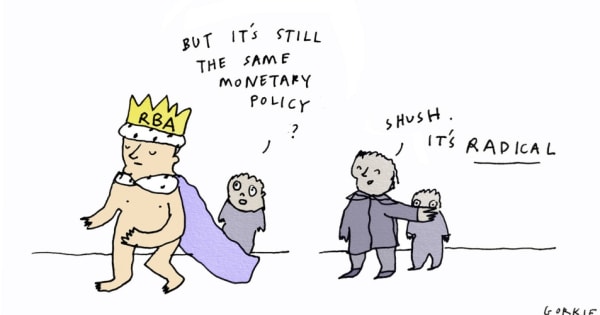

In these financial crisis days every time we hear more bad economic news nearly every commentator calls for or publicly expects another rate cut from the RBA. The RBA usually obliges. It is arguable that the RBA moved rates too high too early and kept them too high for too long. They are now moving them too low too quickly.
There are a number problems with the reverence and central role we give the RBA and one of them is its limited policy options. It really only uses one: interest rates..and not very well. Yet is treated like some sort of sacred cow. I can understand why politicians may want to do this. It removes heat from them particularly when interest rates need increasing or when banks fail to pass reductions on. And politicians don’t want to be seen disagreeing with this unelected “independent umpire”. But economic commentators are another story.
There is a major downside to rate cuts ignored by most economic commentators: they tend to restrict the availability of funds to the market through the banking system from overseas. Why? Firstly banks find it harder to get loans because they can’t afford to pay as high interest rates to secure loans and still retain acceptable margins. Secondly they depress the Aussie dollar. This may be good for exports but it makes overseas lenders wary of lending in Aussie dollars and being hit with capital losses following Aussie dollar devaluations or Australian banks being wary of borrowing in US dollars and being being hit.similarly. What do cuts achieve now anyway? With rates so low it is not the cost of finance which is likely to reduce investment but the AVAILABILITY of finance and and lower consumer and business demand. These latter problems in today’s environment are more likely to respond to fiscal rather than monetary policy.
Commentators may feel safe all agreeing with each other and the RBA but they need to think a little more independently and so does the RBA itself
I think the Labor government should have held back on its massive cash splash and looked at trying to stimulate the economy by making it cheaper to employ and the RBA easing monetary policy further. We could have done that in a more considered fashion and maybe still maintained a surplus but certainly not a 60 billion dollar deficit.
As well as getting credit to flow there have to be incentives to help small business, especially, to keep people on the payroll.
Somehow we need to help the banks to lend and obtain funds at a reasonable rate. Perhaps governments should be playing a greater role in liaising with national counterparts to encourage responsible interbank lending. After all, Australia’s banks strong standing has to help when it comes to freeing up capital.