
During Adjournment Debates on the last sitting day of the NT Legislative Assembly for 2009, Independent Member for Macdonnell Alison Anderson got to her feet and delivered her last speech for the year:
“Ms Anderson (Macdonnell): Madam Acting Deputy Speaker … I refer now to one of the strangest professional connections we politicians have in our public lives. It is one which (sic) has loomed large for me in recent months. I speak of the tie we have with local media.
…
Everyone in this House knows I have been subjected to fierce and sustained attacks from some quarters of the press; and those matters have been dealt with elsewhere and I will not go into them. I want to express one point in the strongest terms I can. I know members on the government benches have sat in silence and watched as I have been bullied by the media outlets they have close ties with.”
What followed was described by the local Sunday Territorian as a “remarkably well-crafted speech” that, notwithstanding its literary qualities, represented a “new low” in Anderson’s Parliamentary career:
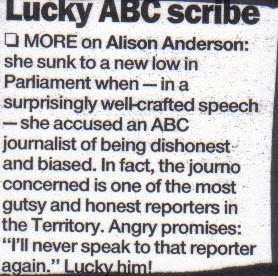
Anderson went on to laud a hand-picked selection of the media — identifying several Darwin radio jocks of the genteel and shock-type — for her praise.
Of the NT’s print journalists, she singled out Dan Moss, of the Centralian Advocate, for deserved appreciation and then lavished praise on the editor and senior writer of the Alice Springs News — a modest weekly freebie that runs to about 16 pages and whom Anderson says represent the “great heroes of the Centre”.
Anderson then turned to the ABC, initially hailing it as a “great national institution” but then identifying “some parts” of Aunty where there is a what she curiously describes as a “mindset linked with the old, progressive, establishment (sic) in indigenous affairs” and that she says is staffed by “… reporters who do not want any annoying Aboriginal politicians getting in their way”.
So far so good — Anderson is just doing what small-town politicians usually do on the last day of the Parliamentary year — slap a few backs, twist a few knives and take a few gratuitous swipes at your (perceived) enemies under the protection of a privilege few other Australians enjoy.
But then Anderson ramps it up a notch or 10 and devotes the rest of her Adjournment Speech to an extraordinary spray at one ABC TV journalist.
It is worth quoting at some length:
“There is an old, dissipated television reporter at the ABC. I am not going to name him today, even though I could under parliamentary privilege. I could use his name and expose him before you all for what he is; but I am just going to tell you about the most remarkable event in a long campaign this reporter and his associates have waged against me.
…
In the early months of this year … this reporter was given a false leak about me, and he pursued it with a will in order to entrap me on camera. He rang my press secretary and told her the ABC had already filmed the CLP opposition discussing this matter. I established, as soon as I had done my television interview with the ABC, this was a lie.
I cannot tolerate liars in private or in public life; and in the media, which trades on truth, lies are utterly unacceptable. I will never speak to that reporter again.”
Anderson didn’t name the subject of her abuse — she didn’t have to. With a local political press corps that could fit in a largish telephone booth it didn’t take any members of that select crew very long to realise precisely who Anderson’s spray was directed at.
Murray McLaughlin has worked for the ABC in the NT for the past 10 years. Two days after Anderson traduced his long-standing reputation as a journalist of no small standing in his profession and among the community at large he wrote to Jane Aagard, the Speaker of the NT Legislative Assembly:
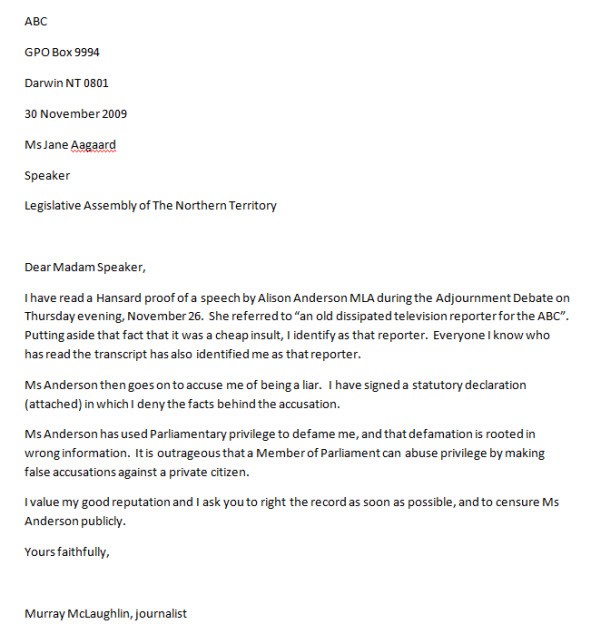
McLaughlin then asked that Aagard correct the Hansard and to publicly censure Anderson for her false accusations.
But Aagard’s hands are tied by the NT parliament’s dilatory approach to righting slurs upon the good name and reputations of its citizens by Parliamentarians and by its failure — almost alone among all Houses of Parliament in Australia — to accord them any right of redress or reply.
In early December Aagard replied noting this deficiency and telling McLaughlin that it was her:
“… intention to refer this issue [the right of reply] to the Standing Orders Committee in the New Year.”
Aagard noted that Anderson’s statement was made under the protection of the absolute privilege enjoyed by parliamentarians in all Australian jurisdictions, she also noted that abuse of that unique power was not without some risk to the member, quoting from the venerable 1978 Report of 5th Conference of Commonwealth Speakers and Presiding Officers:
“This privilege in the past has been used outrageously by individual Members. But … there is a fundamental sense of justice in a House if a Member is acting badly the house will recognize it and treat him accordingly. The public will also recognize it and rob him of his credibility.”
The NT parliamentary year — a grand total of 34 sitting days — begins in mid-February.
Plenty of time for Anderson’s fellow Parliamentarians to examine their collective fundamental sense of justice and for the electorate to consider her credibility.
Crikey talked to a few lawyers working in this field in Darwin and Melbourne and their considered opinion is that Anderson’s comments, if made outside of Parliament, would indeed be actionable as defaming the well-known journalist McLaughlin.
The fact that McLaughlin’s name was not mentioned is not necessarily a barrier since the identity of the subject of Anderson’s comments was well-known in media and political circles in Darwin. And as the slur on McLaughlin’s character concerned his professional reputation and his capacity to earn income significant compensation could be expected if Anderson could not establish a defense.
Crikey approached Anderson’s office on several occasions for comment on her Adjournment Speech and Speaker Aagard’s proposal to refer these matters to the Standing Orders committee but did not receive a response before going to press.

With respect Bob, you don’t tell the story very well. You outlined the case by quoting the Member thus:
“In the early months of this year … this reporter was given a false leak about me, and he pursued it with a will in order to entrap me on camera. He rang my press secretary and told her the ABC had already filmed the CLP opposition discussing this matter. I established, as soon as I had done my television interview with the ABC, this was a lie.”
I don’t wish to know the tawdry details but which one of the three sentences above actually contains the “lie”. Was it a real leak or a false leak or was that a lie? Was the subject matter of the ‘false’ leak a lie? Had the ABC really filmed the CLP discussing this matter or was that a lie?
Well, with respect Charlie, it is Ms Anderson doesn’t set it out all that well – have a look at the Hansard.
Maybe you could ask Ms Anderson some of those questions – we certainly tried to – you might have more success.
But I don’t think that is quite the point – Murray says that what Anderson said about him in parliament was incorrect and wanted it corrected – and to get a chance to reply.
At the moment the NT Parliament does not have a mechanism to do so and I think it is to the Speaker’s credit that she intends to refer it to the Standing Orders committee to introduce such a mechanism in the NT.
It might give more than a few politicians pause to think before they speak ill of citizens under the protection of absolute privilege.
Re previous comment – please insert “that” after “Ms Anderson” in the first line…
Sorry Bob, we are at cross purposes. I’m not in a position to speak to either party whereas you clearly have access to at least one of them. You wrote that “Murray [McLaughlin] says that what Anderson said about him in parliament was incorrect and wanted it corrected”. Reading the quote from the Member, there seem to be about three (or more) different things that “Anderson said about him in parliament….”. Presumably all of them are incorrect, including the one about a false leak (whatever that might be).