
Aboriginal and Torres Strait Islander people, Aborigines, indigenous Australians: it can be difficult for media organisations to know what terms are appropriate when writing stories about Australia’s first inhabitants.
But The Australian Financial Review’s use of the word “blacks” in the headline of a front-page story about indigenous jobs raised eyebrows (as Crikey noted on Monday) about the appropriateness of the word and how offensive it is to Aboriginal Australians.
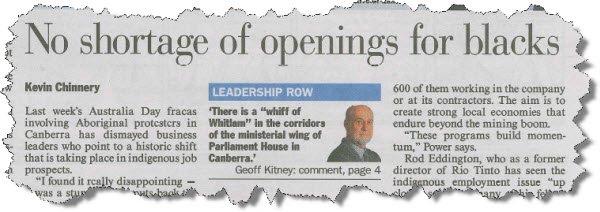
According to a source the headline originally said “indigenous” but was changed by a senior manager before it headed to print.
New editor-in-chief Michael Stutchbury responded to Crikey‘s questions about the headline (a reply which also appeared in the Fin‘s “Notebook” column yesterday under the headline “Crikey’s misplaced outrage“).
“As editor-in-chief I certainly approved the page-one headline reference to ‘blacks’,” said Stuchbury. “It surely is of note that the nation’s business and financial daily newspaper devotes much of its front page to the question of how to improve Aboriginal Australians’ chances of paid employment.”
But it shouldn’t cause offence, Stuchbury asserted: “It may be telling that some instead suggest offence over a simple headline term that is mirrored, for example, in the ABC’s use of ‘black deaths in custody’ rather than the official ‘Aboriginal Deaths in Custody’ or indeed the ‘White Australia policy’.”
Fair point — a quick Google search does show the ABC uses the term. We asked Aunty to clarify its use of “blacks” and it referred us to the broadcaster’s style guide which has the following non-binding advice:
“Aborigine is the noun, although some Aborigines prefer the usage ‘Aboriginal people’. Aboriginal is an adjective, so ‘a group of Aboriginals’ is not correct. There are many regional names — take care not to misapply the better-known ones (for example, Koori). Torres Strait Islanders are a distinct group and should not be described as ‘Aboriginal’ or ‘TSIs’.
“‘Indigenous Australians’ is the preferred collective term for Aborigines and Torres Strait Islanders. Avoid using ‘blacks’ for Indigenous people. It may be considered offensive when used by non-Indigenous Australians.”
So if it suggests not using “blacks”, why can we find it so easily on their website?
“The topic ‘Black Deaths in Custody’ is a search topic on ABC online — the same stories can be found under several other search terms; Aboriginal Deaths in Custody, Deaths in Custody, Aboriginal, Indigenous etc,” explained an ABC spokesperson.
(It’s here that Crikey should admit it has a “boat people” search topic — for Google reasons — although it’s not a phrase you’ll usually find in our reporting.)
But to many indigenous Australians the “blacks” descriptor is offensive. So says Jeanie Bell, a community linguist specialising in Australian Aboriginal languages.
“I believe that most Aboriginal and Torres Strait Islander people would find the use of the word ‘blacks’ in this context on the front page of such a prestigious paper like the Financial Review quite insulting, and somewhat derogatory,” Bell told Crikey.
It’s not just about the word itself, it’s the history behind it, according to Bell: “In my mind when you hear someone using the work ‘blacks’, I, as an Aboriginal person, associate it with colonial language generally spoken in harsh tones with a sense of utter dismissal and bordering on hatred or strong resentment, such as ‘the dirty blacks’ or ‘drunken or lazy blacks’, etc. All of which I find extremely offensive and know many others who would also.”
It may be difficult for media organisations to understand the correct terminology for indigenous Australians but there’s no excuse for “blacks” on a front page, says Bell.
“While there is also a growing rejection of the term ‘indigenous’ within Aboriginal and Torres Strait Islander communities today, I do not feel that there would be any support or endorsement for the use of the word ‘blacks’, especially in a formal or public way,” she said. “While we cannot control how people speak we can surely expect that we be respected by mainstream media in terms of the language they use to represent us.”

Correct me if I’m wrong but isn’t the ABC using “black” as a search result – i.e. they are including the use of “black” because they allow for the fact that a number of people will use the descriptor when searching for these topics? That being the case I don’t see it as legitimising the term but merely anticipating its usage. Anyhow, the headline itself does look a bit offensive – even to this white anglo.
Imagine if you opened a newspaper and read ‘ NO SHORTAGE OF OPENINGS FOR WHITES’ The senior manager who changed it from ” Indigenous” ( which is the acknolwledged’ respectful ‘ term) to Black should be sacked asap..
He is a racist and an insensitive one too!
Blacks or black as a noun is quite different from black as an adjective, e.g., black deaths. I agree with Jeannie Bell about the historical connotations of ‘blacks’. ‘Indigenous’ does seem to be passing its use by date; and ‘aboriginal and Torres State islanders is too much of a mouthful. Perhaps we are moving towards ‘first people’? Indigenous people that I know prefer to be called blackfellers or blackfellas, but this presents a gender problem.
This is a tricky one. We have black citizens in this country who are NOT Aborigines. Judging people by their skin colour may be misleading. ‘Opening for blacks’ may mean e.g. Sudanese, Nigerian or South African Australians.
It looks to me that Americans have similar problem still calling their citizens ‘African Blacks’ although vast majority of them have been there for 400 years, and have nothing to do with Africa.
Other countries do not seem to have that problem, though. I have never heard about ‘African Brasilians’, African Cubans or African French.
At least the English invented a common name: British. And it usually means: non-English.
It’s about time people came together. This reference to colour
is abysimal reporting. For too long certain people have been
using the good will of others to get their life. Why can’t
aboriginal people live in normal houses in towns without
creating difference ?