
There’s an air of growing panic among Australia’s business people. Company directors are calling for a budget deficit, retailers feel like they are peering over a cliff and everybody’s worried sick about the carbon tax and the high currency.
Metcash’s Andrew Reitzer reported yesterday that he is seeing “unprecedented and prolonged challenging operating conditions”. The IGA supermarkets are battling deflation of 0.9%, with specials making up more than half of all shopping baskets and as result Metcash is laying off 478 people.
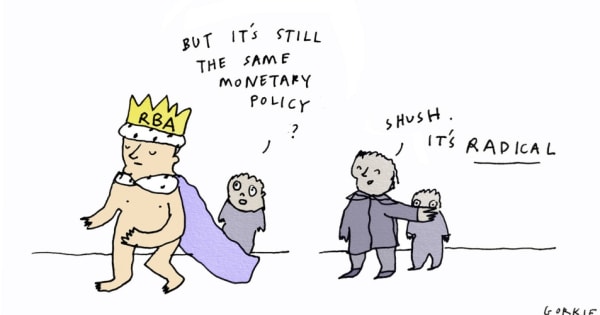
Meanwhile the Reserve Bank and Treasury are insouciant. RBA Governor Glenn Stevens merely said yesterday that “considerable structural change is occurring”, while putting off a rate cut. Treasury is working with the government to produce one of the toughest budgets in the nation’s history.
I can’t remember a time when the policymakers and the real world diverged as much as they do now.
It’s entirely possible that business people are in a funk unnecessarily and that the bureaucrats in Canberra and Martin Place have a better idea of what’s going on, but I doubt it. The truth is that both the RBA and Treasury have been getting it wrong, and both are being forced to adjust their economic forecasts downwards.
At yesterday’s RBA meeting, according to Governor Glenn Stevens: “The board judged the pace of output growth to be somewhat lower than earlier estimated.” But they stubbornly put off a rate cut anyway.
Last year’s federal budget forecast real GDP growth this financial year of 4%, which now looks absurdly optimistic. For calendar 2011, growth was half that figure and there is no reason to think it will be much different for the financial year — perhaps a little more than 2%.
So why do the government economists have their heads in the clouds, apart from the fact that it’s normal?
It’s partly because one person’s “structural change” is another’s nightmare, and partly because it suits them: Treasury needs to produce a $40 billion fiscal turnaround to assist the Treasurer’s political agenda and the RBA is still focused on inflation.
Business people, meanwhile, are seeing weak domestic demand because of consumer deleveraging, weak export demand because of the currency appreciation, and rising costs because of the labour laws and higher energy prices, both present and future.
To a large extent, the yawning gap between the economists and business people reflects the difference between “gross” and “marginal” — that is, the RBA is watching aggregate national inflation numbers while business people are watching their margins get hammered, and Treasury is watching national output, including the mining investment boom, while on the east coast businesses are watching their all-important marginal sales collapse.
Business is a marginal game, while economics is gross.
*This article was first published at Business Spectator
If there goal is to destroy the economy they are right on target!
talk down the Gov. talk down the Economy. O, how to demarkate. Wait
Sick and tired of business whinging. They stick the boot in repeatadly to Labor governments about deficit.
They stick the boot into employees citing the need for change to demand all manner of darwinian employment laws.
They outsource job overseas as a result.
After all the whinging about socialism and its evils, the need for supply and demand now faced with the prospect of being on the less palatable end of those equations they are demanding handouts and susbidies.
Sorry to break it to Alan and the rest but your not owed a living any more than anyone else.
Its amusing though hearing once economist accusing another of getting it “wrong”.
[There’s an air of growing panic among Australia’s business people. Company directors are calling for a budget deficit, retailers feel like they are peering over a cliff and everybody’s worried sick about the carbon tax and the high currency. ]
….and not a word of criticism re Abbotts unrelenting attack on the Govts magnificent economic standing and performance…business as usual from the media
Maybe if business ( and the press for that matter) was a bit more vocal about the gaping holes in the oppositions fiscal ‘policies’ they would be in a stronger position to be heard.
You cant sit back and stay mute on the coalition black hole of spending.. be it 70billion or 40 or 50 billion and then expect to have an influential voice and you cant be selective about which truths you wish to prosecute
Clearly the Australian economy is in a bad way and heading for worse… its like one of those dreams where you can see the crash coming and cant do anything about it.
Its time for some tough and truthful talking by all major players in the economy, instead of turning a blind eye to the tea partyesqe policies of the coalition… repeal the mining tax, pay women some women at the rate of $150k pa to have a baby and others a pittance because thats their wage… oh and by the way we will put a great big tax on companies to pay for the opposition leader to overcome his problem with women voters and lets pay for nannies while we are at it.
Unfortunately labor has been good at policy and bad at politics
Now they are are verging on bad policy as well as bad politics with the balanced budget obsession… at the wrong time in the cycle.
But hey, how much thanks or kudos did they get from business for the stimulus… which despite its faults, (which are to be expected of anything that big and that rushed)
Sadly this country is facing problems of its own making that are solvable.