
Not a religious lot. Do a head count of politicians when it comes to questions where religious leaders have strong views and you might think that Australians are quite a religious lot. From abortion to gay marriage a majority of politicians tend to scurry towards conservative change nothing positions. Which is rather strange in one respect because all the evidence suggests that the views of a clear majority of people are different to those of the religious zealots.
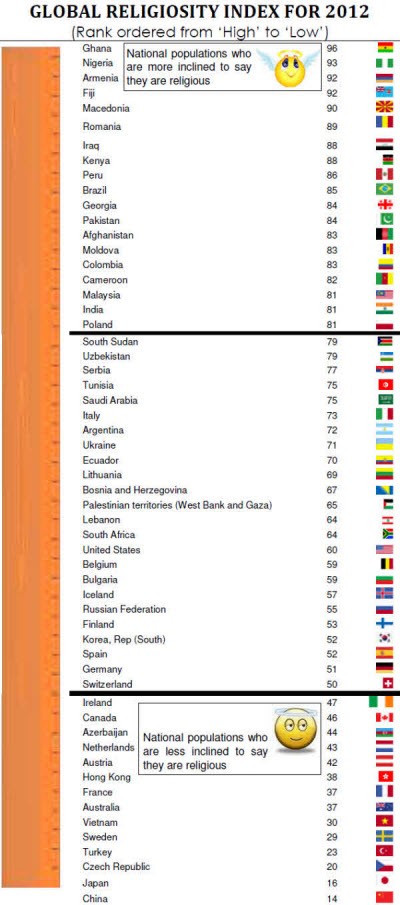
The latest evidence of the attitude of Australians towards religion comes from a just released international survey by WIN-Gallup International that asked people in 57 countries the following question: “Irrespective of whether you attend a place of worship or not, would you say you are a religious person, not a religious persons or a convinced atheist?” Australia came in as one of the seven countries where people were less inclined to call themselves religious. And the proportion of committed atheists put Australia in the top ten list of non-religious-believers.
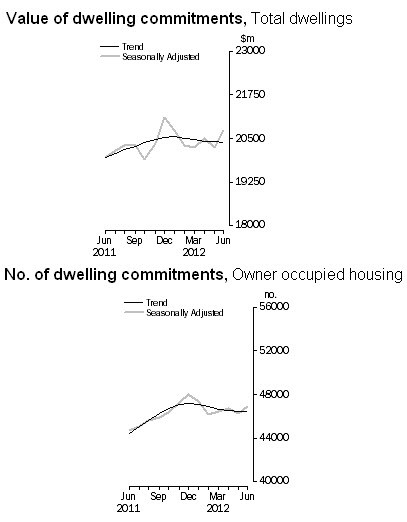
Bottoming out at last? Perhaps the great housing construction decline is coming to an end at last. The Australian Bureau of Statistics figures this morning show that while the trend estimate for the total value of dwelling finance commitments excluding alterations and additions was flat (0.0%) in June, in seasonally adjusted terms, the total value of dwelling finance commitments excluding alterations and additions rose 2.4%.
Preparing for the worst. I unfortunately find myself in agreement with this gloomy call to action published this week in London’s Financial Times. Howard Covington and Chris Rapley, respectively a trustee of London’s Science Museum and chairman of the UK’s national mathematics research institute at Cambridge, and a professor of climate science at University College London, make the depressing case of the need to prepare for the ravages to come from global warming.
“The evidence suggests that humanity is locked into a course that it has limited capacity or appetite to alter. Modern economies are built on fossil-fuelled growth. Changing this model materially and quickly has proved to be untenable in the absence of a disaster. Business-as-usual emissions growth is the consequence. This may well produce a disaster that we will be powerless to redress.
“Those with a more optimistic view of human behaviour or of the impact of new technologies and practices may see better prospects of meaningful action to prevent such a disaster. They must be encouraged. Yet we must also prepare for the challenging times ahead. The Science Museum in London plans to create a forum for the public to discuss the issues with leading climate scientists. Such efforts are essential. We must begin to discuss the risks and impacts of a climate disaster, since our institutions and processes appear incapable of preventing it.”
A memory of Marvin Hamlisch. From the score of The Sting to the original song and original score for Barbara Streisand’s The Way We Were there’s plenty to choose from to remember Marvin Hamlisch who died overnight. I’ve been listening again to his musical A Chorus Line.

A quote of the day.
“The new job of art is to sit on the wall and get more expensive.”
– Robert Hughes
Some news and views noted along the way.
- A “perfect storm” for super low interest rates. But how long can the storm last?
- Is there a ‘concussion crisis’ in sports? and Can the NFL keep fans excited and players safe? — Messages from the US for all football administrators.

I also regretfully agree that we will have to mitigate since we are doing so little to prevent global warming. I have 2 regrets. I doubt that I will be alive to enjoy the schadenfreude when denialists have to accept even if they never explicitly admit they have been wrong. And less selfishly and tragically, once the world agrees to take preventative action it will be decades and perhaps centuries before action stabalises temperatures.
Having lready read the FT article I have a different take on it. Certainly it is right
in being pessimistic about the chances of the international community actually
doing something about it (assuming anything can be done that might be useful)
but I doubt whether either of the worthy authors have any qualifications to be
called “climate scientists” or even to answer the question what qualifies as a
“climate scientist”. (I tend to agree with the FT blogger who opined that the kind of
physics which backs the work of Prof Richard Lindzen provides a different level
of expertise that that of the marine biologists studying the impact of dissolved
CO2 on shell fish or tree ring specialists. From memory he/she made the point
that they seemed to be repeating the line of the discredited aggregator of good
and bad scientific w ork and multiplemore or less useless and unproven climate
models the IPCC – decidedly not a reputable work of science even if co-incidentally
right about some things by accident).
BTW, Gavan Moodie, isn’t mitigation what the IPCC wants us to achieve but the
article is suggesting will be virtually impossible? Don’t you mean that we will have
to adapt rather than mitigate? Assuming you have conscientiously tried to get
these important things right, do you think Australia ought to be spending huge
opportunity costs on subsidies for wind farms and solar panels? Should Austraia
not make itself as rich as possible by using its coal well so that we can adapt and
help others to adapt, given that nothing we do or say will make the slightest
difference to the outcome?
Also, weren’t those FT authors ignorant or oblivious to the real maths of AGW?
Not only the feedbacks and the logarithmic character of the response of radiative
forcing to increases in CO2 but the effect of doubling the CO2 in the atmosphere?
Sorry, I meant adapt.
I’m more optimistic about individual peoples’ and countries’ examples influencing others. In any case, I prefer to minimise even my modest contribution to a serious problem.
I agree Gavin.
On the religiosity topic above, one of the reasons policies are often more aligned with religion is that religious people will often vote according to a small number of, or single, religion related issue. It is probably easier to give an example related to US politics. Take gay marriage rights and abortion. Low socioeconomic US citizens living in the bible belt will always vote Republican because the Republicans are more aligned to the US Christian values (not to be confused with the values of Jesus). Even if the Republicans came out and said “we want healthcare and education to be super expensive so only us folk who are already rich can have any chance of our future generations being rich or even comfortable” and “if you have cancer but don’t have health insurance you should be left to die” (cue audience cheering if it was a Republican presidential debate) the poor people in the bible belt would still vote Republican because of their stance on gay marriage and abortion. Non-religious people however have a policy priority that doesn’t automatically push religion-related issues to the top of the priority list.
Linking the two, I often find climate change sceptics and deniers are often religious… Has anyone else found this? I’m not really sure why and am not sure whether it is a councidence or a reflection of teachings. If it is teachings I for one am glad we live in an age where scientists can have a conflicting view to the church without the fear of being burned at the stake but this doesn’t mean we should forget the fact that the church has been wrong about so many big issues in the past. The difference is this could have serious consequences. If we were still living today believing the Earth is flat or the centre of the Universe it would be a sad state of affairs but if the sceptics are wrong about climate change that’s beyond being merely sad. In fact if the church’s stance is in the deniers camp, going on past performances, we should take that as all the proof required to support the science of climate change.
*coincidence