
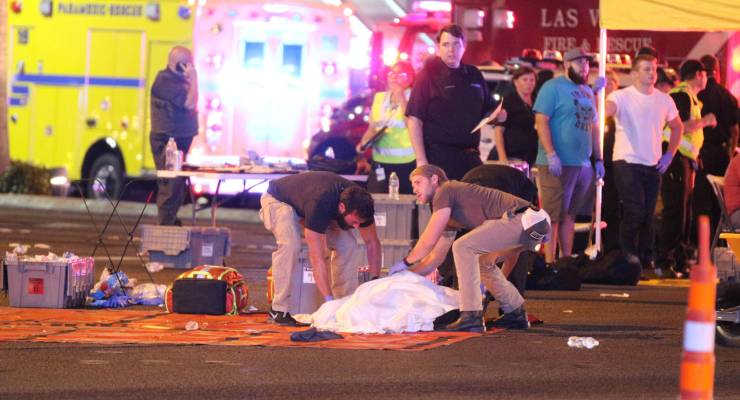
“We still do not have a clear motive or reason why,” Kevin McMahill of the Las Vegas Metropolitan Police Department told press Friday. Five days had passed since the minutes of rounds fired by Stephen Paddock claimed 58 lives, and investigation was yet to yield a useful clue. “We have looked at literally everything,” said the NVPD in a joint appeal with the FBI, whose billboards seeking leads on cause for, or accomplices to, this planned atrocity are now posted across the city. Aaron Rouse, Las Vegas chief for the bureau, swore, “we will not stop, until we have the truth”.
An inversion of this vow informs current US speech around the massacre. It is reformulated by politicians, pundits and social media users to read: until you have my truth, I will not stop.
We heard House Speaker Paul Ryan utter the “truth” about an exceptional nation when he said that these latest gun deaths did not define America, but “the acts of heroism we witness after the tragedy” truly did. He went on to imply that the real cause for such acts was mental ill health, a problem he had this year sought to address by advising President Donald Trump to stand his ground in tearing down Obamacare. There’s some Republican yoga for ya. You can bend to acknowledge a neglected national health concern, but very briefly and only when you’re reaching high for any excuse not to talk about guns.
Hillary Clinton, whose gun control policy is one that marks her distance from Republicans, said that this was the moment to “put politics aside”. She then put politics back in front, and declared that the Republican Party was unable to shake the influence of the National Rifle Association.
[Will the media coverage of Las Vegas lead to more mass shootings?]
This US mass shooting, like other US mass shootings, has become what others have described with terrible precision as a Rorschach test. You see, or you advance, the “truth” that you prefer in the blood left on the ground. In this appalling blot, we can see the problem of masculine violence. We can see Ryan’s sentimental “heroism”, or the old view of the NRA that “people kill people”, not guns, ergo the great efficiency guns provide to people who kill people is not really much of an issue.
Of course, it is an issue. In the US, you’d be a twit, and/or a member of the NRA, to believe that a reduced number of powerful weapons would not result in a reduction of deaths. In Australia, you’d be only David Leyonhjelm, perhaps his new bestie Mark Latham, or “unAustralian”.
There are those Australians who remain grateful to John Howard for the gun reforms of 1996. Some “thank God” in a simple way for his goodness. Others may have a more political, but no less heartfelt, gratitude that a right-wing leader did this. (I mean, “thank God” the Liberals are tied by history to this unusual moment of Howard-era decency. If Keating had introduced the laws, they’d probably have been repealed.) Perhaps many Australians also feel aggrandised by a policy that is now routinely mentioned by US advocates for gun control.
There are few occasions where we feel we get to tell the US a thing or two, but this is one of them. This may explain why Australians hold forth so often on US gun laws, and will even go further, as the The Sydney Morning Herald did, and recommend to an imaginary US audience not only what they should urge their policymakers to do about assault weapons, but how they should describe and understand the mass shootings that occur in their nation.
It’s just not useful, writes Julie Szego, to call Stephen Paddock a terrorist.
Sure. It probably isn’t. Then again, it probably isn’t useful to label a lot of other things, including laws, “terrorist” either. This is possibly the view of Dr Muhamad Haneef. It probably isn’t the view of the many people currently employed in the emerged field of counter-terrorism. It is my view that a securitisation policy emphasis is a dangerous mania, and that the attempt to categorise all threats in a “nuanced” way — this is terror, this isn’t terror, this has shades of terror — can be, and is, used to delude voters and reignite their racist fears.
[What will happen with gun control under a Trump presidency?]
What it may also do is bolster the tendency, previously described, to describe one’s “truth”, and its accompanying solution, while remaining oblivious to the bigger picture.
Not for a microsecond would I oppose attempts to tighten US gun ownership laws. First, no US politician, nor any Australian grandee who knows a US politician, heeds my views. Second, premature death is undesirable. Less obviously appalling, but also undesirable, is the local tendency to echo the US tendency and describe just the convenient truth of a story, and not its other parts.
So, we are agreed that fewer guns will likely result in fewer deaths. We say that it happened in Australia, and so that it can happen over there. But what we do not say, or what we choose, as Clinton chooses, to ignore when we set ourselves up as a marvellous example is that powerful weapons in the USA are not just in the hands of citizens. Estimates for fatalities by police fire this year in the US are up around the 1000 mark. This is a nation that upcycles those machines used to slaughter the “terrorists” of other countries to control its own citizens. This is an arms race that a militarised police force is always going to win.
This is not to be some snotty student-type who “calls out” hypocrisy crudely on her megaphone, but to propose, in a sober way, that life in a nation full of weapons is different to life in one where they are scant. It is also to say that our journalists and our policymakers are so “nuanced” and so very eager to tell their truth, that a whole lot of other truths simply become invisible.
The Pulse nightclub shooting was, of course, horrific. Let’s leave aside that proposed restrictions would not have prevented murderer Omar Mateen, a security guard, from accessing guns, and just cop a look at that war machine Orlando police used to defeat him. It’s in the background, just like the victims of state-endorsed murder. Still, the argument about Pulse was one of nuance — was this a “hate crime” or was it “terrorism”?
Perhaps it was a little of both. I, of course, have no expertise. I do, however, have a suspicion that the need to give every atrocity its proper, nuanced context overlooks the biggest: the USA is full of weapons. And, yes, people kill people. But so, perhaps, does the general refusal to see a big picture, or grand narrative or whatever you want to call it. There’s a background that is not beyond politics but is surely politics itself — one Black Lives Matter has been courageous enough to begin to describe. This, we so often refuse to address in our analysis of great pain.



I fail to understand why the motivation for the massacre is so vital. Whatever the reason, however illogical the act, nothing will prevent future mass shootings in the USA.
Some things don’t have a reason, or a motivation.
“They can see no reasons
‘Cause there are no reasons
What reason do you need to be shown?”
I fail to understand why the motivation for the massacre is so vital.
Are you kidding ? It was a rich old white dude. There’s no stereotype to easily lay over the top and write it off so nothing further needs to be considered.
Of course understanding the motivation is important and precisely this is our best hope of making sure massacres like these do not happen, or at least not happen as often anymore.
There’s never an excuse for massacres like these, but there is always a reason. Sometimes that reason makes no sense, but if we don’t understand those reasons, we have no hope of trying to prevent them.
There need be no speculation about this grub’s motivation when the actual, incontrovertible, FACT is that he had access to guns. The cause of the massacre that news commentators keep brushing aside with red herrings about the guy’s lunacy is the slavers’ and Injun-killers’ US constitution. That constitution, and the vile forces behind it, came to fruition when embolded traitors turned their guns on the elected government of the USA and even after their military defeat had enough influence to stop the North following the Civil War with treason trials and execution of the ringleaders.
This evil finds expression today in the National Rifle Association with a linked chapter in Australia which runs shooters’ political parties for parliament and which has stashes of hundreds of guns planted all over NSW and probably other States ready for the gun freaks to collect when they’re ready.
If we in Australia don’t follow up John Howard’s lead and organise against the gun freaks it’s only a matter of time before we see another Port Arthur massacre or worse, an organised armed uprising like those which keep springing up in the USA.
It’s not a question of us failing to see, in the context I first mentioned it, though. It’s a matter of police procedure. And, you know, it is not a bad thing if a true investigation of the things or persons that led the killer to kill took place. (Unlikely as this is.)
But, I guess you are basically agreeing with me, right? That all of this “he did it because of male violence” or “he did it because of mental ill health” or “he did it to give Americans an opportunity to be heroes” or even just “he did it because he had access to weapons” (again, no problem with weapons control; I stop being any sort of libertarian right there) is unproductive.
I guess where we may disagree is that I do not think such argument is unproductive, because it produces a result. Which is not to see the bigger story about gun deaths in the USA, a percentage of which are administered by the state.
So, sure, police may not be actually as effective in their killing as private citizens. But private citizens are, surely, more inclined to cling to their weapons with cold dead paws etc and their old second amendment beliefs if there is regular very visible proof that they have military hardware pointed at them.
Not a fun conversation. Not meant to diminish the efforts of gun control advocates, either. Just a small effort to consider the thing in the big context of an arms race. (And to remind Australians that their products, like the Howard repeals, won’t necessarily export.)
What nuance could there possibly be . . . for slaughter?
> Estimates for fatalities by police fire this year in the US are up around the 1000 mark.
Weapons are needed by populations with repressive governments.
Everybody knows that removing the huge hoard of guns in the US would solve the immediate problem, but that is only half of the bigger problem. The other half is the psychology of the United States itself. They see their fellows, and the actual government, as predators. Ya need guns for predators – even of you are an accountant on the wrong side of 60.
Perhaps it all originated in the civil war, which is pretty funky when you consider it as a notion? For years one set of Americans set out to murder and destroy the other half. After which everybody rattled along in mutual distrust. What has fundamentally changed?
This random sniper thing in America has now been set in stone and we all better get used to the idea of it happening a whole bunch of times every year. Thoughts and prayers, folks, thoughts and prayers…
Not so Nudiefish. Any attempt to remove the guns . . . would ignite of itself, the social pathology that drives their American ‘dream’. And should that occur it will not be “bunches”; but in ‘Australian’, massed mobs . . . . living, their dream. Justification for and of, their dream.
It seems for many Americans it’s god, Jesus, the bible and its fairy tales, pray, pray and pray some more. But real happiness is notoriety and a warm gun, …bang, bang, shoot, shoot.