
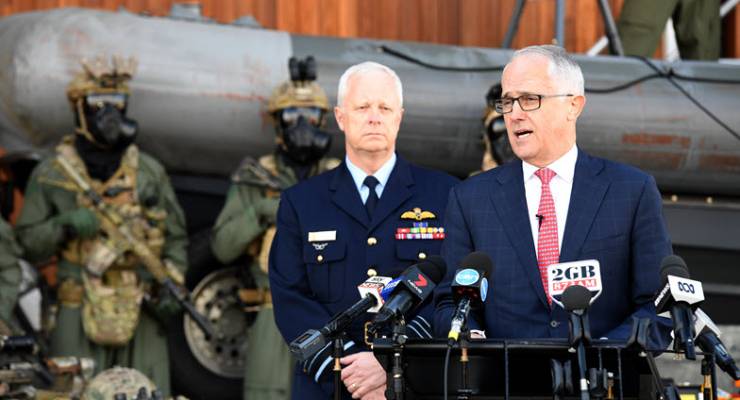
If it wasn’t clear before, the controversy over the government’s proposals to reform donation laws and prevent “foreign interference” confirm that the Abbott and Turnbull governments have been the most repressive and anti-free speech and free press government since World War II.
The issue is best understood as part of a set of new restrictions across three different sets of regulatory proposals — on foreign donations, foreign interference and charities.
After long opposing efforts to ban foreign donations, the government last year decided to prohibit them, realising that its staunch opposition prevented it from properly attacking Labor’s Sam Dastyari for his links with Chinese donors, and seeing that it could provide the opportunity to reduce funding for GetUp. The government belatedly tabled a bill banning foreign donations in December — one drafted so broadly it caught any group, including charities, that might engage in advocacy, prompting the Institute of Public Affairs to attack it along with GetUp.
That controversy erupted around the same time that the government’s Foreign Influence Transparency Scheme Bill 2017 was attracting criticism for its requirement that “representatives” of foreign governments must register with the government if they engage in advocacy, which was so broadly drafted (seeing a pattern here?) that it would, for example, capture Catholics engaged in public advocacy. A wide variety of organisations such as charities would also be caught up in the bill’s requirements.
This was part of the same package as another bill strengthening espionage laws that would see journalists, whistleblowers or anyone else jailed merely for possession of classified information, even if it was in the public interest, and would treat as “espionage” merely the handling of unclassified information by an intelligence official and anyone who “procures” the handling of such information — which includes journalists, editors and politicians who seek to expose wrongdoing. Unusually, Australia’s major media outlets have combined to savage the laws.
The charities sector has also been the target of a long-term effort by the government to silence its public advocacy. In late 2017 the government — which had previously tried to abolish the sector regulator, the Australian Charities and Not-For-Profits Commission — decided to use the commission as its tool to go after vocal charities, and appointed embittered far-right ideologue Gary Johns (who did a Mark Latham long before Latham did) to run the body. Johns is on the record as supporting the removal of tax deductibility status from charities that engage in advocacy.
While the current government proposals to jail journalists are in draft form, the government has previously succeeded in passing laws that enable it to prosecute journalists who reveal intelligence operations and jail them for up to five years. Faced with a similar reaction from the media at the time, then-Attorney-General George Brandis flagged that any prosecutions of journalists would have to be personally approved by him. Christian Porter has now suggested adopting the same approach with the government’s new espionage laws.
Only a politician with a deep authoritarian streak would seriously believe that it offers the media any protection, or assurance, that journalists would only be prosecuted and jailed for doing their job at the personal whim of a politician. Ask Witness K and Bernard Collaery — the raid on whom was happily signed off on by Brandis — how much trust to place in an attorney-general. And what if a Trump-style government won power in Australia? How confident would anyone be that journalists wouldn’t be thrown in jail for revealing the bumbling of intelligence agencies? And what about whistleblowers, conspicuously absent from the protection afforded the media?
These are in addition to a list of other restrictions on free speech or freedom of the press. The government has removed any capacity for intelligence officials to act as whistleblowers in any circumstances, as a defence against what it labels “insider threats”. The Abbott government — via legislation introduced and championed by Malcolm Turnbull — established Australia’s first mass surveillance scheme in 2015 with its data retention laws. Those laws have since been used by the Australian Federal Police to try to hunt down sources for stories embarrassing to the government or its agencies, with raids on politicians and journalists’ phone records obtained; one leak investigation, instigated by Malcolm Turnbull’s hand-picked NBN Co executive, saw raids on Labor offices and email servers in Parliament House, all later deemed an attempted interference in the work of the Senate.
There are other issues beyond legislation: apart from the harassment of K and Collaery, there’s the government’s handing to a blogger of personal information about a Social Services client who had publicly criticised it, and the spectacularly failed effort of Michaelia Cash’s office to coordinate AFP raids on the Australian Workers Union with the media to maximise embarrassment for Labor.
All this has been done by a Liberal government that professes a commitment to freedom of speech and minimising the powers and size of government, led by a man who promised a “thoroughly liberal” government the night he became Prime Minister. To repurpose a term of abuse used by the right in the US: these are Liberals In Name Only.


While it’s good to see the media combining their opposition to this, it really is nothing compared to the outrage that certain sections showed when Labor was in power and proposed rules that, while they were an overreach too, were nowhere near as far reaching and repressing as this.
For years the Libs could fool people into voting against their own interests, so they could gain power in order to serve their corporate donors. In this era of inequality the game is up, so it seems they’re trying to close down as many dissenting voices as posible. It is very disturbing, the start of a road that leads to an authoritarian state.
This is an authoritarian government intent on witholding
all prevously available information from the public for devious purposes.
A military government in waiting, prepared to crush any dissent by any means deemed necessary.
One only has to look at the number of ex military figures from the governor general down,
involved in political institutions.
This country needs a break from militarism.
The Conversation currently has an article on the Cabinet cabinet farce. The comments so far have been only about how better to ensure perfect secrecy with respect to government business. Labor and Coalition alike. Never mind that this locked cabinet revealed shabby and secret conduct wrt to refugees and benefits, about mining. Good journalists tell us about secret, corrupt deals, backhanders to officials, FOI requests turned down, corporations and miners getting nearly always whatever they want. ‘Shithole’ states are not confined to Africa. If this lot , and perhaps not just the Coal-ition, do not clean up people may turn to fully blown fascism, if history is any guide. However: is rule by corporations any better?
Whatever happened to to that LNP carpet beetle Michaelia Cash? Ever since the failed AFP on the AWA and misleading parliament she has been off the political radar. I do miss her highly aninimated bogan speak.
To quote from Arthur Daley – Cash’s every utterance is “GBH of the ear’ole”
The usual argument against laws like these goes something like “well you may trust the current government, but what about anyone who comes to power in future?” In this case, the argument is entirely redundant. I trust the current Government, which has always shown a strongly authoritian streak and which had shown itself on a number of occasions to be not above using the AFP and other instruments of power for political purposes, about as far as I could throw it.
And look who is going to have major responsibility for administering them, the guy in charge of the intelligence agencies, the AFP, “Border Force”, the truly dreadful Peter Dutton, a man of profoundly authoritarian and anti-democratic instincts, who demonises minorities and the weak for political advantage, that I wouldn’t have anywhere near the levers of power.