

Following their Batman debacle, the Greens appear determined to abandon their remaining economic credibility by embracing nonsensical housing and welfare policies: today at the National Press Club, leader Richard Di Natale will announce new policies on the Reserve Bank offering discounted housing mortgages and a universal basic income.
Both policies are the kind of magic pudding stuff that the Greens abandoned years ago in favour of more rational economic policies, including some eventually embraced by the major parties.
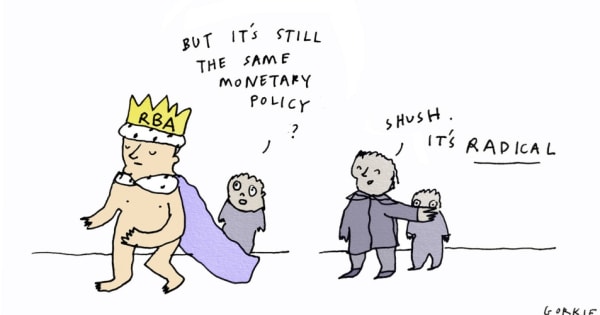
The RBA policy conflates two distinct issues: the lack of competition in banking, and housing affordability. The idea of a new “people’s bank” to disrupt the banking oligopoly, has merit. An ideologically diverse group of “six economists” (including Nicholas Gruen) featured an “Aussiebank” idea in their call for financial reform nearly a decade ago. But the Greens have shoehorned it into housing finance, and propose that the Reserve Bank play that role and offer discounted mortgages for 60% of the price of a property purchased by first home buyers.
Like other demand-side subsidies, such as the notorious first home buyer grants of recent decades, providing taxpayer-funded discounted mortgages will pump more money into the housing market, which in the absence of additional supply will simply push housing prices up. As a political party almost definitionally NIMBYist, the Greens are a priori opposed to additional housing supply in established suburbs. With lower interest bills over the life of a mortgage, home buyers will be able to bid higher for the same pool of properties. At a time when a major party has finally backed curbs on negative gearing and capital gains tax exemptions (a policy originally championed by the Greens), the last thing we need is another mechanism to pump more taxpayer money into house prices.
And like most handout mechanisms, this would be rorted by the wealthy. Who can afford a 40% deposit on a property? They’re the ones who’ll be knocking on the door at Martin Place to demand a cheap mortgage for the other 60%. The rest will have to go another bank for the remainder of the mortgage, and pay extra for the privilege of being given a second mortgage.
There’s good reasons why the Reserve Bank was hived off from the Commonwealth Bank in 1959. Governments realised the then-Commonwealth Bank couldn’t both be a participant in the market and exercise the regulatory and prudential functions of a central bank. The Greens’ plan would undo the 1959 Reserve Bank Act and have the Reserve Bank both competing with, and regulating, other banks. This would wreck the relationship between the RBA and other key financial regulators and compromise the independence of monetary policy setting. And who would vet the RBA’s lending standards? Who would be the lender of last resort if the RBA’s mortgage arm failed? Rival banks would face higher costs from foreign lenders concerned about the implications for stability of a return to the pre-1959 system. We’d need to set up a new, separate central bank to play the RBA’s role, which it couldn’t once it became a competitor to other banks.
Utter nonsense.
Then there’s UBI. If you advocate UBI — paying everyone an non-means-tested basic income — you’re either a fool, or you have an interest in undercutting wages. That’s why some tech billionaires advocate UBI; it would enable them to slash the wages of their workers without worrying that their employees will starve to death or (more importantly) not be able to buy their products and services.
The problem of UBI advocates from the left though is that they can’t do the maths. To give even a minority of Australians — say, those in the lowest two income quintiles — a basic income would require tens of billions of dollars extra beyond the current cost of all welfare — far more than you’d save from sacking every Social Services bureaucrat. And what about people with special needs, or carers? Do people living in cities get more than people living in country towns? Oh wait, you sacked all the bureaucrats, so even if you wanted some nuance in UBI to reflect different needs, you can’t do it.
And what if the best way to fix poverty isn’t the small-government, individual responsibility approach of UBI (just hand people money and let them do what they want) but through quality education and training or a better health service?
Oh yeah, didn’t think about that.




Sorry, Bernard, but I’d rather have policies like the ones The Greens are advocating, over the clearly failed, status-quo “neo-liberal” economic policies still being loudly advocated by the Laboral Party.
Well, that’s a convincing argument. Bonus points for “Laboral” as if the party that wants to finally bring an end to the negative gearing distortion in the housing market and the party that wants to shovel 60 billion into the pockets of big business are exactly alike.
Yeah, a bit of a facile attempt to take down the policy.
I haven’t read the Greens policy, but it sounds like Nicholas Gruen’s highly credible idea of using the RBA to provide basic retail banking, among other reasons to set some competition in the least competitive sector in the nation (ok, the energy sector might be worse)
If it is just Nicholas Gruen’s policy prescription, I’m all for it, but I recognise that they will have to manage the issue of pumping up the mortgage market. I suspect that Nick Gruen has some policy ideas to defeat that problem.
As for UBI, your review doesn’t even make it to facile. If we have a minimum wage (we do!) then I’m not sure how this could be used to undercut wages. And the maths, well, this is where the case has not been made strongly, but it would involve a complete re-set of the tax code, which we need in any case. Companies would have to start paying it, for one. People on big wages would have to pay much more at the marginal rates. It probably requires a cross over where people earning more than say $180K will pay more than they make out of the UBI and their current tax component, but everyone below that ends up better.
Flow on positive effects of a UBI haven’t been remotely considered by the geniuses of economics. You continue to labour under the impression that classical economics has some useful insights, and mostly that isn’t the case. Things considered axiomatic are largely dreamland fantasy world assumptions.
Bill Mitchell has much more useful to say on the subject. I’ll defer to his greater study where he is inclined to advocate a universal jobs guarantee, which would also work, but also requires classical economic theory to take a back seat.
Personally, I want classical economic theory to be thrown off the bus rather than take a back seat, but then again, I’m inclined to look at something that has failed miserably for the last 20 plus years and decide that maybe that’s long enough.
You just let wages stagnate forever and when people complain you go “Look, you got UBI, what are you complaining about?”
Not to mention people above the minimum wage who would continue to have their benefits taken away bit by bit except now you got a UBI, nothing to complain about!
It is just legislating Cashies
I’m not sure you understand the principles involved in getting to a society that is prepared to introduce a UBI. It certainly won’t be run by the likes of our current self serving politicians indebted to the elite ruling classes who contribute to their election coffers.
Once the concept is accepted by the masses, an indexed basic income (as opposed to a minimum wage), would apply to everyone, irrespective of employment/unemployment, ability/disability and gender.
Any other income would be market based and entirely separate from a UBI as far as wage negotiation is concerned. The ‘you’ you are referring to won’t have the power they have today as workers won’t be as financially vulnerable and so wouldn’t be as desperate to accept unreasonable wages. Bad employers just wouldn’t survive.
And no, it’s not ‘legislating cashies’ as we will be living in a cashless society long before any UBI is likely to be introduced.
You think wages can’t be undercut because there’s a minimum wage?
Um, that just sets a floor. That’s even assuming a minimum wage would remain in place with UBI (because the business people pushing UBI would certainly argue there’s no need when people are getting a minimum payment already) and that it wouldn’t be greatly reduced (it would be).
I’ve yet to see a coherent argument for UBI which explains where the money for UBI comes from without slashing social services and infrastructure something drastic. It’s not a left wing progressive idea at all, it’s a nasty little thought virus coming from anti-government libertarians who don’t like welfare, regulation, universal healthcare, universal education etc and instead of spending taxes on those things want money just dumped in the hands of citizens.
Actually Bernard, as you know, the Greens do have excellent policies around health and education. There was never a suggestion that the UBI would replace those. And remember the role taxes play (or should) in income equalisation (and funding health and education). I’m happy to see new (or old) ideas being thrown into the same boring old trickle-down mix of the 2 main parties – and sorry to see you dismiss them in such a superficial way.
The Greens take a step back from the neoliberal cancer that has nearly destroyed civilisation, as opposed to the “go harder, it has to start working soon” perspective and they’re the crazy ones ?
What’s the definition of insanity again ? Doing the same thing over and over expecting a different result ?
UBI is neolib as hell.
As stated previously, I don’t think you fully understand the concept of a UBI or the forces behind this social approach to wealth distribution which has nothing to do with the failed neoliberal ‘trickle down’ economics that have got us into the current predicament of high profits and stagnant wages.
Some UBI proposals are neoliberal. The ones that want to use a UBI to replace all welfare and social services, and privatise all public services and assets.
That is certainly the line taken above and by your local Rupertarian.
But it is not, so far as I can tell – details are sparse – what is being proposed by the Greens.
“Some UBI proposals are neoliberal. The ones that want to use a UBI to replace all welfare and social services, and privatise all public services and assets”
Indeed but such is not the point of a UBI at all. If you wish the UBI to have a label then “Marxist” is as good as any because the point of a UBI is to redistribute the asset base. As someone pointed out it ought to be known as U.B wealth.
Another correspondent suggested that examples ought to be considered from what occurs overseas. Such a proposal doesn’t assist either. As pointed out the proposal is a bit like the matter of the republic : there are any number of models. The idea is anything but new; in fact it has been around for decades.
“But it is not, so far as I can tell – details are sparse – what is being proposed by the Greens.”
Are you in possession of any proposal by the Greens that does possess detail with definitive procedures? The party has not published a single analytical document that is anywhere near tertiary standard; heaps of J.W. -like sheets of A4 : Yes.
Complete with NIMBYism and keeping the rif-faff at bay in their suburbs there is an excellent chance that the big announcement from di Natale will barely amount to a belch.
Indeed but such is not the point of a UBI at all. If you wish the UBI to have a label then “Marxist” is as good as any because the point of a UBI is to redistribute the asset base. As someone pointed out it ought to be known as U.B wealth.
The “point” of a UBI is generally dependent on who is pushing it.
Some people push it as a form of citizens’ dividend.
Some people push it as a way to privatise welfare.
Are you in possession of any proposal by the Greens that does possess detail with definitive procedures?
None whatsoever. Just what was mentioned by Di Natale.
I too, believe that a people’s bank is not such a terrible idea. After all, the Commonwealth Bank did very well for decades putting pressure on the other banks in making them perform under true competition. Selling off the Com Bank was a capitalist’s wet dream come true.
Of course, you would need firm rules to keep out the wealthy rorting the system, but that shouldn’t be too hard if the determination was there.