
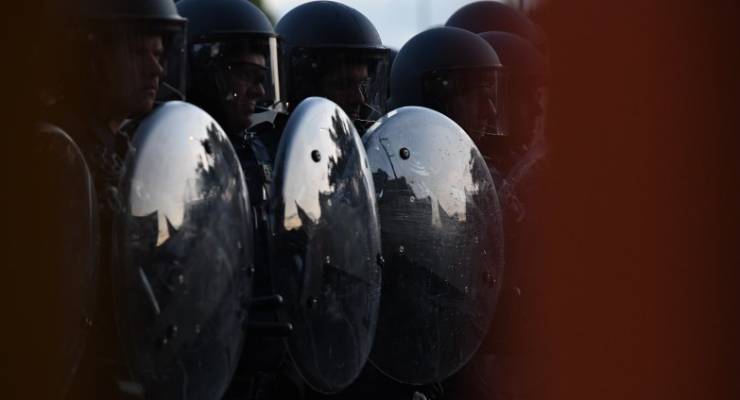
This week, the extraordinary power of Australia’s police and intelligence services to go after the media was on full display. The Australian Federal Police’s raids on the ABC and News Corp journalist Annika Smethurst’s home have exposed the narrowing of press freedom in Australia. They are the outcome of more than a decade spent steadily expanding the national security apparatus, giving agencies greater power to erode our civil liberties.
One of the reasons it is so easy for these powers to expand is Australia’s lack of a bill of rights, or any kind of constitutionally entrenched bulwark against excessive state power. It’s a position that puts us out of step with much of the rest of the world — Australia remains the only Western nation without some kind of bill or charter of freedoms.
United States
The United States Bill of Rights, which comprises the first 10 amendments to the US constitution, was created in 1789 and ratified two days later. The bill enshrines many of the principles Americans now take for granted: the first amendment, which protects free speech; the second amendment, which provides the right to bear firearms; and the fourth amendment, prohibiting unreasonable search and seizure.
For the first hundred or so years of its existence, the bill of rights lay largely dormant. It wasn’t until the 20th century, thanks to the efforts of civil rights organisations, that many of the amendments started being enforced and the rights and freedoms enshrined in the constitution were extended to all Americans, including women and people of colour.
While the US, like the rest of the Western world, has ratcheted up its restrictions on national security reporting, the first amendment has historically provided important protections in this area. In 1971, The New York Times began publishing details from the Pentagon Papers, which documented 20 years of government lies and misinformation regarding US involvement in Vietnam — a situation reminiscent of the ABC Afghan Files stories, which triggered the AFP’s raid.
The Nixon Administration sought to restrain publication of the papers under espionage laws but the Supreme Court, in a landmark decision, held that the first amendment protected publication.
United Kingdom
Britain passed the world’s first bill of rights — The English Bill of Rights — in 1689. It provided a blueprint for the United States’ own version and introduced important concepts, like parliamentary freedom of speech, which still have currency today. In 1998, the United Kingdom introduced its Human Rights Act, which incorporates the European Union Convention on Human Rights into English law. Importantly, the act allowed litigants to get a remedy for breach of the convention in UK courts, rather than at the European Court of Human Rights in Strasbourg.
Article 10 of the convention, contained in the schedule to the UK act, provides a right to freedom of expression, including the right “to receive and impart information without interference by public authority”. Article eight provides the right to privacy.
That legislation had an impact right from the get-go. An early review found that it promoted greater transparency and that public bodies were more likely to conform to human rights obligations. The act effectively provides an additional layer of regulation with which intelligence services must comply.
New Zealand
Following concerns about a dangerous power imbalance in favour of the executive, New Zealand enacted the New Zealand Bill of Rights Act 1990. The act provides protection for a number of freedoms, including freedom to seek, receive and impart information and opinions of any kind.
While the act does not allow individuals to take legal action against the government, it does force courts to consider it when interpreting legislation. It is also less strong than the UK model, as it does not allow courts to make an explicit declaration of incompatibility. However the laws do still influence the development of national security legislation. For example, while New Zealand’s 2017 Intelligence and Security Act expanded the powers of intelligence services, it contained sections integrating elements of the bill of rights act in order to comply with it.
Canada
The Canadian Bill of Rights was enacted in 1960. The ineffectiveness of that law led to the creation of a constitutionally entrenched Charter of Rights and Freedoms in 1982, which enshrined freedom of expression and freedom of the press.
Organisations like the Canadian Civil Liberties Association are empowered to challenge laws that violate the charter. For example, in 2014 the CCLA brought a lawsuit against laws giving the government warrantless access to citizen’s data.
Australian States and Territories
Three Australian states have introduced some form of charter or bill of rights. In 2004, the ACT passed the ACT Human Rights Act. This was followed by Victoria’s Charter of Human Rights and Responsibilities Act 2006 two years later. In February this year, Queensland became the third Australian state to follow, passing its own human rights act.
The protection under state legislation is somewhat limited; they generally harmonise existing state human rights laws and provide avenue for complaints. While they don’t allow courts to strike down laws, they ensure that judges should interpret statutes in line with the acts. Those acts are not entirely toothless: in 2017, Melbourne dumped a proposed ban on homeless people sleeping on the streets, after legal advice suggested it would violate the state’s charter.




With all due respect, if you feel that the Crikey membership requires that kind of a history lesson (dammed falkey by the way) then the subscribers need to repeat primary school.
More to the point, that you OUGHT to have mentioned, is that the Bill of Rights did not protect Snowden (who identified illegal activity by the NSA) and McCarthyism destroyed the lives (Oppenheimer included) of countless writers and intellectuals. Even someone as innocuous as Charlie Chaplin had his visa revoked permanently. Such is just for the USA and I haven’t started with politically directed police brutality from the time of Reconstruction, The Depression, Vietnam and hence. Similar weirdness exists in the history of the UK.
To date I have given you the benefit of the doubt but the presentation of this article revels, it would appear, (1) a contempt for detail and (2) a besotted attachment for particular views. I don’t think that I am being unfair.
Thanks kyle now I get your point and agree. A BoR is only as good as the govt of the day commitment to rule of law and the commitment of the judiciary to same.
The US BoR has been notably absent in protecting against gerrymandering and electoral disempowerment and fraud. I’d still argue it’s better than nothing.
I would not. The First Amendment has protected everything from the KKK to modern-day white supremacists and Neo Nazis still gleefully exercising their rights to fly the flags of hatedom and intimidate African-Americans in their community to “fake news”. It didn’t protect people from McCarthyism. It didn’t protect anti-war advocates from being demonised and intimidated and shunned… Or look at the kneeling protests in the NFL. The establishment just finds other ways to get you for speech they don’t like.
The Second Amendment has enshrined gun culture in America, obviously.
Most of the rest of the bill of rights focuses on rights to a fair trial and other fair treatment in criminal processes.
The good parts of the US constitition, such as the guarantee of equal treatment under the law (which has begun to belatedly be realised as guaranteeing equal treatment for black people and gay people and women and not just straight white dudes) were not in the “bill of rights” per se.
The last part of article
“Those acts are not entirely toothless: in 2017, Melbourne dumped a proposed ban on homeless people sleeping on the streets, after legal advice suggested it would violate the state’s charter.”
Is really an argument against the function of a human rights bill in advancing society
Its on the threshold of my point Desmond. There is a swag of common law and any amount of ad-hoc Statute to deal with “rights” now. Another straw is not going to contribute a damned thing (of significance) however wishful the thinking might be.
As Raws (because he was introduced by another subscriber in regard to the result of the election) would be obliged to admit : how is the “right” to sleep in the street (or under a bridge) to be reconciled with with someone in Toorak (or elsewhere, with equal rights) who deems the conduct unbecoming?
To be fair to Rawls, he did recognise that his theories do not translate easily into policy [although they do make some people feel good] but it is policy (for the future) that is under discussion.
This would have been better presented in comic form for all the information contained therein that might have been new – to anyone who didn’t leave skool before the Intermediate, as was.
NOW there is an interesting educational initiative for future topics for those with, shall we say, different leaning styles, upon which references, however authoritative, seem to have little effect; including some of the staff.
Can we stop harping on about a bill of rights? After the last election I would have thought that the electors’ cowardice and ignorance was sufficient to make even a modicum of change to tax arrangements impossible. A realignment of the power relationship between the citizen and the state is a fantasy.
Of more concern than a Bill of Rights, which may make absolutely no difference to the behaviour of the ‘man”, is the sudden burst of energetic activity that has inspired the AFP to act on these points…and the amazingly striking timing of it.
The over delicate acting Commissioner is hurt by the public scrutiny…wants everybody to know his mob are on the up and up and that we should all just forget about the firing squads in Indonesia and the Australian kids who the AFP sponsored to attend.
Yer Nah……………..I wont ever forget that one.