
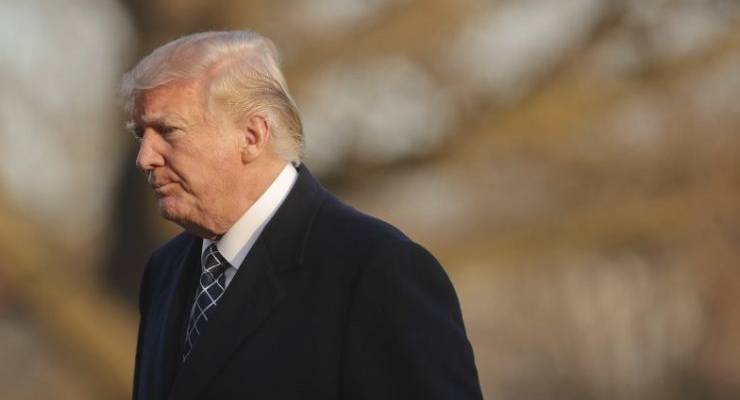
One of the problems for people who rail against Trump is that the First Toddler is so wildly inconsistent. As such, a “Trump is wrong on all things all the time” mindset is apt to induce inconsistency on the part of those who hold it.
The same is true for his diehard supporters — much comment has been made about Senate leader Mitch McConnell, normally a diehard Trump supporter, excoriating the president’s Sunday night “decision” to clear the way for Turkey’s murderous Erdoğan regime to invade Syria and attack Kurdish groups, most of whom have been helping Western forces destroy Islamic State. “It is time for us to get out of these ridiculous Endless Wars,” Trump tweeted, before going on to refer, Mao-like, to his “great and unmatched wisdom” in promising to punish Turkey if it does anything untoward.
Trump officials then scrambled, as they have scrambled so often before, to explain his tweets: the US wasn’t actually leaving Syria, but merely moving a small number of troops out the path of Erdoğan’s plan to exterminate as many Kurds as he could — a plan the Turkish president promptly implemented. The collective reaction to Trump’s move — from right to left, Republican to Democrat, US and abroad, Trump supporter to bitter critic — was that this was a disaster. The US had once again betrayed the Kurds; its credibility was now so tattered no ally could depend on it; the Turkish attack on the Kurds would release hundreds of IS fighters and create new areas from which they could launch attacks.
Here, the Australian government had to express a different view. Having outsourced our entire Middle Eastern foreign policy to the White House, the Netanyahu regime and the mass murderers of Riyadh, Scott Morrison had to reflexively support Trump despite being taken entirely by surprise. The prime minister tempered his support by hilariously urging “restraint of all of those who are involved”. Particularly the Kurds, one assumes, who should restrain from getting in the way of Turkish bullets and bombs.
By and large, though, the reaction from the foreign policy establishment was summed up by Nine’s Chris Uhlmann — a regular and savage critic of Trump — who argued “if an alliance that is measured in a sea of blood has no value to Trump, then what price does he put on defence relationships built on pledges of burden-sharing made by nations such as Australia?”
Trump, as on everything else, is entirely inconsistent about “Endless Wars”: at the behest of the Saudi tyranny and his former national security adviser John Bolton, he has prepared the ground for a war against Iran, which Morrison has eagerly signed us up for (Bolton’s departure hasn’t removed his toxic presence, by the way: only this week we learnt the US would be abandoning the “open skies” arms control treaty). But Trump’s shuffling of troops around Syria has exposed how fragile — and facile — the arguments are for maintaining Western forces in yet another Middle Eastern country.
Trump’s former UN ambassador Nikki Haley argued that the US had to continue to, in effect, guarantee Kurdish security because of their contribution to the defeat of IS. But think that logic through: IS was created as a direct result of the illegal Western attack on Iraq by George W. Bush, Tony Blair, John Howard and other miscreants. IS then became the pretext for another military venture in the Middle East in 2014. Now we’re told that, as a consequence of that secondary venture, Western forces must remain there.
These are literally “Endless Wars”, with each one creating the pretext for another venture justified by neoconservatives and the foreign policy establishment as crucial to security, stability and that precious commodity of “credibility”. For Trump’s critics there will never be a point at which the US, and other Western countries, should end their interventionism.
The same circular logic applies to the argument that continued Western involvement is crucial to prevent the establishment of safe havens for terrorists. But we’re still in Afghanistan more than 15 years after invading it for that very reason, and continue to be there because our invasion created more terrorists. The Iraq invasion created an entirely new generation of terrorists around the world, as did Islamic State. As Patrick Buchanan notes, “al-Qaeda and ISIS are in many more places today than they were when we intervened in the Middle East”. Interventionism, as Crikey has argued for years, simply creates more terrorists, which become the pretext for more interventions.
Trump is rarely right, and when he is, you just need to wait five minutes and he’ll change his mind, or his officials will brief something different. But his resistance to “Endless Wars” — at least those he hasn’t started himself — is a rare moment of open challenge to the doctrine that has given us nearly two decades of a multitrillion-dollar War On Terror with no end in sight.
Has Donald Trump made the right decision on Syria? Send your thoughts to boss@crikey.com.au. Please include your full name for publication.




I would be interested in David Kilcullen’s comments on the Syrian conflict, Turkey, the Kurds and the US pull out.
A truly brave and great decision if it sticks.
there is nothing “brave” about Trump’s decision. He is just selling out the Kurds to the local bully (Turkey) & getting US forces for the next big Middle Eastern War.
Oh Dear, the US has systematically betrayed its non-state allies at least since the end of WWII. The Italian Partisans (Communist), the French Resistance (Communist) may not have faired too badly, but the Greeks (Communist) who started a a civil war in 1946 found British, and US troops in their way. The Malaysian Communist the Indonesian and others who fought with the Allies against Germany and Japan were betrayed.
My record is not complete, so, what about the Kurds? They fought for us against ISIS, and , now the US is leaving them to be attacked by the Turks..
I agree with Trump withdrawing from the middle east. But, how do we unravel this monstrous mess?
Trump should be negotiating a state for the Kurds.. I know many don’t like that idea much either but, letting the Turks wipe them out so that he ca do what needs to be done isn’t right either.
“They fought for us against ISIS, and , now the US is leaving them to be attacked by the Turks…”
This is the spin as presented by the Kurds and the US eternal war establishment who seem unrestrained by allegiance to their current war master. I suggest consider the statement another way around…. “ they fought for their own and our perceived interests against ISIS with our help (and pay) and now that period has ended its back to fighting the Turks…”
Afghanistan was a homicidal disaster with totally illegal and pointless mass bombing of civilians to start and war on rural peasants thereafter. Invasion was completely unnecessary. A police style action to track down bin Laden in a failed state was all that was required. Iraq was a complete fabrication and even bigger disaster creating ISIS and the Syrian war.
There is no nice way to wrap it all up. Conflict will continue regardless. The US should attempt to do what it always should have – play the honest broker to help negotiate workable diplomatic and political solutions. A fool’s errand perhaps but much better than killing people endlessly and pointlessly.
The US has never played the honest broker. The US has always done whats best for the US. And that usually involves oil. And the people who are on the boards of oil companies.
Great points Mark, all Western powers, including us, should stop indulging in endless wars and get on with some serious infrastructure rebuilding and humanitarian aid in the middle east…..if the place can be made safe and habitable the tide of refugees will stop and many will be happy to return home.
And, another thing, are the Kurds less deserving of a national homeland the Jews?
I agree Karl. In fact, I think it would be a very smart move on Israel’s part to sponsor the creation of a Kurdish homeland. Surely, of all the nations on earth, the Israelis must understand the importance of a homeland to a people better than anyone else? Plus, it would be the right thing to do morally, it addresses at least some of the problems that the West created last century when it divided up the region with no concern for the people who lived there, it would remove some of the pressures for conflict, it would weaken Israel’s enemies to an extent, it would demotivate Kurdish alignment with another power (like Iran or Russia) and it would give Israel something it desperately needs in the region: an ally.
It would also allow the West to withdraw its physical presence while Israel and the Kurds remain as proxy (which it could then support with economic and military aid behind the scenes if it wished). I think a managed removal of the West’s physical presence would be in everyone’s best interests.
Granted it would annoy a few people. Tinpot dictators like Assad and Erdogan. Aspirationals like Putin and the Iranians. People who profit from endless war, like the US military industry. Excuse me while I cry into my handkerchief.
I’m not a Middle East expert. Maybe I’m oversimplifying, but it ticks quite a few boxes as far as I can see. Whether the Kurds would accept Israeli help is another issue, but surely it’s worth a try?
Unfortunately Israel’s government does not want peace. Peace means an end to the military industrial complex. Peace means countries can develop and modernise their economies and begin shaking off colonial influence. Peace is a disaster for the US/Saudi/Israel alliance. Although Saudi Arabia is slowly coming round to the idea after their recent military humiliations. The Saudi regime seem to do a competent job bombing Yemeni civilians and infrastructure whilst simultaneously causing mass famine, but they seem pretty amateurish when faced with active resistance from impoverished Yemeni soldiers attacking Aramco oil facilities and ambushing their poorly paid foreign mercenaries.
It’s not the worst idea Graeski. The newly formed Kurdish nation might also be a block against a Turkish tyrant in the region.
Erdogan worries me as much as the Saudis. Economic sanctions should be brought to bear against Turkish over reach.
I have no idea about Syria and that murderous Assad. His presence continues to ensure no peace in the middle East. The question is well put by bones as to who in the middle east wants peace. I dont think Israel, Saudi Arabia or Syria have the slightest intention of allowing peace right now.
I was reading about this the other day, and it seems Israel has backed Kurdish independence for a long time. Even Netanyahu has spoken out in favour of it. So the will is there, but the question is how you’re going to convince Iraq – much less Assad’s Syria – to cede territory.
History shows that that the Middle East has been in conflict for thousands of years. How niave are Western Governments to believe that they have the answer to stop this.
Invading Syria, Iraq etc is like hitting a wasps nest with a stick. The wasps will come out and follow you home to make you pay for disturbing them. This is exactly what happened. Just leave them to it.
History shows the indigenous were in Australia for thousands of years and the West had an answer for that .Just leave them to it doesn’t seem to work historically ..Leaving the party after you’ve managed to help trash the place doesn’t seem to be very civilised behaviour ..and the unintended consequences ? The intended consequences were bad enough. You can’t always run away from the problems that you helped create and expect all destruction that you’ve had a hand in will then leave you alone..History doesn’t seem to work like that..
Western governments are there to control energy resources (primarily oil) and create failed states. Zero sum game theory.
Hmmm. I think you’ll find that most of the conflict in the Middle East has been since European colonisation and interference after WW1 and the collapse of the Ottoman Empire. In the centuries prior to that, the Europeans were much more effective at internecine slaughter than the Middle-Easterners.
Read some history, it started before the creation of the Ottoman Empire, and the picture may look somewhat different.
“Just leave them to it.”
With that approach Saddam Hussein would still be in control of Kuwait and God knows what else.