

On the eve of Britain’s third general election in five years, late indications are that the Conservatives have a nervous night ahead of them, after starting the campaign hot favourites for an elusive parliamentary majority.
While continuing to rate that the most likely outcome, the final reading of YouGov’s multi-level regression and post-stratification (MRP) model appears to confirm a late trend to Labour, leaving a hung parliament scenario well inside the margin of error.
The model is being taken particularly seriously, as its skeptically-received prediction in 2017 was entirely vindicated by the result — a particularly remarkable achievement in the UK, where pre-election polling has long struggled to prove its worth.
A similar prestige was enjoyed in the US before the 2016 election by Nate Silver and his ilk, whose poll aggregation methods likewise enjoyed a record of near pinpoint accuracy — right up until they didn’t.
Whatever methods a pollster employs, the great imponderable at this election is how the age distribution of the voting population will break down on polling day.
Such is the extraordinary imbalance that has developed between old and young voters that even a small miscalculation in turnout projections will cause a pollster’s reading of the situation to be badly askew.
The emergence of age as a powerful predictor of voting behaviour comes at a time when social class, which has long provided the British party system with its defining cleavage, has ceased to carry weight.
According to the YouGov MRP model, the Conservatives now hold a 44-37 lead over Labour among voters without post-school qualifications, whereas Labour leads 39-33 among those with a university degree.
The Conservatives are accordingly plotting a path to victory through pro-Brexit working class seats in northern England and Wales, potentially offering a counterpoint to Labour’s 2017 victories in the once blue-ribbon seats of Kensington and Canterbury at the other end of the country.
While the situation in Australia is in all respects less dramatic, this dynamic should sound familiar from our own election in May, at which the Liberals suffered large (albeit ultimately harmless) swings in wealthy capital city seats. Blue-collar voters in regional Queensland and northern Tasmania turned decisively the other way.
Puzzling though it may seem that affluent voters should turn to a party running an unusually bold redistributive agenda, the trend makes more sense when viewed through the lens of the age-effect.
Seats like North Sydney and Higgins, which delivered Labor some of their strongest swings, are distinguished not only by wealth, but also by large concentrations of voters in their 20s and 30s.
This point was reinforced by the release this week of the Australian National University’s regular post-election Australian Election Study survey, which produced a sting in the tail for the winning party by finding its support had fallen to an historic low among those aged 18 to 34.
Notably, the beneficiary was not Labor but the Greens, who are rather a better proxy for Corbynite sentiment in Australia than Labor.
The Greens were credited with an unprecedented 28% to 23% lead over the Liberals among this cohort, blowing out to 37% to 15% among those under 25 (with due caution in this case for a small sample size).
In Australia as elsewhere, though, the new young left has appeared impotent in the face of a rising populism for which support has been concentrated among baby boomers.
Minus the Australian peculiarity of compulsory voting, this could be readily explained in most overseas contexts by young voters dropping out of the political process altogether, while their more conservative parents and grandparents maintained lifelong habits of civic engagement and belief in the efficacy of the electoral process.
Jeremy Corbyn’s demonstrated capacity to energise young voters, together with an upsurge in pre-election enrolments, offers Labour a flicker of hope that things might be different this time.
Although a Labour win must still be reckoned a long shot, and a parliamentary majority all but out of the question, it would be a considerable understatement to say that election night in Britain has surprised before.
Should it do so again, the result may yet demonstrate that the evident demise of the west’s liberal consensus offers just as many opportunities for the left as the right.



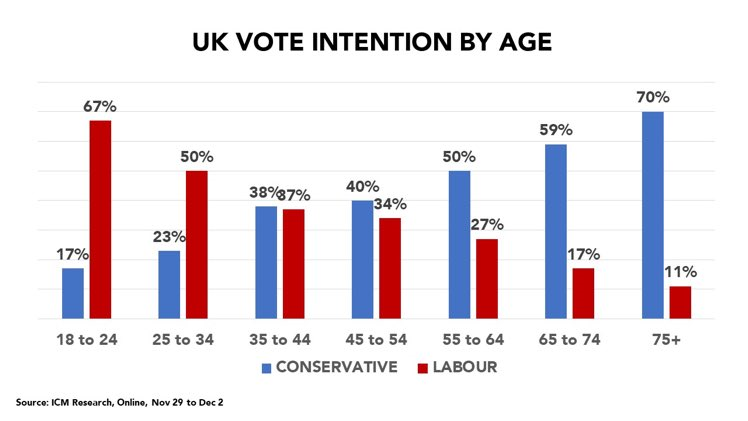
‘The evident demise of the west’s liberal consensus offers just as many opportunities for the left as the right’ – yes, except that older voters are more likely to vote than younger ones, and are more likely to vote conservative; and voters of any age are more likely to be galvanised by right-wing populists to vote at all; whereas left-wing voters disenchanted by the demise of the liberal consensus are more likely to disengage from the voting process altogether. The situation is exacerbated by the fact that the voting population in developed nations like the UK, the US and Australia is already heavily skewed towards older voters. In short: the parties of the left need to strategically elect leaders who will galvanise younger voters. Obama was the most obvious recent example in the US; Bernie may do likewise, despite his age; Alexandria Ocasio Cortez and Ilhan Omar are obvious future candidates for leadership; in Australia, Penny Wong is the obvious choice. Meanwhile, perhaps we just have to wait for the boomers to roll over and die.
… and leave their houses and other assets to their children, who will promptly switch allegiance to the party of capital. Be nice to think otherwise.
I do think its going to come down to preference of prime minister, Boris Johnston has the same issues as Donald Trump does. their both in it for the razzle dazzle, the reality is they don’t have the political stamina or where-with all to do the long haul, they both really don’t understand the concept of governance well enough to work in a democratic government especially of the size & importance of the UK & US, (it takes a certain type of person to be able to make a success of this type of occupation), neither have a) a the necessary leadership qualities or b) the capacity to actually develop policies that will actually have the staying power & fit with the current world issues we’re living with…
With young people demanding to be heard & actually holding governments accountable for the inertia that has been happening for many years/ also to ransom & demanding they start actually playing their part in changing the direction of what’s happening to the world before it’s too late, this will make the difference..
This last part is going to have a real affect on the outcome of this election…
Not a bad synopsis, WB, but it seems to be that you have over-thought the matter. I agree as to the implied autocorrelated polling that will require special consideration.
GR pointed out that that not a scrap of policy has been mentioned post Brexit regarding the election by any side. Yet, Boris holds the moral ground just on the basis of the referendum. Do the anti-Brexit-ers of Labor
think, by some miracle, that there will be a 2nd referendum with a result contrary to the first referendum?
“as its skeptically-received”
Do you mean ‘sceptically’?
Oh well. Someone will point out the spelling in 16th century East Anglia which proved you right.
From an analysts perspective, I don’t know how anyone claims knowledge of likely voting patterns in an non-compulsory, first past the post, vote on a work-day poll, but that would just be me.
If it does come in as per polls, let me confirm for you that it is a fluke.
non-compulsory : about 7 millon eligible votes failed to register on the Rolls so “indifference” can be factored.
first past : kinda but at least the result is more or less binary; little auto-correlation
week-day voting : the Brits are accustomed to it but has associations with “indifference”
The Brits have a practice known as “exit polling” were one indicated how one voted and one departs from the booth. The correlation between the trends with the exit polls and the actual result are remarkably high.
I’ve remarked on the Scottish vote, the Brexit vote and the (latest and greatest) May 2019 general election in Australia from a statistical perspective. Suppressing my humility, I predicted correctly all three and indeed (see above) the victory for mob-head.
Looks like the young people have spoken and wiped the floor with Jeremy Corbyn.