
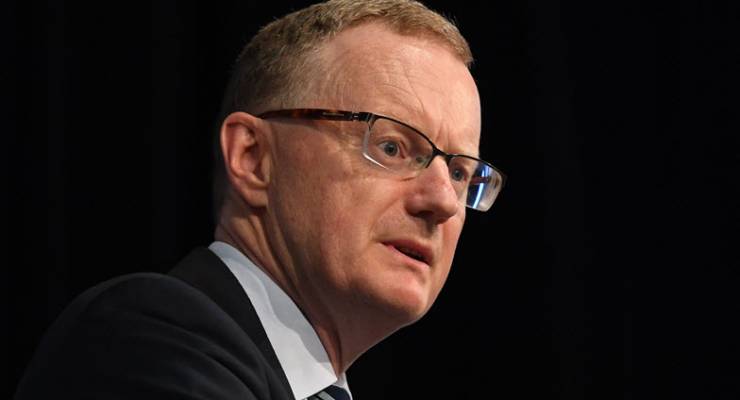
While markets think an interest rate cut by the Reserve Bank this afternoon is a given, it’s not clear exactly what it would do.
The lesson from interest rate cuts of recent years is that they encourage housing markets but consumers don’t spend more — instead, they keep their mortgage payments at the same level and try to pay their mortgages down faster.
Recently, the proportion of mortgage holders that reduce repayments is as low as 1% at some banks, and no higher than 7% at others.
During the financial crisis, substantial Reserve Bank interest rate cuts also saw mortgage holders preferring to pay down debt — in fact, the crisis saw a big rise in Australian households’ savings rates that took years to wear off.
When consumers are being bombarded with news about imminent recession and possible financial catastrophe, the instinct is to save as much as possible.
But they did spend the Rudd-Swan government’s stimulus handouts, with strong and effective encouragement from our political leaders to get out and shop.
Last year consumers hoarded interest rate cuts again: people on maturing fixed interest home loans have been moving to lower variable rate mortgages at such a pace that the average rate on all variable rate mortgages will fall by 0.75% by May of this year, according to the Reserve Bank, with the savings are going into bigger repayments.
But they also hoarded Scott Morrison’s vaunted tax offsets, with retail sales actually falling in their wake.
That reflects a bunker mentality on the part of consumers, one created not by a sudden burst of bad news, but by years of wage stagnation that has shrivelled household incomes and ingrained long-term expectations that pay is barely going to keep ahead of inflation even when the latter is at historic lows.
As the key architect of wage stagnation, with a suite of anti-union legislation, support for penalty rate cuts, neutrality on minimum wage rises and an endless series of endlessly wrong forecasts that wages growth was about to surge, the government is thus trapped in a low-confidence spiral of its own creation.
Business isn’t spending either. Last week’s awful investment figures for the December quarter point to a deep reluctance by business to invest given a stagnant economy and consumers whose first instinct is to save.
One of the funnier pieces of spin around about that is the claim that the December quarter investment slump was because business was waiting for the depreciation allowance everyone thinks the government is going to announce in the budget.
Unfortunately, investment has been trending down since 2018. It fell nearly 6% across 2019. A bigger depreciation allowance or some other investment incentive will spur investment, but is not going to make up for several quarters of investment decline.
An interest rate cut will further reduce borrowing costs for business, which should encourage more investment, but when rates are already at record lows, another 0.25 percentage points, or even 0.5, isn’t going to unleash a tsunami of new spending either.
It’s interesting that some of those urging against a rate cut now are the usual suspects: Warwick McKibbin, Warren Hogan, Michael Stutchbury at The Australian Financial Review.
They spent much of 2018 calling for interest rate increases. Given the investment and consumer spending slump that unfolded over 2019, just imagine what a mess we’d be in if the RBA had taken their advice, altered its inflation target and inflicted punitive rate hikes on an economy in desperate need of help.
The recession that Hogan is now warning of might have come a lot sooner, leaving us in deep strife after the summer from hell.
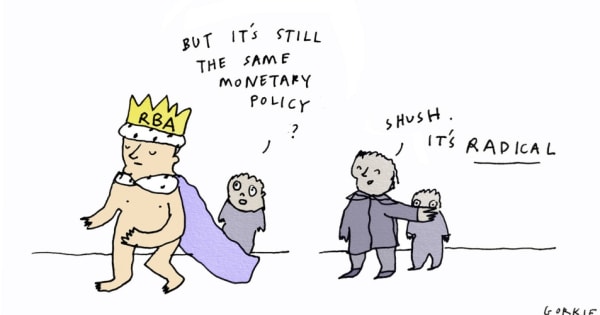
About the only thing that an interest cut will do at this point is to provide a cushion against the slump in China, and signal to business, consumers and investors that at least some policymakers recognise the need for action as a potentially severe economic disruption takes hold.
But both the Reserve Bank and the government have to be in lockstep for that to work effectively, as it did during the financial crisis.
At this point, officially, the government is still committed to a contractionary fiscal policy while the RBA has the monetary flood gates nearly at maximum width.
What the country needs is leadership, a signal to voters that someone competent is in charge and has a plan for how to deal with what’s happening.
Philip Lowe can’t do that by himself. Scott and Josh, we’re still waiting.


How much are they on?
“Stagnant wages”, “artificially inflated house prices” – what part of “shoring up home ownership before the flood comes” human nature doesn’t the RBA or this government understand?
Would the RBA and the rest of the Morrison government trust Scotty From Marketing, and his Marketeers Club government, to look after them when the grits hit the pan?
I’m probably amongst those that is counted as making lower repayments on their loan as my bank reduced my monthly minimum, but the reality is that the extra money is just sitting and pilling up at a faster rate in my offset account, ready to be spent sometime in the future if i need it.
Up until now, this Government has mismanaged our national economy – all the while telling the public that everything is fine and that they are better economic managers than the opposition. Looking at the evidence, that is bullshit! Regrettably, It appears that the saying that bullshit baffles brains may be true in this instance .
According to our Prime Minister he remains wedded to a surplus and will not fiscally stimulate our economy if it begins to tank under pressure from the COVID-19 scare. He still decries the fiscal stimulus deployed in 2008/9 by Rudd/Henry, (with world wide acknowledged success) when the Global Financial Crisis struck Australia. The man is a stupid, incompetent idiot!
Politicians grapple with the concept of wage stagnation – mostly because it doesn’t affect them.
It’s worth noting that while Morrison & Co are hellbent on fiscal responsibility with the budget producing a surplus they can’t understand why Australians are equally determined to be prudent at home.
So the rate cut is official.
Down to 0.5% now.
0.5% & going down, Pass the parcel musical chairs property waltz anyone ? The monkey is grinding up the organ .