
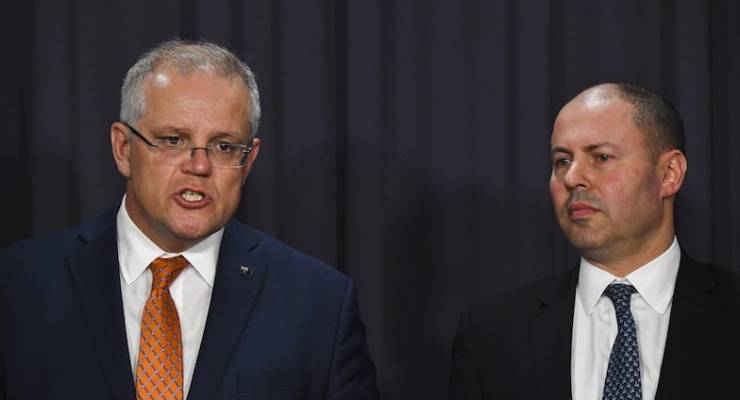
In the wake of COVID-19 Prime Minister Scott Morrison has shown some willingness to engage in fiscal stimulus.
The PM has flagged spending plans that are “targeted, modest and scalable”. This likely means some help for the sectors most affected by the pandemic at present — higher education and tourism.
Morrison was quick to emphasise that “we’re not a government that engages in extreme fiscal responses”. Translation: I’m no Kevin Rudd and I’m not going to start cutting $1000 cheques.
At this juncture, the PM has the right response. Universities and the tourism sector are being hammered, but the rest of the economy is largely feeling the flow-on effects from those two sectors. Those effects are much less severe. For now.
The real test for the Morrison government will come if COVID-19 causes severe dislocation in financial markets or a massive contraction on the demand-side of the economy, as occurred during the 2008 financial crisis.
When to use dramatic stimulus
It’s worth reprising why the Rudd-Henry fiscal stimulus was so important to Australia avoiding the worst effects of the 2008 crisis.
After the Lehman bankruptcy in mid-September 2008, global credit markets completely froze up. Banks that relied on short-term funding — often 24-48 hours in duration — to keep their operations afloat saw those funding sources evaporate. Potential lenders needed to hold on to those funds to keep their own operations from folding.
Non-financial businesses radically cut back production and employment. Households slashed spending, leading to a vicious cycle of economic contraction.
All this highlighted the central pathology of financial crises: what matters is not just what I believe is going to happen, but what I believe that you believe is going to happen, and what you believe that I believe is going to happen. And so on.
What is required to overcome this vicious cycle is what I have called the economic equivalent of the Powell doctrine (named for US general and later Secretary of State Colin Powell): “overwhelming force”.
In Australia in 2008 this meant a $52 billion stimulus, the animating idea of which was captured by then treasury secretary Ken Henry’s admonition “go hard, go early, go households”.
The COVID crisis?
Right now, the COVID-19 panic has hit global equity markets hard — with most down around 10% last week. It has led to the cancellation of a number of large conferences and festivals. It may end up severely disrupting the Olympic games.
But it has yet to cause global credit markets — the lifeblood of economic activity — to freeze up. And it has yet to lead households to retreat into a fear-induced spiral of economic contraction…
Unfortunately, there is some meaningful chance that COVID-19 morphs from a public health crisis into a full-blown financial crisis. And if it does, then the Australian government will need to be prepared to use overwhelming fiscal force to rescue the Australian economy.
There is little room for the Reserve Bank to move on monetary policy. There are only 50 basis points of rate cuts left for them use. A typical recession –let alone a depression-level event — involves about 500 basis points of rate cuts. Quantitative easing (buying long-term bonds) could help, but we can’t rely on monetary policy to save us.
The right move for now
Morrison’s “targeted, modest, and scalable” approach is right for now. But he has signalled a kind of allergic reaction to Rudd/Henry-style stimulus irrespective of the circumstances.
That’s worrying and it’s also dangerous. Now is not the time for this government to be painting itself into a corner should the crisis escalate.
Political brand differentiation is all well and good. Well, it’s not actually. But it is a reality. This government has consistently sought to contrast itself as “being able to manage money”, unlike Labor, it claims. But the Australian people will not forgive a government that puts politics ahead of economics and puts party above country.
Morrison casts his government as being fiscally prudent, but also practical and driven by common sense. If this crisis becomes a financial one, then common sense and practicality will need to take precedence over short-term balanced-budget fetishism.
Richard Holden is professor of economics at UNSW Business School.

Right wing ideology (Laissez Faire stuff) religiosity (it’s just God’s will) or is Scott Morrison just way out of his depth?
Scomo and frydenbrain, DIM AND DIMMER, no talent, no brains and no hope.
An LNP “stimulus” is really pretty easy to predict. Big banks? Tax cuts. Big miners? Tax cuts. Other big businesses who are also LNP donors? Tax cuts. The very wealthy? Tax cuts. Expect a strong “argument” that the corporate tax rate needs to be cut quickly to 25%, or even less to stimulate the economy. Expect to hear phrases like “trickle down”, “when business does well we all do well” and “a rising tide floats all boats”.
A rise in Newstart? Forget it.
Tax cuts and subsidies for the wealthy is like throwing more coal in the Titanics boilers and the result will be the same, so man the lifeboats and grab a lifejacket, Capt. Scomo and ist mate Frydrain are full steam ahead for their economic trickle-down iceberg
The article states there is a meaningful chance this virus will morph into a financial crisis where international credit markets freeze, but does not explain why or how this should happen. Hard for me to see it – can anyone help?
Coronavirus translates to Scom`s last hope for something, anything to blame for his economic mess, he thought he was out of office in may so he set the economy up for a big fail to leave labor a mess, now he`s hoist by his own petard.
Hmm….just a massive impact on consumption…millions of people not leaving their homes….massive medical costs for the already overburdened health sector….apparently toilet paper purchases will save us however….
Because international finance is all about speculation and peer-group pressure. It has nothing to do with any real-world connection or commitment, so these vast money flows go only where their controllers see money or ego-tripping to be made.
This sort of article makes me quite cranky, and its why naïve economists need to be given much less media coverage. On the surface it appears fine, but the overall message and vibe is that the Morrison/Frydenberg non-government is a safe and steady fiscal manager and is a good trustee in managing our public funds. This is massively wrong. It perpetuates that lie and is really just propoganda, repeating the misleading marketing jingle of Morrison.
This is the same political party that: pissed the opportunity of the mining boom down the toilet; that gave unsustainable tax cuts to the well off; that continue massively fiscally costly tax expenditures to the rich via superannuation tax treatment and private health insurance; and to top it off, appears to have spent nearly a billion dollars unlawfully just prior to the last election making that election result tainted with illegality and illegitimacy never seen before in federal elections. They see nothing wrong with ministers using their positions to enrich themselves or their families at the public’s fiscal cost (eg. Murray-Darling water). As well, they have steadfastly refused to introduce an effective anti-corruption body that would help stop their fiscal misconduct. Furthermore, they are, like other far-right governments attacking the very institutions introduced to assist maintain integrity such as the Auditor-General and the High Court (when Cormann effectively gave the Court the finger when he ‘forgave a debt’ of those people unlawfully paid public funds in the chaplaincy program).
Really, given their track record the only thing you can really say is that Morrison’s propaganda/ marketing jingle sounds good. It obviously sucked in the author of this article.
This government is the worst government in our political history, full of corrupted lying hypocrites and thieves, where is Scomos economic degrees that make him suitable or qualified to be first the treasurer and now the leader of this nation, he has none, propped up by a power-mad megalomaniac Rupert Murdoch and a captive of foreign corporations and Chinese big business who are buying up our farms and their water rights for peanuts and big mining stealing our minerals and getting paid by taxpayers to do it while a dumbed down population looks blindly on too stupid to see or understand what is happening to their country.
Typical and stupid response from an economists, economists are the people that get economies into recessions by their conservative ideology of take from the needy to give to the greedy, the only thing that will stop our economy from diving into Scomos ideologically driven extreme recession is a substantial lift to Newstart and his foot taken off the wages of consumers and the income of pensioners and retirees, a sugar hit of tax cuts and gifts to business will have no long term benefit with no long term lift to economic activity and just money into the pockets of the few, once this recession is entrenched it will take at least 2 years to turn around, it’s like a speeding train that needs the brakes on now and not after it leaves the tracks, it makes one wonder where these so-called economists get their degrees from, out of a Kellogs corn flakes packet it seems.