
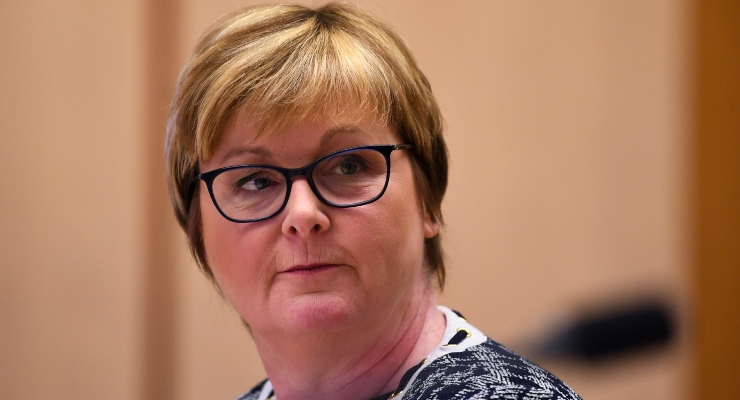
A parliamentary inquiry into controversial changes to the eligibility test for the National Disability Insurance Scheme (NDIS) has raised more questions than it answers, with seemingly misguided statements raising alarm within the disability community.
At the final hearing yesterday, NDIS chief executive Martin Hoffman said he expected more people to stop needing NDIS support (a strange assumption, considering that to be eligible participants have to prove they have a permanent disability) and was questioned about previous comments made by NDIS Minister Linda Reynolds.
The changes, called independent assessments, would see the needs of people with disabilities assessed by government-funded contractors rather than their regular healthcare specialists.
Exiting the scheme
When talking about the scheme’s sustainability, Hoffman said: “We expected more people to ‘exit’ the scheme.”
But as People with Disabilities Australia president Samantha Connor tells Crikey there are only three ways to leave the scheme: become so fed up with it you leave voluntarily; a miracle cure; death.
“To suggest that you somehow get better or recover is just this contradiction because you might build capacity but it’s just a flawed premise that you’re going to somehow need no help because you’ve had some help,” she said.
A 2017 review by the Productivity Commission found fewer people exited the system as planned. The scheme assumed more people over 65 would die or enter residential aged care, giving up their NDIS funding, and fewer children would need the NDIS as they aged.
The costs
Independent assessments are expected to save the federal budget $700 million by reducing the value of NDIS packages (though the government has denied it is a cost-cutting measure).
Hoffman pointed to the rising value of NDIS payments going to individuals: average payments to each participant increased from $39,600 to $52,300 between 2018 and 2020.
This isn’t much higher than initial estimates: in 2012, the Australian Government Actuary revealed that at full operation the NDIS would provide care to 441,000 people at a cost of $22 billion a year or $50,000 A person. There are about 10,000 fewer people on the scheme than anticipated.
Costs are expected to have increased due to COVID-19 as participants purchased personal protective equipment and at-home equipment, and group supports were replaced with one-on-one sessions. Data on plan duration is also important — as people join the scheme, initial costs may be higher due to investments such as home modifications or new wheelchairs.
“We can’t see that there is any indication that the NDIS is is unsustainable,” Connor said.
The NDIS says the increases were rising higher than estimates provided in the Productivity Commission’s 2017 review and needed to be addressed.
High- and low-functioning
At Senate estimates on Monday, Reynolds said there had been a drop in participants classified as “high functioning” and an increase in “low functioning”.
“If you think about the implications of that, it’s quite alarming,” Reynolds said. “Is the NDIS actually making people less functional over time?”
But according to the latest NDIS report, the proportion of participants categorised as low functioning remained steady at 27% between December 2017 and December 2020, with a slight increase in those recategorised from high to medium functioning.
The NDIS says it isn’t making people less functional, but that the data shows problems with how functionality is recorded: “The lower the level of function the higher the support need. This is one reason for plan budgets increasing over time.”
Misquoting experts
Senior research fellow at the Sydney University’s centre for disability research and policy Ros Madden has criticised Hoffman for misquoting her in support of the independent assessments.
In a submission to the inquiry, she wrote: “[I] request that the NDIA immediately stop quoting me as being in support of their current approach to independent assessment. I am concerned about the ongoing selective quoting and misuse of a note of support [written in a previous paper] … It is surprising and distressing that our trust has resulted in our views being misrepresented.”

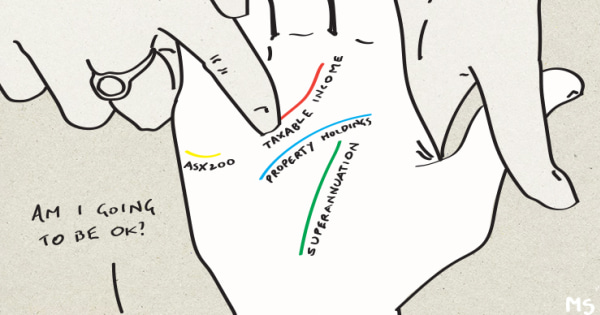

Perhaps the government expects a laying on of hands to be a panacea.
This govt hates spending money on poor and vulnerable people, hence their grudging acceptance that they had to be ‘seen’ to support the NDIS at the 2013 election. They have never been committed to the program. Anyone who thought a new minister has going to change their approach was fooling themselves.
Watching my friend (whose adult son is non verbal, low functioning autistic with behavioural challenges who lives in a group home) trying to navigate this system is heartbreaking. Her son will never get better, she is terrified what will happen to him when she dies and yet she takes no comfort from the idea the NDIS will ensure his needs are met, as the govt is so ambivalent about funding and supporting it properly.
Funding the NDIS properly allows parents to go to work and protects their physical and mental health. I worked for a period at Disability service in Sth Wst Sydney where a parent was told by an NDIA assessor that ‘working is a lifestyle choice’ when she she argued she needed after school care in her child’s plan.
The Coalition can’t do social policy, as neoliberals who believe in survival of the fittest, they simply can’t be trusted to run the NDIS. We saw what they did with Robodebt, we are in for yet another debacle.
It’s shameful that a country as rich as Australia is penny pinching when it comes to supporting their weak and needy. Plenty of money for subsidies to fossil fuels, to get ex ministers to their job interviews and the ‘PM’ to religious gatherings that benefit the society not one iota. But when it comes to provide assistance to those who need it we’re always, always cash strapped.
Do independent assessments if you must but at least use experts relevant to the individual cases who know what they’re looking at and talking about. And stop harassing disabled people. It seems it’s the specialists that are mistrusted. Have an expert in the same field talk to the specialist and check their records then. That would make sense if the ‘government’ was interested in improving things for disabled people. Since it’s not it’ll push ahead with the ‘independent assessments’.
What is it with these creatures? What part of Liberal voters have family with disabilities too don’t they get?
https://aso.gov.au/titles/tv/fast-forward-series-4-ep-3/clip3/