

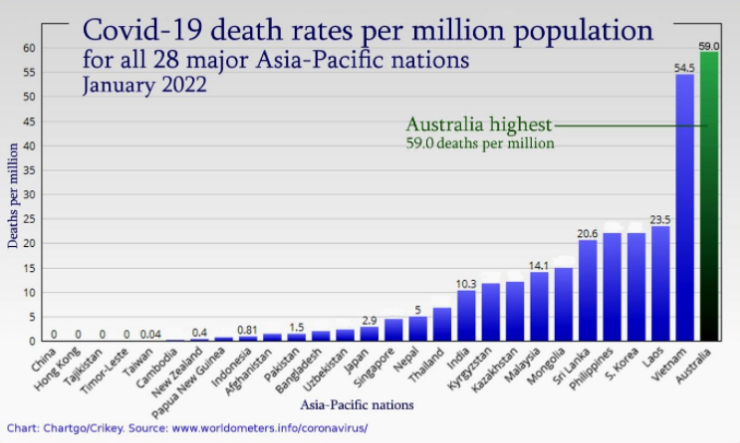
Australia’s COVID-19 deaths in January are the highest relative to population of all 28 major Asia-Pacific nations (with populations above 1 million). Vietnam is second. The other 26 are a long way behind. Not that this is a race.
In January Australia experienced one of the worst surges in the region since the Chinese city of Wuhan copped the first wave of COVID fatalities in February 2020.
Thereafter, virtually the entire hemisphere — comprising continental Asia, Eurasia and the islands in the Indian and Pacific oceans — has been spared the horrific death rates suffered in western Europe and the Americas. None of the 57 countries with total deaths above 1000 per million since the pandemic started is in Asia.
Regional rankings for January
Australia’s regional neighbours with the best control of the pandemic are China, Hong Kong, Tajikstan and East Timor — they all reported no deaths in January. All four have, however, experienced a surge in cases as the Omicron variant rapidly spread.
Next best performed, in order, are Taiwan, Cambodia, New Zealand, Papua New Guinea and Indonesia. They have fewer deaths than one per million.
The situation worsens thereafter, as shown in the chart below. Just two countries were particularly severely affected last month: Vietnam with 5383 deaths at a rate of 54.5 per million, and Australia with 1532 deaths at 59.
Global fatality rates
Europe and the Americas continue to have substantially worse infection and fatality rates than Asia. Of all 38 highly developed OECD countries, the worst hit in January were Greece with 262 deaths per million, Hungary with 231, and Slovakia with 219.
Other major European countries faring better than these but still much worse than any Asian country were Italy with 150, France with 110, the United Kingdom with 104 and Denmark with 86.
Nations in continental Europe now with lower fatality rates than Australia’s 59 include Ireland with 45, Austria with 41, Norway with 22 and the Netherlands with 19.
The United States was by far the worst hit in January with 186 deaths per million. Then followed Bolivia (104), Canada (93) and Paraguay (87), all faring much worse than Australia. Others doing better than Australia include Mexico with 50 deaths per million, Brazil with 36, Chile with 30 and El Salvador with 12.
Among all 38 OECD members, Australia ranked 16th for deaths in January. Leading the developed countries were New Zealand with 0.4 deaths per million and Japan with 2.9.
Data reliability
This analysis uses coronavirus data updated daily by Worldometers. As reported in Crikey previously, data from poor developing nations and some repressive regimes may not be entirely trustworthy. Is it true that a vast country like China has had not one single death in the past 12 months? It’s possible, but it seems unlikely. There is no data from North Korea or Turkmenistan.
Causes of Australia’s crisis
The question the above data raises is what has Australia done, or not done, differently from New Zealand, Taiwan and other neighbours in recent months?
This sudden fatality surge may be explained partly by some parts of the nation still feeling vaccine hesitancy and scepticism about the science.
But a great part is due to the federal government’s multiple failures identified in recent months. These include inadequate PPE supplies, delays with the original vaccination rollout, the tardy booster rollout, late and inadequate supplies of COVID tests, and monumental failures in aged care administration, a critical federal responsibility.
Colleague Bernard Keane’s searing analysis on Monday put it succinctly: “Whatever ministerial flaws, ineffective bureaucracy or supply chain problems have occurred previously, that hundreds of seniors are dying two years into a pandemic due to persistent government failure is a national tragedy that lies at the feet of Colbeck, his portfolio minister Greg Hunt and Prime Minister Scott Morrison.”
Two days into the second month of the year, indications are infection rates are declining. Let’s hope so.


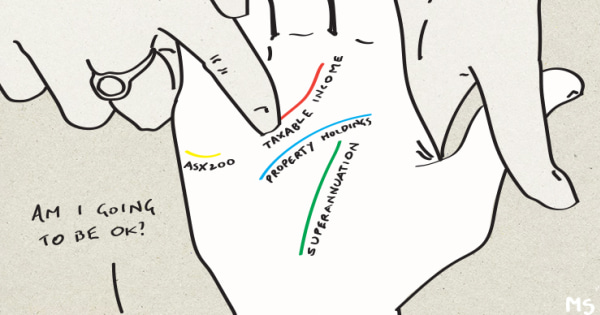



What a pity this remarkable graph wasn’t available at the National Press Club yesterday. Not that facts would impact in any way on a Morrison response.
As Stuart Robert suggested this morning… Jen would know.
Like Maroochy, I would also like to thank you for this clear and concise article Alan.
When I look at that graph you have included I just shake my head in disbelief and despair. Just how is it that struggling third world countries like Kyrgyzstan, Nepal, Uzbekistan and Afghanistan, etc. have such low rates of COVID-19 deaths per million while so-called “first-world” nations have such high rates? There does not seem to be any ‘rhyme or reason’ for this? Possibly the Viets are asking themselves the same question. I know that they were doing quite well some time ago too and now they are virtually on par with us.
Anyway, I have resigned myself to just living ‘the quiet life’, by ‘keeping my head down’ while most of our governments (Federal and State) follow some sort of quasi ‘let-her-rip’ approach to dealing with this virus (which of course is entirely consistent with free-market economic ideology). Perhaps they are hoping for some funeral parlor led economic recovery?
I don’t trust the reporting in some of those states. They also doubtless get some benefit from little travel to them, unlike the now comparatively wide open Australian borders.
I don’t much trust our infection reporting anymore either, since our testing capacity is now overwhelmed. Nonetheless I do appreciate the substance of the article. Morrison and his crew have a standard deflection from their incompetence of look at how well we are doing compared to the rest of the world. To which the reply is now clear. We are doing among the worst in our region and we only look good compared to other incompetent and callous nations that don’t have our distance advantages or our sensible state premiers.
Some very fair and reasonable comments there AP 7, although for me, the only sensible remaining State Premier would be Mark McGowan in Western Australia and it seems to be a matter of time before his state will be in trouble. I only hope that he can ‘hold his nerve’.
Richer countries’ populations skew older, which might be one reason for the higher fatalities.
Also, it’s only a snapshot of one month. Infections come in waves.
Two quite reasonable observations Woop. You are right.
Always love your work Alan. Clear and concise.
Absolutely…we can always rely on Alan to tell us the truth and give us the facts. Many thanks, Alan!
Alan Austin continues to delight with his clear writing – no padding.
“lives are at stake today and he is just obsessed with petty political point scoring’ (Gladys Berejiklian)
.
The Omicron corona-virus strain episode largely confirms the above statement; this variant of COVID19 first appeared in Australia in late November 2021. By this stage the World Health Organization has listed Omicron as a variant of concern and said’ it could take several weeks to know if there were significant changes in transmissibility, severity or implications for COVID vaccines, tests and treatments’
.
Morrison and Hunt choose to ignore this red light in their pursuit of giving Australians their ‘freedom’ from government mandates and win votes at the next election. This poor policy choice has cost many Australians the loss of loved ones. Morrison and Hunt bear responsibility from these foreseeable consequences
.
Now the best that these two can offer is that most of the aged patients who have since died were in palliative care – read here, so what they were going to die anyway.
Just adding to Alan Austin’s analysis, as of the end of January 2022 the four (4) Nordic nations of Denmark, Norway, Sweden and Finland were also recording lower death rates than Australia. So obviously Australia is doing well in a race we have no desire to be among the leaders but thanks to Daggy Dad’s incompetence we are.