

Australia’s immediate economic future depends on the willingness of consumers to run down their savings, at a time of falling real wages and rising inflation.
Yesterday’s national accounts for the December quarter showed a bounce back from the lockdown-driven contraction in the September quarter last year, boosting GDP by 3.4% after a 1.9% slide in the September quarter, for a 4.2% growth rate for the year as a whole.
It’s all pretty historical stuff — but there are important points given the big question about when and how strongly the Reserve Bank will respond to inflation. In February, the RBA forecast 5% growth for 2021 and just over 4% for the year to December 2022.
The December quarter result was fuelled by a spend-athon by households — there was a sharp fall in household savings, with the savings-to-income ratio slumping from 19.8% in the September quarter to 13.6%. That also reflected a drop in government support during the quarter as Delta-era assistance came to an end.
After spending grew strongly in October and November following the Delta lockdowns, the appearance of the Omicron variant in December saw sales slow sharply again — they fell 4.4% in the final month of the year, though sales partly recovered in January with a 1.8% gain, and anecdotal reports in trading updates from a number of retailers suggest that sales growth continued last month.
Household spending was necessary: trade and investment gave no help to growth — in fact they detracted from it. There was a fall of 1.4% in private investment, which was impacted by shortages of labour and construction materials. In turn, dwelling investment fell 2.2%, despite high levels of dwelling approvals in recent quarters. Government spending also fell from its high levels in the September quarter.
Household spending was channelled into recreation and culture, cafes and restaurants, though clothing and footwear also saw strong rises. The increase was concentrated in NSW, Victoria and the ACT, where spending rose 9.6%.
It’s worth more today, so spend it
The question now for the RBA and the government as it frames an election budget for delivery on March 29 is: can consumers be relied on for another heroic spending effort this quarter and next? The December savings ratio of 13.6% is still above levels in early 2020 (ahead of the first lockdowns), so there’s room for more household-fuelled growth — if households feel inclined.
There will also be disaster-relief payments in south-east Queensland and much of NSW, but the floods will also lift food costs (because of flood damage to crops), while Vladimir Putin will push petrol prices higher and higher.
In fact, spiking and volatile energy prices might inflict significant damage on the global economy in coming months, adding to the uncertainty for policymakers.
The high rate of inflation means Australian workers — especially the most lowly paid — will be facing a second year of a decline in real wages. The RBA expects its underlying inflation rate to rise above 3.25%, while wages growth isn’t predicted to reach 3% before next year.
There’s also the looming federal election, which traditionally isn’t a good time for spending or investment — except if you’re in the media business, which is already benefiting from election advertising spending.
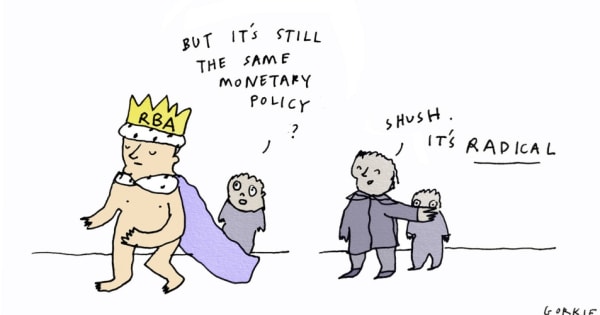
For all those reasons, despite the lamentations of the “rate rise now!” types in the media, the Reserve Bank is likely to wait quite some time before hiking rates.


This just confirms the irrelevancy of conventional economics. A dismal ‘science’ that excludes human and social interaction and altruism from all analysis under the exclusion that it cannot be ‘priced’ or ‘valued’. Show me one Treasury model or scheme that values altruism, a crucial force that keeps society functioning. But because there is obviously no profit in doing good for others, not neoliberal break economical modelling accounts for only of the crucial reasons for society.
Strong growth off a reduced base?
OK, if we’re actually talking about raw growth in a vacuum, aside from the real world’s tumultuous upheaval over the past couple of years, I can only say that my super has done barely nought. Australia’s second largest superannuation fund has gone on in fits and starts but in the end (today), after taxes and fees and on their ‘Balanced’ level, it has produced a smidge above inflation over the last three years.
Perhaps that’s a sensational result…? And perhaps that’s growth?