
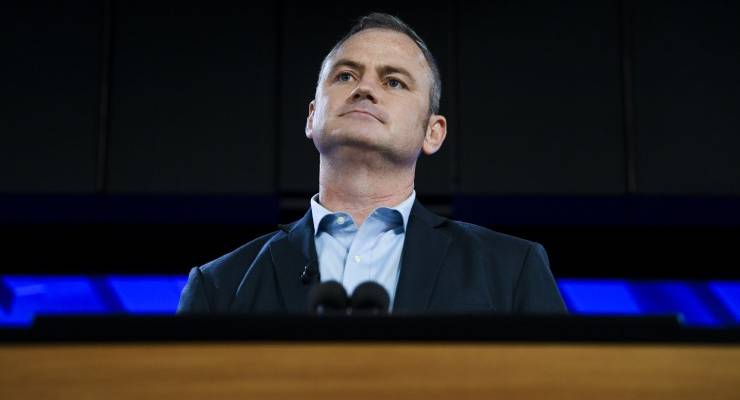
Michael Yabsley was a minister in the Greiner government and a federal treasurer of the Liberal Party and treasurer of the Liberal Party in NSW. He was founder and chair of the Millennium Forum, established to raise money from the corporate sector and wealthy individuals.
Dear candidates,
When he addressed the National Press Club on February 16, Climate 200 founder Simon Holmes à Court placed integrity in politics — including reform of political fundraising — at the top of the national agenda. Rightly so. He rated it second only to climate change when viewed through the eyes of Climate 200.
He also joined forces with Professor Lawrence Lessig from Harvard Law School, an American academic and one-time Democratic presidential hopeful, by invoking the words of acclaimed American author and philosopher Henry Thoreau: “There are a thousand hacking at the branches of evil to one who is striking at the root…”
While Holmes à Court’s intentions may be good, when it comes to money in politics, the truth is Climate 200 is one of a thousand hacking at the branches of evil.
Complete reform of this broken system is required. Reforms such as real-time disclosure, as important as they are, do not go to the heart of the problem, or as Thoreau would say, the root of the evil. In fact, real-time disclosure and many other proposed reforms are window-dressing to give the appearance that meaningful reforms are being made.
The real problem is big money and the perceptions that surround it. The problem is not how much and when it is given, but the fact that it is given at all.
Why Holmes à Court cannot see this is baffling, initially at least.
The problem for Climate 200 is that it risks catching the big party virus of relying on big money. There’s simply no getting around the fact that Climate 200, funded by Holmes à Court, is fielding 20 of you in the federal election and showing all the signs of relying on and showcasing big money rather than working out how to get it out of Australian politics.
There is a multitude of measures that can make the system better, but the only way to fix it properly is to strike at the root of the problem: mandate low-value, high-volume fundraising.
‘Vexed, complex and serious’
Climate 200 candidates, I am writing to you about a problem as urgent as it is important: money in politics — a matter that is vexed, longstanding, complex and serious.
Political fundraising, and the way it is conducted in Australia, is eating away at the heart of our democracy and taking us closer to the American style of politics.
Holmes à Court frequently reminds us that Climate 200 is not a political party. I am contacting you as an individual, relying on the key point that candidates supported by Climate 200 are free to determine their own policy positions. (However, I note there is an expectation, according to Holmes à Court, that they will support Climate 200 “values”.)
There is a solution to the crisis. Dark money: How to reform Australia’s political donations system, a Grattan Institute podcast, embraces and details that solution. Its centrepiece is a 10-point reform plan designed to get big money out of politics in Australia. I commend it to you.
In my opinion it is inconceivable that the 10-point plan would be out of step with the values of Climate 200, but that’s not for me to decide. It should go to the heart of your integrity and political fundraising reform-related values.
I want our dialogue to be candid, so it has to be said that some Climate 200 fundraising practices are alarming and put the movement into the same fundraising boat as the major parties.
But this malaise is not limited to the major parties. Other parties and many unaligned candidates have also defended the prevailing culture of money in politics. The rhythm of this view is linked to when MPs get elected. If they are not brought into line by a party machine, they discover that raising a small number of large donations is easier than raising large numbers of small donations.
There is also gravitas associated with support from the top end of town.
The colour of the money
Political life in Australia is littered with money-driven deals, where the colour of the money is somewhere between white and black. Often it is dark.
What Climate 200 has showcased about its fundraising revolves around million-dollar-plus budgets in seats that have been targeted, raised among mainly well-heeled supporters. If that is not the case, it should sack those responsible for your fundraising publicity. Boasting about cutting a $500,000 matching deal with one of Australia’s wealthiest families to support candidates is not a good look.
You’ve got to be suspicious that this is the one area of policy and administration where there has been no dissent for 40 years among the warring free spirits and ideological enemies inhabiting the Australian political landscape. My hope is that you Climate 200 candidates will not blend into this landscape.
By any measure, Climate 200 has sought to benefit from flawed fundraising laws rather than to lead by example. When Holmes à Court said “one of the biggest challenges is fundraising” and that Climate 200 would not disadvantage itself relative to others, he comprehensively left the door open to a brand of “do as I say, not as I do” politics.
If you and other Climate 200 candidates follow what is being done in the electorates I’m following closely, you risk squandering your integrity legacy before you’re even sworn in — should you be elected.
Alarmingly, the unprecedented unity ticket that has supported the fundraising status quo for decades just happens to be about the distribution of whopping amounts of private and public money that benefit all the parties, and in most cases individual candidates.
Until Malcolm Turnbull donated $1.75 million to the Liberal Party in 2016, the largest single donation given in Australian political history was by Wotif founder Graeme Wood of $1.6 million to the Greens in 2010. The record tells us there are very few saints in this game, and the double-speaking angels should get the attention they deserve.
‘Goliaths that rig the game’
Today it’s taxpayer money through so-called public funding that provides the river of gold that pays senior party officials large salaries and has all but replaced the need for parties to have members at all.
At the National Press Club, Holmes à Court said: “Politics is a multibillion-dollar game, where the winners write the rules,” describing political parties as “goliaths that rig the game”. He’s correct.
The problem is that across the political spectrum, certainly since disclosure laws were introduced and commenced in the late 1970s, all political players have been winners on the fundraising gravy train. Everyone has had a go at writing the rules, generally with much mutual benefit. Political conflict has been basically confined to matters of detail, such as the quantum and timing of changed thresholds. This “hacking at the branches” has conveniently stolen attention from the failure to address the root of the problem.
Based on actions and appearances to date, Climate 200 is shaping up as the next in line to co-write the money-in-politics rules that give us the tainted system we have today.
Extraordinarily, the response to Holmes à Court’s address at the National Press Club was borderline hostile, reflected in the bevy of media questions. “Disingenuous” was one word used to describe part of what he had to offer. “Slippery” is closer to the mark. But that’s a term used for more seasoned players in the rough and tumble world of real politics. Welcome, Simon.
Frankly, Holmes à Court’s account of two things did not pass muster: meaningful commitment to fundraising reform, and whether or not Climate 200 is a party. Failure to understand the origins of the money-in-politics problem, as appears to be the case with Holmes à Court, means guaranteed failure to provide a credible solution. Or does he, like other politicos, understand the problem but like them is unwilling to take the hit to the bottom line necessitated by having to comply with higher standards and a more demanding fundraising model of chasing small donations?
Seeing Climate 200 fundraising on the ground challenges fundamentally that it understands the depth, longevity and complexity of the problem.
Poacher turned gamekeeper
When it comes to political fundraising, I am a poacher turned gamekeeper. I have been federal treasurer of the Liberal Party and treasurer of the Liberal Party in NSW, as well as founder and chair of the Millennium Forum, established within the party specifically to raise money from the corporate sector and wealthy individuals.
I also founded a national government relations firm, which operates to this day on a bipartisan basis.
I know the money in politics scene inside-out. And I know it casts a long, dark shadow over the integrity of the democratic system.
I ask that you accept on face value the fact that while I remain a committed member of the Liberal Party, I reserve the right to criticise its track record on money in politics, and to advocate for reform. I also reserve the right to criticise other parties or organisations that fall short when it comes to money in politics practices.
Crikey political editor Bernard Keane said recently: “Michael Yabsley’s proposals are excellent and would, I believe, go a very long way to addressing the toxic role of donations in politics by removing corporate donations and forcing political parties back to the community for funding. They’re the most democratic reform proposals I’ve ever seen on donations.”
Dark side of fundraising
The ABC’s two-episode Big Deal series last year lifted the lid on many important aspects of the dark side of political fundraising and election funding.
Across the political spectrum there are no more uncomfortable home truths than those associated with the grubby subject of money, whether that money comes from the private or public purse.
In my paper Dark Money, I also reveal how public funding, or what I prefer to call taxpayer funding, has been debauched. Subject to an independent inquiry, I have no doubt that public funding practices would be revealed as comprehensively flawed through decades of malpractice.
Public funding as it operates is part of the trust deficit problem in Australia, not part of the solution.
If you are elected on May 21, your voice in Parliament could be critical to this issue and its advancement. The major parties will never take this cause on without external pressure. It’s a gravy train that suits both sides of politics and most other political players as well. Frankly the train needs to be derailed by a combination of new voices like yours and old voices like mine.
The only way to kill this disease is by rendering so insignificant the amount of money that can be lawfully donated that it could never be considered an inducement that affects policy, commercial transactions, preference deals or any other goings-on that characterise the often byzantine, sometimes nefarious world of politics.
That is the centrepiece of the dark money reform proposal.
Frankly I do not know the fundraising and election campaign funding practices of Climate 200. I do know that fundraising practices vary from candidate to candidate and seat to seat, as they do within and between parties.
Clearly I have taken a close interest in what Holmes à Court has had to say about integrity in politics, including political fundraising. His role is confusing as he insists he doesn’t play a leadership or decision-making role in an organisation that in his words “has no hierarchy, no leader, no head office and no coordinated policy platforms”. He says the organisation relies on “spontaneous outcomes and an entirely individual set of responses”.
But what I have seen from Climate 200 generally and among candidates in seats like Warringah, Wentworth, North Sydney, Kooyong and Goldstein is enough to make me think here we go again.
I have seen enough first-hand to say that while some Climate 200 candidates are on board with the key reforms I have spelt out in Dark Money, others including Holmes à Court have already caught a strain of the big-party virus: a liking for big money and showcasing high-profile donors. This underlines a major trait in fundraising, where many givers and receivers like to be part of the “rubbing shoulders scene”.
The ‘rubbing shoulders scene’
Don’t get me wrong, I’m all for rubbing shoulders — providing the price for the privilege is capped at $200. Dark Money is all about getting big money out of the equation.
A key part of the Dark Money campaign is to illustrate that the low-value, high-volume fundraising model will allow political parties and candidates to meet their financial requirements and will put political parties in touch with a large number of small donors rather than a small number of large donors.
This proposition is no long shot. If just 2% of the 17 million Australians eligible to vote donated an average of $200 to political parties of their choice, $68 million would be collected — about the same amount ripped off unwitting taxpayers in public funding at the past federal election.
Put another way, in a federal electorate with an enrolment of 105,000, if 2% of voters donated an average of $200, that would raise $420,000. Is anyone going to seriously argue that’s not enough? Or do we now say $2 million campaigns are the new normal?
Late last year Holmes à Court gave a very bad answer to a very good question from Peter FitzSimons, who asked: “Is the list of donors to Climate 200 publicly available?” His answer was: “We will abide by all the rules of the Australian Electoral Commission assiduously and list all those who contribute above the disclosure limit.”
This is the stock answer used for decades to justify what parties and candidates want to do, rather than what they should do.
An inescapable truth
Frankly, I see a greater opportunity for reform by convincing a cohort of new candidates, such as you, and the organisation supporting them, than the major political parties whose bread has been buttered the same way for decades.
But what some Climate 200 candidates are doing does not pass muster. For you, the inescapable truth is that the public profile of Climate 200 fundraising has little to distinguish itself from what the major parties and most of the other parties have done seamlessly since contemporary fundraising records were kept.
The danger is you will squander that opportunity because what you are doing does not align with what you say should happen. For your integrity message to have credibility, it’s not enough to just say: “We are doing what the Australian Electoral Commission requires.”
Reasonably you will ask if I am writing to the major parties in the way I am writing to you. No, I am not. That will happen after the election. I could not let the election come and go without pointing out the wrinkles and warts on what Climate 200 is doing.
The 10-point Dark Money reform plan is, I believe, beyond the grasp of most in the major parties, simply because big money is so entrenched in the way they operate.
That said, there is encouraging support for the Dark Money reform plan among many former members of Parliament from across the political spectrum and across jurisdictions around Australia. They are joined by many Australians of note who loathe the omnipresence of money in politics. They are prepared to stand up and be counted.
The real test is not what serving or former MPs or leading Australians think. The real test is what the electorate thinks about money in politics — money in politics accounts for a significant part of the trust deficit in Australia today.
The 10-point plan was launched in Sydney in November 2021. I urge you to consider it and would be happy to discuss it further with you. And I would welcome all aspects of it being put to a citizens’ jury.
This is moral relativism with a price tag. The price tag is public trust and the integrity of our democratic system. That’s a big price to pay. It’s too much and it’s time we stopped. Because as while the political fundraising process allows things to be done for money and because of money, it will remain tainted and compromised.
History tells us that basically enduring change happens in one of two ways. Governments either lead or follow. Governments follow when enough people in the community stand up and be counted about something that demands change. Matters as diverse as the environment, to institutionalised child sexual abuse, to smoking, to women’s rights — each are examples of change that has happened under pressure.
The process of change is helped if the calls for reform are evidence based. There is no shortage of evidence about the role of money in politics in Australia, although much of it is muted because political interests across the political spectrum have collaborated to keep things as they are.
Low-value, high-volume fundraising cannot only generate sufficient income for political organisations. At the same time it can democratise and empower large numbers of people to participate in their organisation of choice.
Money in politics is not the only thing that explains the trust deficit that relates to public life in Australia, but fixing this one defined matter would be a good start.
I would welcome the opportunity to meet and talk to you during the campaign, or any time after it, whether you are elected or not.
Kind regards,
Michael Yabsley


A focus on a small new group (which is a challenge to the re-election of the current government), by a current member of the Liberal party. Given your CV as outlined in this piece, why the focus on C200 and not focus on One Nation, Clive Palmer etc . Or even the LNP or ALP?
Exactly what I thought.
What a coincidence. Yabsley chooses to hold to account a group of people that are the biggest threat to his beloved Liberal Party in the current election. Why wasn’t calling for this reform whilst he was doing the job?
“Why wasn’t calling for this reform whilst he was doing the job?”
Because he’d have been sacked? Because it took time for him to see how bad things are? Because it’s perfectly reasonable to change your mind when you find out things you previously were not sufficiently aware about?
“Yabsley chooses to hold to account a group of people”
He’s not ‘holding them to account’, he’s trying to persuade them that the objective of the reforms they want requires a more radical policy. Good point. Well said Yabsley, it’s a useful contribution and let’s hope they are listening.
There seems to be a fair number of Crikey readers who are just as annoyed with Yabsley changing his tune as his old Liberal colleagues.
“not sufficiently aware about”. lol. there’s no factual uncovering, it’s a change of heart because he’s not playing big bad politics boy anymore.
Whatever. I find learning from experience is a good thing.
“Make me good, oh Lord, but not yet.”
Quite So. Augustine. What a hypocrite. Stayed long enough in the rotten system he sustained and supervised to be able to be enriched with it all, even post politics, and as well the life-long fully indexed to serving salaries pensions. The last to be imploring the present crop of candidates along with S h C to forgo becoming the members and instruments of those who could change what he deplores ……… NOW. Simply put. He’s saying don’t be in the game that you could change, so that as he knows it’ll never thus change.
No, Michael, “money in politics” is not the problem. The problem is corruption. The problem is what people do with the money. The problem is lack of principles.
No candidate can succeed in the current political environment without substantial financial backing, and you know it. Sure it would be great if we could rescind it, it would be wonderful to rid ourselves of all the consquences of too much money sloshing around the electorate, but the first person to do that loses. Like climate change, we do need to revise the rules. But we can’t survive, and win, on personal integrity alone. If we are serious about removin the temptation for corrupt behaviour by not dangling cash in front of politicians, the only answer is for teal independents to be elected now, under the same rules as everyone else, and argue for changing those rules once they are in power – which most of them are keen to do.
You are confused.Yabsley is not saying anyone in this election should not follow the current rules. He is saying what you argue – that the system should be changed so every candidate and party depends only on small donations from individual Australians. He is also saying that candidates in this election who talk of reforming ourt corrupt politics without going that far are missing the root of the problem. He’s absolutely right.
Yep, but he’s also going after SHaC quite unnecessarily.
Fossil fuel donations? Coalition YES; Labor YES: Greens NO; Teals NO
Can you quote him saying that? I cannot see it.
All I see is him saying is even the parties who want reform are not advocating for the reform needed. That’s different.
The Greens have a highly transparent
and timely dislosure system, yet I didn’t notice Mr Yabsley giving them any credit.
He remains a committed member of the Liberal Party, but he’s castigating others on their fund-raising methods. He wants them to “play by the rules” against those who are playing dirty. He admits that money buys seats, but wants the independents to try to succeed without it. It feels like he has a hidden agenda.
He certainly does.
I cannot see anything in Yabsley’s article that says different parties should follow different rules. Nowhere does he say, for example, that anyone in this election should return any of the money they have received.
He’s only saying that those who want reform need to work for reform that will fix the problem.
Yes. There was a moment when I thought “this bloke wants the teals playing with one hand tied”. Glad it’s not just my suspicious mind.
I agree
The dreaded NSW gov’t.Did not have the guts to say that! The ghastly little man.I have a very long memory and never forgive.
Sorry Mercurial, Wrong.
Abolish the current candidate funding system.
No money, gifts etc. to be spent on elections by candidates. All gone. Automatic dis-endorsement if caught in breach. Maybe even jail time.
Have AEC set up an electorate web site with each candidates policies. (Maybe issue written booklet) Most likely cheaper than Federal Funding.
Let them walk the streets and rub shoulders with the constituents.
Maybe even have political rallys in halls and streets.
Dear Poacher-turned Gamekeeper,
Ha ha ha ha ha ha ha ho ho ho ho ho ho hee hee hee hee hee hoo hoo hoo hurrrgh!!! Oh dear do excuse me, I had a very large lump of Shameless Bloody Gall stuck in my throat.
There is commonly only one real reason a poacher turns gamekeeper, Michael. That being because other, younger, smarter poachers have found new ways to get through the fences faster and better, while the older poachers have grown too lazy, entitled and tubby to fit through even the well-worn holes they’ve come to regard as their birthright. Your lament is not uncommon among your hapless, witless, watery-weak generation of lifelong narcissists: One finds oneself these days hearing the same Boomer dotage-age protests from Legacy media elders eying e-readership data with alarm; long politicised senior public servants worried about younger, even more cynical promotion gazzumpers; bonus-drenched corporates suddenly worried about collapsing company integrity and short-termism, after lucrative careers based on just that; long-tenured managerial academics cheerfully presiding over ruthless lower order cuts while wringing their over-paid, araldited-into-place hands about from where-oh-whence the next generations of professional free-thinkers will come…
Mate: yeah yeah, you’re probably right – of course, you’re right – about donation reform. Of course you are. (Wow, you’re a regular democratic Einstein, you are Mikey!)
But…no, you ain’t the solution to the democratically-corrupting problem of big money. You’re the problem, MY. The people who will change this loaded mess aren’t retired poachers with nothing to lose now and retirement conscience twinges to pacify. They’re people with live skin still in the dirty game. Now. What live dirty skin sacrifice can you – will you – make to lead the way, Michael? Give back some of your own long-poached, opportunistically accumulated dirty skin?
Go on then. Show, don’t tell. (Something you Boomers have yet to learn.)
Michael: Margo K went after donor corruption two decades ago. (Heaps of others before and since.) We wrote about all this stuff in forensic detail in NHJ. Forensic. You were in the poaching thick of it, old chap: you were key to John Howard’s long and odious donation-whispering insider game for years. You’ve had more dirty skin in this dirty corrupting process as a poacher than probably any one poacher in Oz political history.
You didn’t do anything about changing this while you could have. You made it worse. Much worse. And now you’re utterly powerless, you decide you want to make some cute pointless noise, do you? Well: OK, good for you. But here’s your problem, my friend: you ignored us, back then. Sneered at us, back then, as hopelessly deluded, ranting conspiracists.
Why on earth do you expect Holmes a Court – any of the live dirty skin merchants of today – to act any differently towards you? Your sheer political charisma, your unstoppable moral Force 4 Goodness?
Ripper. Bonzer. Onya. Good luck with it. Quite genuinely so…good luck pushing for donor reform. Belatedly. But…strap in for the long, slow, grinding, ritual humiliations of futile systemic Outsiderhood, mate. Is my only advice. This I imagine will be a very new feelzzz for someone with your poaching pedigree (nope, coming out doesn’t remotely count these days…!!).
Politics is full of decent people – all parties, all shades – who only ever allow themselves to be honest about their freely chosen pragmatic cynicisms and moral bankruptcies…once they have no power to choose differently. Who try to make amends for their own failings when it counted…by shouting the most loudly at themselves in the rear view mirror…when it doesn’t.
Yours is not the Poachers-turned-Gamekeepers Club, MY. Still, as then when it mattered, and so alas as always…The Poachers’.
Just a poacher. Soz, Mike. But you made your choices.
Yrs,
Once, always, only (if I can keep it up)
Gamekeeper.
Thanks Jack, I enjoyed this.
I do waffle. But cynics of MY’s ilk destroy many good, decent, idealistic people over their cynical lifetimes. Even if genuine, they should never be allowed to recant, rehabilitate and redeem their knowingly hardened souls lightly.
How many voters can seriously say they can not smell the stench of corruption that envelopes the Liberal/Country Party /Nationals Party minority government.
It must be obvious to any rational voter that the reason the PM is so against an ICAC looking into the actions of senior members of the minority government and himself.
ICAC first new Canberra Prison to follow ?