

America’s July jobs report has shown the dilemma central banks and governments face in the most inflationary period since the two oil shocks and Vietnam War in the late 1970s and early ’80s.
More than half a million jobs were created in July and US unemployment fell to 3.5%. That’s despite the US Federal Reserve putting interest rates up to 2.25-2.5% from 0.1% in just seven months.
Monetary policy is slow to work at the best of times, but the central bank’s “shock and awe” approach of large-scale rate rises is partly designed to change consumer and business behaviour as rapidly as possible. There’s no evidence it’s worked so far in terms of employment outcomes — not in the US, where unemployment has fallen from 4% to 3.5% since the start of the year, and the three months to the end of July saw nearly 1.3 million new jobs created. And not in Australia, the UK, Europe, Canada and other developed economies. Jobs growth just keeps on coming.
What hasn’t been coming, though, is real wages growth. Even though US inflation has risen to 9.1% in June (there’s an update for July this week) from 7.4% in January, US hourly wages growth has slowed from 5.7% in January to 5.2% in July, meaning tens of millions of US workers are seeing a growing fall in real wages.
US markets are now tipping another 0.75% rise from the Fed at its next meeting, but there’s no meeting now until September 20-21. August is reserved for the annual Jackson Hole Symposium in Wyoming run by the Kansas Fed on August 25-27. That means the Fed will have both the July and August consumer inflation data, allowing some perspective on the trajectory of inflation — though if the CPI jumps well past 10%, it may force a very rare between-meetings rate increase.
High unemployment is a toxic and immiserating phenomenon that leaves permanent scars on communities. But it’s also a very strange problem to have, reflecting just how unusual our current economic circumstances are, when inflation is caused not by excess demand of wage-price spirals but external factors beyond the capacity of governments or central banks to address.
It’s also a taste, perhaps, of what the future will increasingly look like: low unemployment driven by the fact that there’s a growing global shortage of workers; supply chain dislocation driven by weather extremes (and, perhaps, novel diseases) caused by the climate emergency; market power wielded by giant corporations against workers and consumers.
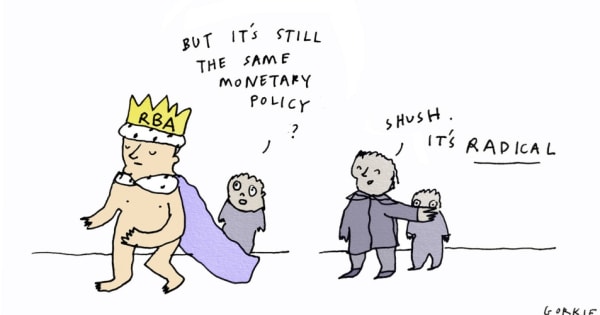
Central banks, however, only have one tool, interest rates, with which to clobber demand, rather than address the primary causes of inflation. So far, the jobs market has shown no evidence that clobbering demand has so far had any impact. Central banks like the Federal Reserve and the Reserve Bank might need to hit and keep hitting demand until they kill it. If only demand were actually the problem.






Central banks have been playing with interest rates because concervative governments around the world refuse to use fiscal policy to fix things. Our Morrison govt was a classic. The main cause of that it that conservative govts are lock step with employers in trying to maximise the wealth of rich people. They see the economy as a zero sum game and hence wages have to be suppressed. We have let them get away with it by allowing then to embrace the myth of globalisation, thereby wiping out much local manufacturing industry, and we have stopped joining unions, dramatically weakening our bargaining power.
This shows just how stupid the economic model for western society is.
Profits up 70%, wages growth -5% considering inflation and do we hear anything from supposedly world renowned economist? The answer can be found in the teachings of economics at universities who still espouse Reaganomics as the true way.
The old saying “doing the same thing again and again and getting the same stupid results” – or words to that effect – holds true for even supposedly smart people obviously.
Nailed it, Mike.
If there where any justice in the world, the inflation fix would be to lower the cause- excessive profit making. But no. That’s not what we have, is it?
The best way to get a wage rise is to move on. The workforce could be made much more mobile if there were vacant rental housing near currently employing destinations. The mining industry is familiar with transportable villages, so we are quite capable of creating instant towns at a fraction of the cost of brick and tile. Because local council regulations are inevitably hostile, it may take government intervention to make such towns possible, even if they must be made temporary. If large employers find they are losing staff that they would otherwise have trapped at low wages, they may be that much more amenable to raising the wages.
I remember reading a book where the characters did something along those lines to get work. Moved on, I mean. Repeatedly. The Grapes of Wrath. Bloke called Steinbeck wrote it.
Yep, Steinbeck was awarded a Nobel Prize for literature, largely for the exposé in The Grapes of Wrath. In the 1960s, the British had embarked on policies on home ownership, trapping their occupants near to obsolescing employers and leaving Britain pockmarked with hotbeds of unemployment. Germany had no such problem, as it had committed post WW2 to rental housing, with commercial managers making adjustments for changes in housing demand. In Australia, despite widespread opportunities as farm labourers, our couch potatoes prefer to tighten their grip on the family home lest the oldies sell it before they drop dead.
“High unemployment is a toxic and immiserating phenomenon that leaves permanent scars on communities. But it’s also a very strange problem to have, reflecting just how unusual our current economic circumstances are, when inflation is caused not by excess demand of wage-price spirals but external factors beyond the capacity of governments or central banks to address.”
Don’t fully agree. The stagflation of the 1970s and 80s was in large part brought about by the huge oil price hikes of 1973-74 and 1979-80. Beyond the control of the West. They occurred as a result of OPEC flexing its muscle, realising that they had been ripped off by the West for decades and it took wars for the oil producing countries to assert themselves. The Yom Kippur War of 1973 and the Iranian Revolution of 1979. The Carter administration instantly recognised the regime of Ayatollah Khomeini when the Islamic Republic overthrew the Shah but didn’t do the same for the Sandinista regime which took over Nicaragua from the Somoza dynasty/dictatorship in the same year.
Secondly, there are few economists who have analysed the causes of inflation properly in the 1970s and 80s. Some have and have ascertained that the cause of high cost of goods came about largely as a result of the high cost of money itself. Credit. Finance. Lending was restricted in many ways not the least of which was how much one could borrow for a home loan. A sledgehammer approach to lending was wielded rather than behavioural mechanisms like interest rate adjustments. More competitors would bring competition into the finance industry. Controls were eased. This had the effect of cheapening the cost of borrowing in the short to medium term.
Inflation in Australia in the 70s and part of the 80s was caused by external oil shocks working their way through the economy, the transport system bore the brunt of these first. Secondly, the cost of borrowing remained high due to higher degree of controls and regulation in and around the finance sector. This was why there was a housing slump from late1980-83 after there was a mini-boom in early 1980. The high cost of finance kept these prices low.
There definitely needs to be more economic and historical analysis done which would provide useful comparisons – temporal comparison not just international ones.