

Once again the Reserve Bank has made it clear that the poor and marginalised in the community will feel the brunt of its tightening in monetary policy to control inflation — which no one in Australia outside company C-suites is responsible for.
The central bank’s August statement of monetary policy, released on Friday, makes no bones about it — Australian households face a fall in their real incomes until 2024.
The RBA now sees real disposable household income falling for almost a year and a half, including a 3.1% drop in the June quarter of next year. It will only start growing in late 2024, which is too far out in the forecast period to be accurate.
In the May statement, the bank said it expected household income to grow by 0.9% in the final three months of this year. Now it believes they will shrink by 0.9%.
Even by the end of next year, incomes are tipped to be going backwards by just under 1% (0.9%).
The line from the RBA, as it has repeatedly hiked rates, has been that Australian households have plenty of “buffers” — savings built up over the pandemic that they can now draw down to cope with higher mortgage payments and a rising cost of living.
Except, low-income earners have much less in the way of buffers. Finally, the Bank has admitted that.
“Higher prices, especially for food and fuel, are likely to impact low-income households in particular (which tend to spend a larger share of their income on these necessary items),” the Bank said.
“While household balance sheets are generally strong and many households should be able to absorb these price increases, others have limited savings buffers and may have to reduce spending elsewhere. For some of these more vulnerable households, the impact of price rises will be mitigated to some extent by the indexation of social assistance payments twice per year, though price rises will reduce recipients’ real incomes in the near term.”
Low-income households with mortgages, of course, face the double impact of higher mortgage costs. And it’s not much better for renters, who face rapidly rising rents due to a housing crisis no politician seems serious about responding to.
There’s virtually nothing such households can do about inflation — they have little discretionary spending to curb. For such households, reducing demand would be about choosing whether to fill the car, pay the power bill or put food on the table. But they have to pay the price for supply chain problems, a spike in energy prices, the pandemic and the greedy profiteering of corporate executives using general inflation as a cover to boost profits.
The Bank revised down its shorter-term forecasts of wages growth from May. What was 2.7% for the year to June is now expected to be 2.6%. But it’s OK — as always with the RBA, surging wages growth is just around the corner, up to 3.4% in June 2023 and 3.7% a year later. If only workers could take the RBA’s promises to the supermarket and pay for their groceries with SMP forecasts. The June wage price index (WPI) will be out on August 17, so we’ll find out whether wages growth has finally cracked a whopping 2.5% for the first time since 2014.
Inflation is expected by the Bank to peak at 7.8% in the December quarter, edge down to 6.2% by the middle of next year and still be at 3.5% in the June quarter of 2024.
That still means a massive 2.8% fall in real wages this financial year, after a 3.5% fall in 2021-22. All after a decade of wage stagnation — a decade the RBA could never quite bring itself to forecast.
The RBA is also optimistic, with stronger grounds, on unemployment. The jobs market is expected to defy the tightening in monetary policy, with unemployment still at 3.4% by the middle of next year and 3.7% 12 months later.
But in turning the screws on households, and especially low-income earners, the Bank admits this might have an impact. “A decline in real incomes for the average household could weigh on spending more than expected, particularly if household wealth is also declining.”
That will in turn flow through to the job market, with falling spending forcing businesses to lay off staff — particularly in discretionary spending areas like non-essential retail, hospitality and travel. Those also happen to be where a lot of low-income earners work. To steal a line from Paul Keating, God help you if you’re a low-income renter with a retail job.
Are you feeling the pinch of tough economic times, and how? Let us know your thoughts by writing to letters@crikey.com.au. Please include your full name to be considered for publication. We reserve the right to edit for length and clarity.




Low wage outcomes are government policy. Real wages have been falling since 2014. The FWC as well as the Liberal Party and the Federal Government including Treasury have been critical in ensuring this outcome.
I don’t know why BK et al have difficulty in grasping this concept. Strikes are effectively illegal. The fact of this is made clear in every workplace contract, AWA, award and EA. Employers can unilaterally terminate an EA. Labor has no power unless it can change the FWA to make these hostile actions by employer illegal with punitive damages. Further it has to loosen the requirements for strike action. None of this 7 days’ notice or 3 days’ notice rubbish. Our fathers only got wealthy by taking workplace matters into their own hands. The dingbats and wonks that read this forum who are partial to occupations and people they don’t like or think are deserving, think it was people power that won the anti-Vietnam War movement. Nup. In 1972 when Gough abolished National Service the majority of Australians still believe and supported it. And he abolished it. Decisive! It was the passive-aggressive actions of our servicemen that won it. Not serving when called on to yet on the army payroll. In the US, some in their Navy mutinied. As did their Army who were becoming more heroin addicts by the day. America saved their Army by withdrawing from Vietnam.
If you have no right to withdraw your labour you have no effective economic power and no real full human rights.
Banks and large business’s have well and truly sucked in the Australian public, particularly the low income
disadvantage. First they drop interest rates very low, to convince people to take out ever large bank loans to by houses, they can’t afford. Then they raise interest rate to much higher levels, that the low income group are expected to pay, further disadvantaging that group. So banks that borrowed large sums of money, at very low rates, are now chasing returns at much higher margins. A despicable act.
It feels a slap in the face to see how much prices are rising on everyday products, knowing that for the most part those rises are taking advantage of the necessary rises caused by inflationary pressures. It’s pure bastardry given what effect it’s going to have on those who can least afford it.
Where’s Joe Hockey to tell us that the first step in being able to afford groceries is to get a really good job?
Or, in his case, a wife with an exceptionally good job, leaning all the way.
Somebody, maybe Anatole France, pointed out long ago that the poor would be able to support themselves perfectly well if they were not also made to support the rich.
In 1381 radical, thus ex-communicated, priest John Ball roused all during the Peasants’ Revolt at Blackheath with “When Adam delved and Eve span, who then was the gentleman?”.
Sure, he was hanged, draw & quartered but ne’er truer words were spoken.
how long before we’re in the recession no one saw coming?
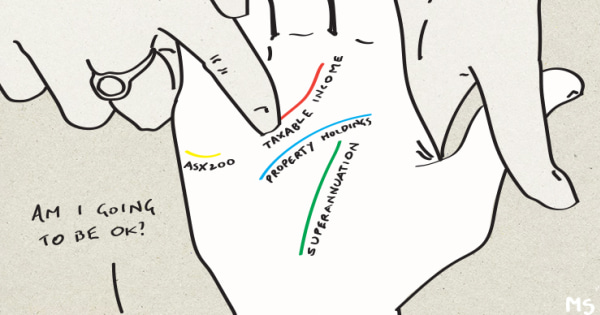
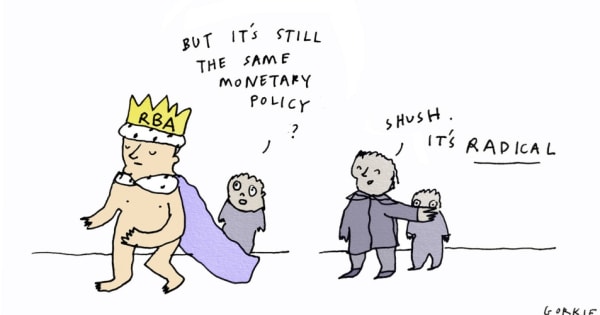
Great cartoon in this one Mitchell