

“The Australian economy today reflects an unholy mess of monstrously confusing data that’s only getting messier, so it’s time we pause and rethink our approach” is exactly what Philip Lowe should have conceded in Senate estimates last week, but did not.
The Reserve Bank governor instead prevaricated, serving the Senate economics committee his usual blend of contradiction, dissembling and defensive posturing.
It’s no secret Australia’s central bank has engaged in a series of rapid interest rate rises over the past several months as it grapples to dampen high inflation. So much is to be expected, given what’s passed for conventional or “orthodox” thinking about the challenge of inflation in recent decades.
Yet for all that, low unemployment is galloping on — notwithstanding the financial pain ripping through low- and middle-income households — and inflation is proving stubbornly sticky, having climbed in the 12 months to April following a subtle fall a couple of months ago. Meanwhile, for all of Lowe’s spooky warnings about a ’70s-style wage-price spiral, it remains a phantom wholly removed from reality.
The reason these considerations combine to paint a decidedly confused pointillist picture about the state of the economy — at least for those who subscribe to Lowe’s way of thinking — is that they run entirely contrary to what members of the Reserve Bank board believe ought to be occurring as monetary policy tightens.
Theirs is an approach, it bears repeating, underpinned by the enduring neoliberal idea that the only way to cool the economy and slow spending is to squeeze borrowers and mercilessly shove thousands upon thousands into Centrelink’s benighted unemployment queues. Against this thorny backdrop, any prospect of meaningful wage rises to compensate for high prices likewise fades as the spectre of unemployment cows the remaining workforce of low- and middle-income earners into accepting real wage cuts.
It’s an economic theory, in other words, predicated on the idea that inflation is an “everybody-problem”, as Lowe is fond of reminding the government, but one solved by raising unemployment and suppressing wages, both of which constitute a “some-people problem” — something you’ll notably never hear Lowe say explicitly.
By linking low unemployment to high inflation, it’s also a theory that (wrongly) assumes inflation is either always or overwhelmingly caused by excessive demand, as opposed to disruptions to supply chains caused by, for example, natural disasters, a pandemic or war — considerations that can’t plausibly be tempered, much less controlled, by higher interest rates.
And perhaps most profoundly of all, it’s a theory whose logical endgame is not without tangible risk.
“What we’re seeing [play out in the economy] reinforces the view that the Reserve Bank can’t manage high inflation by simply manipulating the cash rate,” economist and Torrens University Associate Professor in Economics Steven Hail told Crikey:
“As is the case historically, the risk here is that the lag between the sequence of increases in the cash rate and their impact [will ultimately] push the economy off a cliff, and you end up rapidly reversing policy to try to avoid a recession which you shouldn’t have ever had in the first place.”
The charitable view, and one Lowe would have you believe, is that he’s trying to engineer a “soft landing” between Scylla (persistent inflation) and Charybdis (severe economic malaise in the form of a recession or stagflation) by destroying residual demand as much as possible — but not so much that the economy crashes and burns. But as Nine newspapers’ Shane Wright reported on Monday, such a feat is freighted with difficulty, with the task increasingly described within the fraught contours of metaphors such as trying to land an “A380 on an aircraft carrier”.
The opposing view is that the Reserve Bank board, blinded or otherwise by the bias against vulnerable or low-income workers and the unemployed embedded in its rigid ideology, is determined to throw petrol on the fire and hope no one notices its mistake.
This much finds support in modelling undertaken by RBA researchers in February and released under freedom of information last month. Buried towards the end of the bundle of documents is analysis claiming that inflation — all things being equal — would have returned to the bank’s “gospel” target cash rate of below 3% by mid-2025 even without further interest rate rises beyond February of this year.
Though a strategy of even higher interest rate rises would arguably see the economy arrive at the same destination marginally sooner, it would conversely force an extra 50,000 or so people into the Reserve Bank’s Orwellian pool of the haplessly unemployed and materially heighten the risk of a recession.
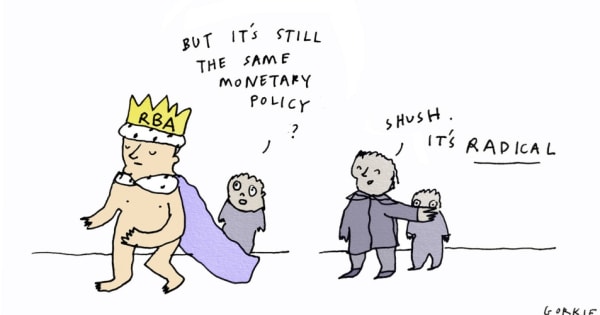
Yet despite this modelling, the Reserve Bank board raised interest rates again in March, again in May, and will most likely do so again today for the month of June. And if not today, then next month.
One of the clues to this lies in the way Lowe carefully walked back his recent admission that wage growth hasn’t been adding to inflation. Last week, he subtly reformulated this view, telling Senate estimates that nominal wage growth — as distinct from real wage growth (which takes into account inflation) — of between 3% to 4% absent productivity gains is inflationary.
As the Nine newspapers’ Ross Gittins pointed out on Monday, by not taking real wage growth as the appropriate measure, this argument is as “dishonest” as it is misleading, but his reasons for making it are nonetheless fairly transparent.
Were he to accept, as leading economist Ross Garnaut and Treasury Secretary Steven Kennedy have done, that our low rate of unemployment has not visited any material wage pressure on inflation, then much of his justification for pulling the trigger on further interest rate hikes falls away.
And so, by pretending the spectre of a wage-price spiral still poses a problem, Lowe is able to front Senate estimates with a straight face and describe the nation’s low unemployment level as “beyond full employment”, which in turn paves the way for further interest rate hikes.
It’s from this twisted vantage point that Lowe’s worldview on monetary policy, fuelled less by reflection than ideology, withstands everything but close scrutiny.
What he’s attempting to do, in other words, is conceal the reality that the ideological assumptions underpinning prevailing monetary thinking are starting to crumble — and with it the credibility of the central bank as the oracle of all monetary wisdom.
By pretending his orthodox theory still holds together, Lowe is then able to shamelessly bat away the contradictions that reside at its heart — chief among them the way in which it fuels inflation by, for instance, driving up rents (as mortgage holders pass on costs to tenants), something he’s conversely blamed entirely on red tape and lack of “supply, supply, supply”.
The same holds for the legion of price rises witnessed in sectors dominated by monopolies and oligopolies, such as banking, large supermarket chains, resources and airlines — another consideration he refused to concede despite the weight of evidence to the contrary. And so too the way in which the poor, young and middle-income earners are bearing the brunt of inflation as the spending habits of older Australians continue unabated.
As Hail put it to Crikey: “The main impact of an increase in interest rates is to redistribute income from people who don’t have much income to people who have a lot of savings.”
In truth, there are only two reasons beyond institutional and personal defensiveness or even incompetence that explain Lowe’s conduct. One is he faithfully believes he needs to be seen to be acting on inflation lest a dangerous mentality that inflation is here to stay sets in. The alternative is that his biased worldview, bending as it does in favour of business and profits over people, sees him consciously or subliminally elevate those interests above all others as a matter of course.
Perhaps it’s a confused blend of all of the above.

as Upton Sinclair wrote: “It is difficult to get a man to understand something, when his salary depends on his not understanding it.”
— add to “salary” things like, self image, social standing, and his “friends” who rely on Lowe to leave them to their billions, while he stomps on the proles
Agree with the article and your comment but let’s not forget that if the govt & other bodies such as ACCC etc are not doing what ithey need to do, the RBA is left to do what its charter demands. Given the relatively low unemployment rate, that target is not their issue, the inflation rate is. The RBA doesn’t determine the inflation rate, it responds to it. That is, looking at how inflation is calculated would also make a difference.
What I’m saying is what Lowe can’t say – the sytem is a mess. The inaction by other bodies including govtr leaves RBA as the one visible actor in the scene. But he has to stick to the script, and he is the one getting pelted.
Maeve McGregor has tabled the inconsistencies and errors of economic fact displayed by the RBA. However, there remains the elephant in the room, that our tax system and the role of the RBA are way overdue for serious reform.
Under its charter the RBA actions must devastate the poor, young and middle-income earners. Yes, it is class warfare, because others impacted like business or investors have easy paths to offsetting the imposition of higher interest rates.
Via generous tax concessions from the reasonably well off to the top earners, and of businesses – especially miners, there are ways and means to minimise their contributions to the ATO.
The Government does appear to be considering the inequality of the current tax regime, it can’t come soon enough.
While I largely agree with what you say Pedantic, the “elephant in the room” for me is the capitalist system itself (especially this neo-liberal strain of the disease that we are currently afflicted with).
In agreement that the capitalist system itself is the cause of this schemozzle, but it’s a bit like like Churchill’s observation on democracy – it’s the worst possible system except when you compare all the other systems.
IMHO, what is needed is a complete re-structuring of the whole system – demolish the lurks and perks of the tax system, the special privileges to the wealthy, including state aid to religious and other special interest schools, the whole lot of Howard’s vote-buying traitorous policies, re-instate death duties, bring back the 80 – 90% tax rates for the super wealthy etc. etc.
But no government will ever have the guts to do those things, even incrementally, so we just go further and further down the rat-hole of facism.
Thanks for your reply Bill. I agree with much of what you say. The only point that I would like to clarify is that while I also fully agree with Churchill’s observation about democracy, I do not see a democratic socialist system (and I know Bill that term “democratic socialist” will be interpreted in an almost infinite number of ways) is not incompatible with democracy. I do not see capitalism and democracy as being inextricably entangled. However, I do see the kind of socialist system that I favor as being inextricably entangled with democracy.
What is obvious is the RBA has no idea what its core function is, rather it solely relies on neoliberal ideology in pursuing its remit.
Set up by the think tank neo libs Howard was it not? The same idiots who thought trickledown economics is good for “business investment”; more of our kids were buying property in the 70’s and 80’s than now . That is with all the pressure of inflation etc. Fact we have more money sloshing around and less wealth distribution due to this blokes and his ilk in charge. Sack him. Clean out the myopic board it is not working Jan. Guesswhat Phil ya are wrong
Ah, yes. The consequences of Little Johnny’s Prime Ministership continue to mutilate what was once a fairly equitable, decent society.
And still he is revered by the Right as their tinpot hero, all while the poor get poorer and the rich laugh all the way to the bank. But that was The Plan, was it not? To lower wages because the working class had it way too good and ‘you just can’t get good staff anymore, can you’? Keep women in the kitchen and the working classes knowing their place.
This is all so frustratingly true! How much longer can this go on? He needs to be gone. The damage he is causing is/will be significant.
I’m not sure him going would fix the problem. He’ll only be replaced by someone who has the same ideology as many at his level do.
If that person who gave Hamilyn the ‘downvote’, cares to stop and think about Hamilyn’s comment in a bit more detail they might realize that the comment is absolutely ‘spot-on’. Getting rid of the likes of Abbott, (well he’s gone), Morrison, (yep, he’s gone too) and RBA governor Philip Lowe (he is still around but I can assure you Tired mum that getting rid of him will only bring about the result that Hamilyn so succinctly indicates. Getting rid of these conservative individuals can be likened to putting a band-aid on a major injury. It is the system that needs to be changed and changed radically. I do not see any chance of this happening unless/until the system itself collapses under its own weight. And that means something worse than the GFC that we experienced circa. 2008.
I agree Robert, it’s the system that needs to be changed, but let’s put out a wish that the catalyst for that doesn’t have to be a disaster. Have you come across “donut economics”? It’s a crappy name for a very powerful concept – the opposite to the gaslighting of trickle down economics.
If the ALP was even slightly left leaning [pro-labour] and recognised its duty to resolve the housing crisis in its broadest context, would have taken control through Treasury to override the RBA, launched an adequately funded federal/state housing authority to build dwellings and rationalised migration intake accordingly.