

If there’s one subject of universal agreement among Liberal veterans of the Abbott years lining up to offer their take to the ABC, it’s that the 2014 budget was a disaster and where it all began to go horribly wrong for Abbott. It’s a view shared by the media and political class in general.
And, politically, it was a disaster, particularly around the spectacular array of broken promises — about the only person who doesn’t think it was one long list of broken promises is Peta Credlin. Not for nothing did Sarah Ferguson begin her budget night interview with then-Treasurer Joe Hockey by asking: “Is it liberating for a politician to decide election promises don’t matter?”
Other things helped: Labor had rediscovered its mojo under Bill Shorten after the disasters of the Rudd-Gillard years, and it was ready to punch on against a prime minister it suspected was far more fragile than his 90-seat election win made him look. That photo of Hockey and Mathias Cormann celebrating with cigars was a shocker. And in trying to replicate Howard and Costello’s hardline 1996 budget, Abbott and Hockey demonstrated they were not a patch on their predecessors.
Despite News Corp trying desperately to breathe life into the debacle, within weeks much of the budget and its host of controversial cuts was DOA, although many of the latter were to hang around as what even the then government described as “zombie measures”.
But while it might go down in history as up there with Fightback! as a lengthy political suicide note, there were some virtues to that budget — and, uniquely, virtues that those responsible never wanted to embrace.
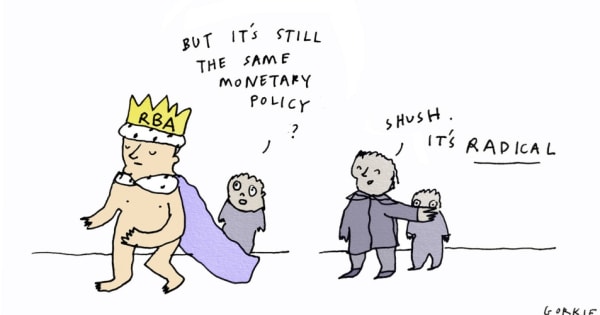
Abbott and Hockey were determined to be seen as committed to a draconian austerity budget because that was what Australia needed. Abbott, hilariously, compared himself to the “fiscal fire brigade” whose mere appearance on the scene made everyone feel better. The waste of the Labor years was over, the adults were back in charge and the “age of entitlement”, as Hockey put it, was done.
Except the 2014 budget wasn’t any sort of austerity budget — it was a big-spending budget. And that was what Australia needed.
The economy was slowing significantly in 2013 and 2014 after the mining investment boom that had sent the Aussie dollar to over parity with the US dollar and pushed unemployment down to 5%. It caused then treasurer Wayne Swan to make the humiliating but correct decision to stop constantly cutting spending in search of the surplus he and Julia Gillard had promised over and over again. In the end, Swan would only get the budget deficit down to $18 billion for 2012-13, and forecast a similar deficit for 2013-14 in his final budget before he and Gillard were removed by Rudd in 2013.
Once the Coalition was elected, they engaged in the traditional trick of loading as much spending as possible into 2013-14 and blaming it on Labor (to be fair, Swan had got the 2012-13 deficit so low by pushing some spending into subsequent years). The Coalition blew the deficit out to $50 billion in the 2013 MYEFO and said a “line in the sand” had been drawn on revenue writedowns (spoiler alert: it hadn’t).
To that point, they got away with it politically. But the 2014 budget, despite its draconian reputation, didn’t alter the fiscal settings much: it bumped up receipts a tad (they would, yes, come in below forecast) and increased spending, though not by very much, over the 2013-14 “look at the mess Swanny left us” MYEFO settings. In particular, this allegedly horrific austerity budget forecast a $30 billion deficit, way above the deficit level Labor had achieved in 2012-13.
That is, the fiscal fire brigade arrived, said it was appalled to learn things were even worse than they’d heard, and… lit some more fires. The deficit would actually end up hitting $38 billion — $20 billion more than Labor.
Nor did a budget notorious for its fiscal rigour actually change much in the forward estimates. The 2014 budget projections for subsequent years for both revenue and spending looked an awful lot like the ones left behind by Labor.
The thing was, however, pumping extra money into the economy, much more than Labor had been, was exactly what we needed. Unemployment was already on the rise when Labor lost in 2013. By June 2014 it had topped 6%, and it would stay there for another year. Without Hockey pumping extra tens of billions of dollars of deficit stimulus into the economy at the end of 2013 and in 2014, unemployment would have been significantly worse. And if the Abbott government had been foolish enough to actually implement its “fiscal fire brigade” silliness, it would have led to much worse joblessness from 2014-16.
Problem is, that wasn’t the narrative Abbott and Hockey wanted. They wanted to be the fiscal he-men, the leaders capable of making the tough decisions, and repeat the success of the Howard government in both establishing their reputation for fiscal rigour and Labor’s for indiscipline. But in reality, they were ensuring employment didn’t fall into a hole by the old-fashioned method of spending like drunken sailors. They didn’t keep their jobs, but a lot of Australians did as a result.
Was the 2014 budget better than we remember it? Let us know your thoughts by writing to letters@crikey.com.au. Please include your full name to be considered for publication. We reserve the right to edit for length and clarity.

Interesting analysis. But as far as I remember, most of the headlines around the 2014 centred on what looked like the ideologically motivated hit-list (ABC, SBS, universities, etc.) rather than the macro-economic merits. I wonder how much thought Abbott gave to the macro-economic dimension as opposed to trying to punch the lights out of people he didn’t like. And on that occasion, the broken promises were pretty egregious, as well.
That and the infamous GP copay that very quickly could be called a tax … pretty sure no one thought “no cuts to Medicare” meant a GP tax.
Let’s not forget also that Joe Hockey is the treasurer who single-handedly rid Australia of its car manufacturing industry (this wasn’t part of the 2014 budget, but rather a feat which Joe managed to achieve just a month or so into the Abbott govt, via a few choice hairy-chested words in parliament about no more corporate welfare from this govt…). If I recall, when Turnbull got in, the Adelaide manufacturing component of the French submarine deal he negotiated was to assuage the electoral problems the Coalition was facing in SA, on account of the hordes of unemployed SA voters who previously worked at Holden or one of the many smaller parts manufacturing companies. But then a bit later Scummo came along with the AUKUS deal, ditched the French subs and, well, the rest is history.
I’ll never forgive Hockey for killing the local car industry. I will never get to buy a new Falcon ute – ever again. A unique vehicle format, totally suited to ‘Australian driving conditions’.
Next time you’re on the freeway with one of those god-awful pick-ups (Hilux, Ranger, Isuzu….or even worse, a Ram) filling your rear-view mirror, thank Joe and his pissant world view.
The Hilux is an outback institution much like the Land Cruiser. Ford ute, not so much. Anyway, yes, we could have looked forward and got Ford to start the transition to hydrogen but visionary leadership, or lack of… Seriously I’ve turned off from Aussie politics. If the CWA and Blacktown high student council were political parties, I’d vote.
Australia gave US companies 100s of millions of dollars so Australia could manufacture cars even we didn’t want to buy….and they left anyway .. I am glad Hockey ended this particular graft.
This is a very simplistic view of the situation at the time. Most countries, if not all of them with an indigenous automotive manufacturing industry accept taxpayer funding to keep developing and building cars locally. Australia’s financial support was on the low side, globally. Why not ask instead why we subsidise the mining industry as we do?
At the end of 2013, Ford had built 29,000 examples of Falcon and Territory. GM-Holden had built nearly 40,000 units of Ute, Commodore and Caprice, plus another 29,000 units of the Cruze small car. And Toyota had built 36,000 Camrys and Aurions, which didn’t include the tens of thousands of cars exported from Altona to the Middle East. Toyota is not an American company, by the way. To say that Australians didn’t buy locally built cars – in a very diverse and open market – is much like saying no one votes for the Greens.
Privileged Starvation, what Ken Grattan points out (below) is correct. Perhaps more people should have considered buying a locally-made car for the good of the country, but right to the end sales of locally made cars was solid. We were buying them. The problem is that the diversification of the market (where once there was just a sedan or station wagon, now there is the choice of sedans, a bewildering array of SUVs and even dual-cab light trucks), and a huge influx of additional brands in the last 10-20 years has diluted the market – none of them sells a huge amount of cars these days. We had a great export industry going (Commodores were being exported to the US to be sold as Chevrolets), and the whole thing (taking into account the myriad of supply industries) was a huge employer. Yes it was subsidised but that’s pretty much par for the course globally. In the end, stuff has to be made somewhere. Why not here? Just think, without smoking Joe’s intervention, today we could have been manufacturing EV in the Holden plants in Adelaide and Melbourne, at Toyota in Melbourne and Ford in Geelong.
Hey, Bernard, what’s this about “the disasters of the Rudd-Gillard years” and “the waste of the Labor years”? Huh?
160 independent economists have praised the Rudd-Gillard administration as the world’s best at economic management – by a street.
You are one of them. In fact, you are in the top five.
See here: https://www.friendlyjordies.com/post/australia-gfc
Jordan Shanks is an open Labor stooge; you might as well link to Labor’s own website – hardly a source for unbiased truth.
I recall the outcry about that Budget was mostly concerning “fairness”. It seemed to target the vulnerable re savings disproportionately to those better off. Details are sketchy, admittedly, in my memory but that was definitely the “ vibe” at the time. Voters were outraged at the hubris of it all, exemplified perfectly by Cormann and Hockey congratulating themselves sucking on their cigars, grinning maniacally.
It was about ‘lifters and leaners’ remember. Filter that through the Liberal world view and it was all pretty clear. Warmed over Thatcherism delivered with even less charisma (yes, that’s possible!)
The size of the deficit in those days was a drop in the ocean compared with the eye-watering half a billion and growing they left a couple of years ago .
Half a trillion, would be closer
ah Yes. sorry