

“The price of food is through the roof.” This is a widely held belief, but is it true?
In the week the prime minister admitted he doesn’t know how much a litre of milk or a loaf of bread costs, we dive into the supermarket aisles to find the truth about the price of groceries, and how they have changed.
In the past two years, food and non-alcoholic beverages cost 5% more. That’s the overarching category — you can see it about a quarter of the way down the following graph. As usual, there are products that have risen in price by less than the category overall, and products that have risen by more.
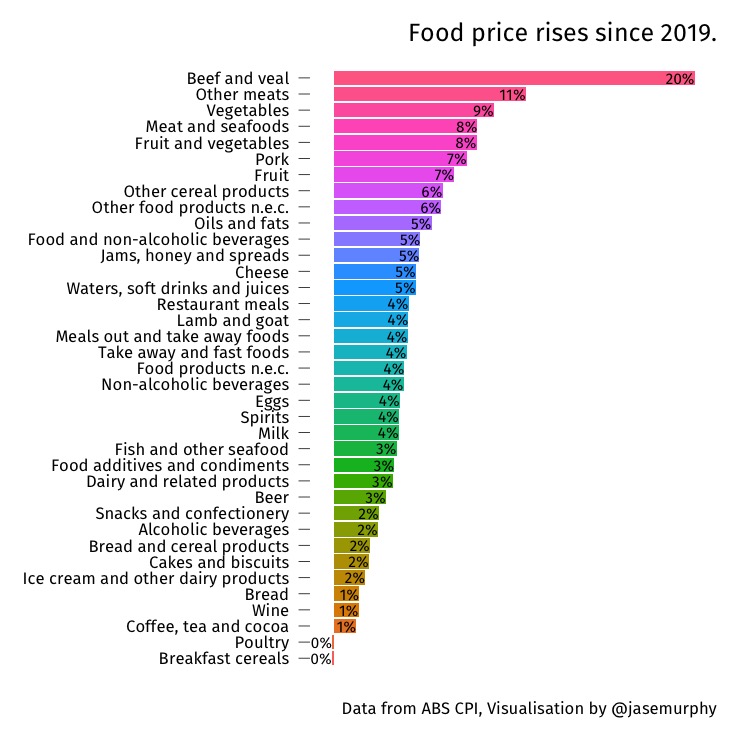
Your choice of meat makes a big difference. Like a bolognaise sauce? You probably reckon food inflation is high. Prefer penne al pollo? You reckon inflation is low. The reason beef prices have shot up so much is the recent rains. The number of cattle sent to slaughter has fallen from 200,000 every three months to 150,000 as farmers try to let their herds live long and multiply. They call this “restocking”.
Eventually the paddocks of Australia will be full and the number of head of cattle processed will return to normal. That should cause some normalisation in beef prices. Then, of course, in the next El Niño, every cow and her calf will be sent off to the abattoir and steak prices should plummet.
Fruit and vegies have also risen in price heavily, while bread, wine, coffee and tea are more stable, rising by less than inflation. Breakfast cereals have also stayed cheap — it’s a great time to have Weet-Bix for a snack!
In summary, a few notable items have shot up in the past two years but the great bulk of your shopping list is pretty stable. Don’t believe people who say their grocery bill has suddenly doubled. But to be fair, inflation in food items is higher than inflation overall, and certainly higher than wages growth in the past two years.
What about the long run?
I remember when meat pies cost less than $1. Now they’re more like $5. What’s happened to food prices over a longer period?
As this next chart shows, the highest price rises have been in lamb and goat meat (mostly lamb; Aussies eat hardly any goat). They have risen more than threefold since 1990. Beer is also up a lot, although that mostly has to do with taxes. Vegetables are up a lot too. I wonder how much of that has to do with changed expectations about the quality of what we get — capsicums were not so big and bright red in my youth.
Also up at the top end are restaurant meals and takeaway foods, whose prices have been driven up by rising wages over the past three decades.
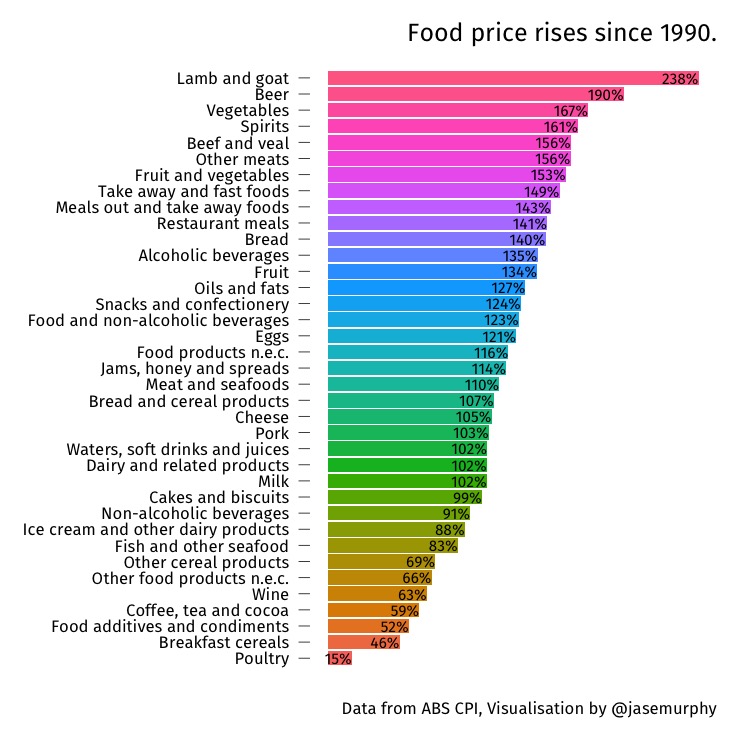
“Food and non-alcoholic beverages” — the overarching category — has risen 123% in 31 years, slightly more than doubling. CPI inflation in the same period has been 108%, so food has risen in price slightly faster than the overall basket of goods.
Over this multi-decade period chicken is down the bottom of the ranks of price-risers. Seafood price inflation is also surprisingly low, speaking to the incredible cost-efficiency of industrialised food production. Farmed fish is now nearly half of the seafood we eat. Also chicken and seafood production need very little land, and we know what has happened to the price of land.
Feeding your family has certainly become more expensive over the years, but not so expensive as to make it the number one issue at election time.
In my view, progressive people should mostly shut up about the cost of living, because when the cost of living dominates political discourse it becomes impossible to make structural changes that could make the world a better place. Action on, say, climate change and action on the price of petrol/beef/bread are basically mutually exclusive.
What government will introduce a policy that could have some adjustment costs when people are ultra-sensitive to costs? Prime ministers might not know the price of bread, but they know people will blame them if it goes up.
Are you feeling slugged at the supermarket? Let us know your thoughts by writing to letters@crikey.com.au. Please include your full name if you would like to be considered for publication in Crikey’s Your Say column. We reserve the right to edit for length and clarity.



WOW! BARNABY BEETROOTER RIGHT ABOUT SOMETHING, the $100 roast beef or lamb is here!
secondly, no surprise here, but economist unable to distinguish between elbow and arse.
A quick trip to the supermarket by me yesterday shows up a vast difference between the ABS figures and the shelf prices.
I suppose that’s where the saying about “Damned lies and statistics” arose.
Actually the ABS Statistical Bureaucracy (you know, one of those “well run Public Institutions” that I keep hearing about) came up with the formulae that have been in use for decades. They are used for multiple purposes commercially and usually won’t change very often (current CPI was introduced in 1960 and amended in 1998)
The CPI measures the changes in price of a fixed basket of goods and services based on average household expenditure by capital city households across Australia, not of any specific family or individual. For example, it includes both rental and owner–occupier house purchase costs in the basket, which is unlikely for a single household. It is unlikely that any individual experience will correspond precisely with either the national index or the indexes for specific capital cities.
In other words, don’t try and apply it to the prices that you personally experience.
I don’t hear people complaining about the price of food being through the roof. I hear people complaining about the cost of living, particularly people paying rent. Not sure they are “progressive”, just people struggling.
So many people would be glad of an affordable roof that they’d probably cut down on the food, if only to save on retiling.
I remember when we lived in hole in ground and had to mine ton of coal before I walked 10 mile to school….
Those were the days.
Did the person asking the question have any idea of what they were asking. Was that person some miserable repetitive purchaser and eater of the same product.
Yes I buy the bread but I ask which bread? The standard loaf sliced or the larger square restaurant one which I prefer. Generally at the local bread shop but occasionally at Woolies. That’s four different prices so far.
Then on occasions I may purchase bread at a different shop, not to mention an occasional treat of a different style of bread such as sour dough. Then on Sundays I purchase a large fruit loaf but if I am late only the smaller ones are left.
And that’s only Bread. Don’t start me on milk.
Thank you for the comparison charts as in my opinion it was a stupid question that most people could not answer.
Why give the compulsive liar an easy way out with such a ridiculous question?
example today: Woolworths, packet of seeded prunes I regularly today up from $3.50 to $5.
What is really infuriating on the duopoly shelves is to see foreign food always cheaper than domestic – a kilo of Turkish sultanas is $4, Australian Homebrand $5, Sunbeam $6-7 – if available, often only seasonal.
The same with any other basic food lines, tinned veg or nuts – Thai corn, Philipines pineapple, French peas etc etc.
About the only edible product of this country would be fresh vegetables – even ‘fresh’ fruit is often imported, Californian lemons $1 each, Chinese garlic $2 a kilo, Spanish $25 & Australian $30.
On & on it goes and we wonder why.
Foreign food will largely always be cheaper than domestic. The significant difference in Labour costs aside, the US and many other countries subsidize their farmers. Makes me laugh when the US complains about “State-Owned” companies in other countries.